
Ecklonia stolonifera extract,
does it really help with Liver health and liver-enzyme improvement?
research showsIn a 12-week RCT that randomized 65 people with mild or moderate liver-function abnormalities, Ecklonia stolonifera extract at 420 mg/day lowered AST, ALT, and GGT relative to placebo. However, only 55 participants completed the trial, and the published human evidence is concentrated in one blood-surrogate study involving several authors employed by the ingredient supplier; the rating is C.
ads claimProducts use broad language such as 'liver health,' 'liver protection,' and 'improved liver function.' The direct result shown by the public human trial is change in AST, ALT, and GGT over 12 weeks, not treatment of liver disease or prevention of clinical events.
Useful facts when choosing a product
- The human-trial dose was 420 mg/day of Ecklonia stolonifera extract for 12 weeks.
- The primary outcomes were AST, ALT, and GGT; lipid markers did not differ from placebo.
- The result cannot be directly applied to products with different extraction methods or standardization from the tested extract.
- A liver-injury case involved a combination product containing catechin, Phellinus linteus, and Ecklonia stolonifera, so the contribution of Ecklonia alone could not be isolated.
What the research actually shows
Kim et al. 2022 randomized 65 people with mild or moderate liver-function abnormalities to Ecklonia stolonifera extract at 420 mg/day or placebo, and 55 completed the study. After 12 weeks, AST and ALT were lower than placebo with p<0.001 and GGT with p=0.016, while lipid markers did not differ between groups. Liver protection has also been reported in rat models of alcoholic fatty liver and carbon-tetrachloride injury, but the public search identified no independent repeat human trial of the same extract.
Why this is classified as C (50)
Regulatory recognition itself is not grading evidence. All three liver enzymes improved in a completed double-blind RCT, but this was one manufacturer-specific Ecklonia extract product trial. Surrogate rather than clinical outcomes, a small single-center sample, ten non-completers, ingredient-supplier authorship, and no independent replication support C with 50 points.
Counterpoint. A liver-enzyme signal exists for the same standardized extract at 420 mg/day. The result does not extend to ordinary Ecklonia foods or outcomes in advanced liver disease.
Rejudgment record. Reassessment (cross-check reflected) — Regulatory recognition is not grading evidence; one manufacturer-specific Ecklonia extract product RCT was positive for AST, ALT, and GGT, but it was small, single-center, limited to surrogate endpoints, and lacks independent replication
Cross-check — Codex and Claude
Evidence Table
| Study | Design | Sample | Funding | Endpoint | Result | Weight |
|---|---|---|---|---|---|---|
| Kim J et al. 2022 | Single-center randomized double-blind placebo-controlled parallel trial | 55 | Several authors were affiliated with ingredient supplier Naturalway; external funding unknown | Primary AST, ALT, and GGT; secondary TC, TG, HDL-C, and LDL-C | After 420 mg/day for 12 weeks, AST, ALT, and GGT decreased significantly relative to placebo, while lipids did not differ between groups. | Key, manufacturer-linked |
| Lee MS et al. 2016 | Rat study of ethanol-induced fatty liver | Korean government research support | Hepatic fat, histology, AST, ALT, and lipid-metabolism proteins | Ecklonia stolonifera ethanol extract reduced ethanol-induced fatty liver and liver enzymes, but this was not a human result. | Preclinical support |
Receipt — 2 References
All 2 cited sources were verified for existence at the original page (as of 2026-07-11).
Reviewed and approved: Chamgap Editorial Team · Approval date: 2026-07-11 · Corrections: none
Cite this verdict
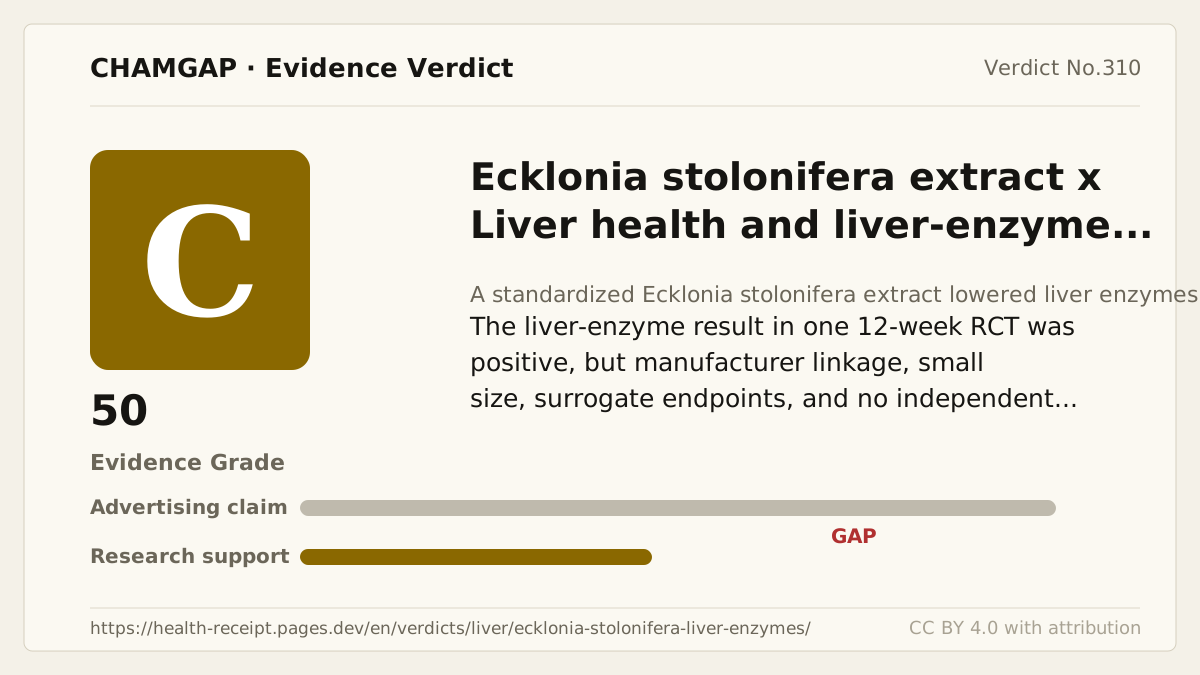
[Chamgap] Ecklonia stolonifera extract × liver health and liver-enzyme improvement — Evidence Grade C·50. 2 cited sources checked. Source: https://chamgap.com/en/verdicts/liver/ecklonia-stolonifera-liver-enzymes/ · CC BY 4.0CC BY 4.0 — free to use with attribution; do not distort grades, numbers, or verdict meaning.
What this document does and does not do
Chamgap is an information source. It reports what research has and has not confirmed; it does not tell readers what to take or buy. That decision belongs to readers and, when needed, medical or legal professionals. This verdict reflects literature available up to the search date and may change as new research appears. Nothing here is medical advice.