
Hawthorn leaf and flower extract,
does it really help with Improvement in chronic-heart-failure symptoms, exercise capacity, and blood pressure?
research showsThe central claim for hawthorn leaf and flower extract—heart-failure symptoms and exercise capacity—is D. In the independent 120-participant HERB RCT added to modern standard therapy, six-minute walk distance (P=0.61), symptoms, and function were negative, and the 2,681-participant SPICE trial also found no difference in the first cardiac event at HR 0.95. Blood pressure is at the lower end of C based on small-trial signals, but the 2025 meta-analysis abstract called systolic pressure significant while reporting a 95% CI of -11.72 to +1.59, an internal contradiction. Direct failure of the central clinical claim results in an overall D.
ads claimAdvertising may combine heart strengthening, blood flow and circulation, exercise capacity, and blood-pressure balance as one product effect. Research is concentrated on specific standardized leaf-and-flower extracts, and substitution for modern heart-failure therapy or reduction of cardiac events has not been confirmed.
Useful facts when choosing a product
- The representative heart-failure ingredient is WS 1442, a leaf-and-flower extract standardized to 17.3-20.1% oligomeric procyanidins, commonly at 900 mg/day.
- Evidence on hawthorn berry extracts, teas, and camphor combinations cannot be directly combined with evidence on a single leaf-and-flower extract.
- The large heart-failure trial tested addition to standard therapy and did not confirm a reduction in first cardiac events.
- Long-term interaction data in people with cardiovascular disease and polypharmacy are limited, and more adverse events were reported in the HERB trial.
What the research actually shows
The Pittler 2008 Cochrane review reported improvements in exercise workload, dyspnea, and fatigue across 14 double-blind placebo-controlled trials, but actual sample sizes in several analyses were only 98-239 participants. The Holubarsch 2008 SPICE RCT added WS 1442 900 mg/day for 24 months to standard therapy in 2,681 patients with heart failure, but the first cardiac event was negative at HR 0.95 (95% CI 0.82-1.10, P=0.476). The Zick 2009 HERB RCT found no benefit in six-minute walk distance (P=0.61), quality of life, or functional capacity after six months in 120 participants. The Walker 2006 RCT found that 1,200 mg/day lowered diastolic pressure more in 79 patients with type 2 diabetes, but systolic pressure did not differ. The Szikora 2025 meta-analysis abstract covering six placebo-controlled trials and 428 participants described systolic pressure as significant while reporting a 95% CI of -11.72 to +1.59; because these statements conflict, the estimate was not treated as confirmed positive evidence.
Why this is classified as D (29)
The central clinical claim of heart-failure symptoms and exercise capacity is D because the 120-participant HERB trial on modern standard therapy was negative for six-minute walk distance at P=0.61, symptoms, and function, and the 2,681-participant SPICE trial was also negative for the first cardiac event at HR 0.95. Blood pressure is lower-C, and the systolic-pressure 95% CI of -11.72 to +1.59 in the 2025 meta-analysis abstract contradicts its significance wording, so it was not treated as confirmed positive. The central D claim determines the overall score of 29.
Counterpoint. Past symptom signals for standardized WS 1442 and possible blood-pressure changes with some hawthorn extracts remain. The overall D reflects direct failure of the central heart-failure clinical claim on modern standard therapy, while blood pressure is separately labeled C.
Rejudgment record. Reassessment (cross-validation incorporated) — The central heart-failure symptom and exercise-capacity claim was negative in 120 HERB participants for six-minute walk at P=0.61, symptoms, and function on modern standard therapy, and the first cardiac event in 2,681 SPICE participants was also negative at HR 0.95; blood pressure is separated as lower-C
Sub-claim grades by effect
This ingredient is marketed for several effects. A single overall grade blends strong and weak claims together, so each effect is graded separately here. The overall grade reflects the strongest disconfirming or core claim.
| Effect (sub-claim) | Grade | Basis |
|---|---|---|
| Heart-failure symptoms and exercise capacity | D | In 120 HERB participants on modern standard therapy, six-minute walk at P=0.61, symptoms, and function were negative; the first cardiac event in 2,681 SPICE participants was also negative at HR 0.95 |
| Blood pressure | C | Small RCT signals exist, but results and preparations are heterogeneous, and the systolic-pressure 95% CI of -11.72 to +1.59 in the 2025 meta-analysis abstract contradicts its significance wording |
Cross-check — Codex and Claude
Evidence Table
| Study | Design | Sample | Funding | Endpoint | Result | Weight |
|---|---|---|---|---|---|---|
| Pittler MH et al. 2008 | Cochrane systematic review and meta-analysis | 1,110 | Independent academic review; included trials had mixed links and manufacturer contact | Exercise workload, oxygen consumption, dyspnea, fatigue, and adverse events | Reported improved exercise workload and symptoms, but actual samples in several pooled analyses were only 98-239 participants. | Key |
| Holubarsch CJF et al. 2008 (SPICE) | Multicenter randomized double-blind placebo-controlled event trial | 2,681 | Supported by the manufacturer of WS 1442 | First cardiac event, cardiac death, and heart-failure hospitalization | The 24-month first cardiac event was negative at HR 0.95, 95% CI 0.82-1.10, P=0.476; only an exploratory subgroup was positive. | Key |
| Zick SM et al. 2009 (HERB CHF) | Randomized double-blind placebo-controlled trial | 120 | Funded by the U.S. NIH/NCCAM | Six-minute walk, quality of life, functional capacity, and LVEF | No benefit in six-minute walk distance (P=0.61), quality of life, or functional capacity; more adverse events were reported in the hawthorn group. | Key |
| Walker AF et al. 2006 | Randomized placebo-controlled trial | 79 | Unknown | Systolic and diastolic blood pressure and interactions | After 1,200 mg/day for 16 weeks, the between-group difference in diastolic pressure was P=0.035; systolic pressure was negative at P=0.329. | Supportive |
| Szikora Z et al. 2025 | Meta-analysis of randomized placebo-controlled trials | 428 | Academic institutions | Systolic and diastolic blood pressure | The abstract describes systolic pressure as significant, but its 95% CI of -11.72 to +1.59 includes zero and is internally contradictory; diastolic pressure was not significant, and dose and design heterogeneity were substantial. | Supportive |
Receipt — 5 References
All 5 cited sources were verified for existence at the original page (as of 2026-07-11).
Reviewed and approved: Chamgap Editorial Team · Approval date: 2026-07-11 · Corrections: none
Cite this verdict
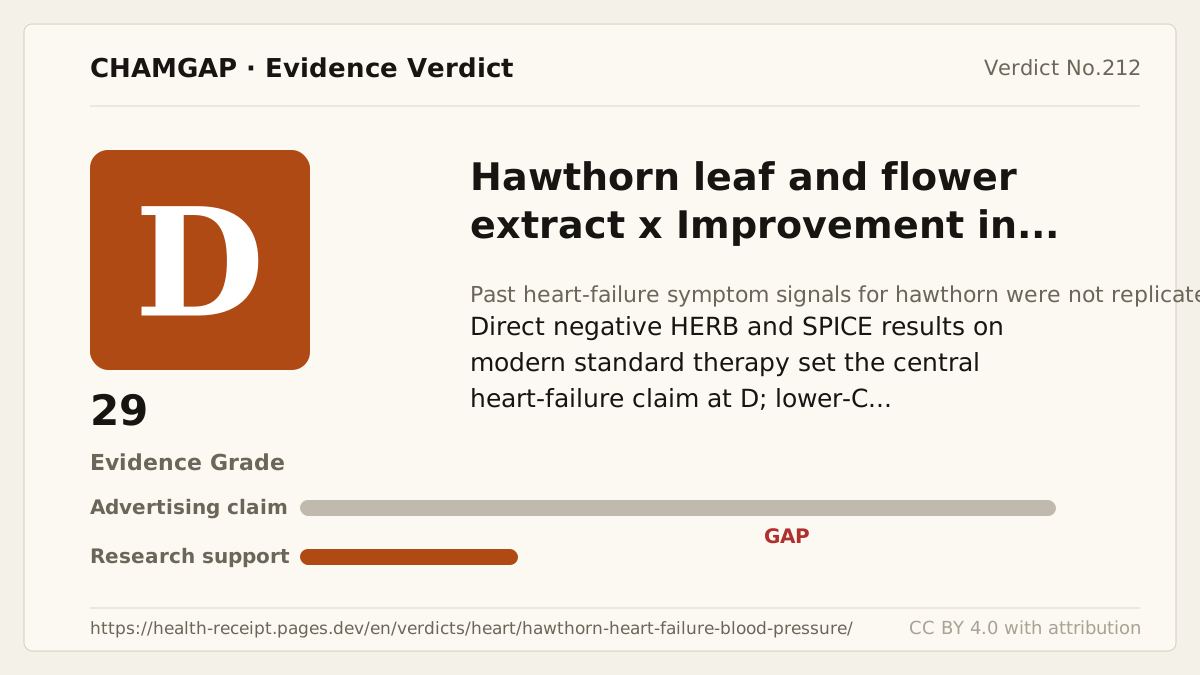
[Chamgap] Hawthorn leaf and flower extract x improvement in chronic-heart-failure symptoms, exercise capacity, and blood pressure — Evidence Grade D·29. 5 cited sources checked. Source: https://chamgap.com/en/verdicts/heart/hawthorn-heart-failure-blood-pressure/ · CC BY 4.0CC BY 4.0 — free to use with attribution; do not distort grades, numbers, or verdict meaning.
What this document does and does not do
Chamgap is an information source. It reports what research has and has not confirmed; it does not tell readers what to take or buy. That decision belongs to readers and, when needed, medical or legal professionals. This verdict reflects literature available up to the search date and may change as new research appears. Nothing here is medical advice.