
Plant sterols and stanols,
does it really help with Reduction in LDL cholesterol?
research showsPlant sterols and stanols lower LDL cholesterol in a dose-dependent manner across many RCTs and meta-analyses. LDL fell by -0.31 mmol/L across 59 RCTs, 124 studies showed a 6-12% dose-response across 0.6-3.3 g/day, and a 2026 umbrella review reported LDL reductions of -0.26 to -0.36 mmol/L with high certainty of evidence. The grade for the explicit LDL-lowering claim is A. This is limited to lowering the surrogate marker LDL and does not directly establish prevention of myocardial infarction or death.
ads claimFortified foods and supplements may display cholesterol management, inhibition of cholesterol absorption, and heart health together. The confirmed human effect is mainly the LDL laboratory value, not direct proof of preventing myocardial infarction or stroke.
Useful facts when choosing a product
- A common effective intake in studies and fortified foods is a total of about 1.5-3 g/day with meals.
- Both sterols and stanols reduce intestinal cholesterol absorption, with average LDL reductions of roughly 6-12%.
- Efficacy can vary by food carrier and timing, including fat spreads, dairy foods, beverages, and capsules.
- Accumulation of plant sterols is a concern in the rare genetic disorder sitosterolemia, and concentrations of some fat-soluble carotenoids may decrease.
What the research actually shows
The AbuMweis 2008 meta-analysis found that in 59 RCTs, LDL was 0.31 mmol/L lower than placebo and that efficacy varied with food carrier and timing of intake. The Demonty 2009 meta-analysis of 84 trials and 141 trial arms found that a mean 2.15 g/day lowered LDL by 0.34 mmol/L or 8.8%. The Ras 2014 meta-analysis pooled 124 studies and 201 strata and reported a gradual mean LDL reduction of 6-12% across 0.6-3.3 g/day, with similar dose-response patterns for sterols and stanols. The Zurbau 2026 umbrella review pooled RCT meta-analyses and reported LDL reductions of -0.26 to -0.36 mmol/L with generally high certainty of evidence. The Scholle 2009 meta-analysis of eight RCTs and 306 participants receiving statins found an additional LDL reduction of 13.26 mg/dL but concluded that morbidity and mortality trials were needed.
Why this is classified as A (90)
For the explicit LDL-lowering claim, consistent reductions across 59-124 RCTs, a 6-12% dose-response across 0.6-3.3 g/day, and LDL reductions of -0.26 to -0.36 mmol/L with high certainty in the 2026 umbrella review support A with 90 points. The directness is at least comparable to oat beta-glucan at A88 and psyllium at A84. LDL is a surrogate marker, so cardiovascular-event prevention remains a separate claim, and regulatory health claims were not used in grading.
Counterpoint. LDL reduction around an average intake of 2 g/day has been repeated across formulations and populations. The A grade is limited to this biochemical effect and does not apply to claims of preventing myocardial infarction or death.
Rejudgment record. Reassessment (cross-validation incorporated) — For the explicit LDL claim, 59-124 RCTs show consistent reductions, 0.6-3.3 g/day shows a 6-12% dose-response, and the 2026 umbrella review reports LDL reductions of -0.26 to -0.36 mmol/L with high certainty; cardiovascular-event prevention remains separate and regulatory claims are neutral
Sub-claim grades by effect
This ingredient is marketed for several effects. A single overall grade blends strong and weak claims together, so each effect is graded separately here. The overall grade reflects the strongest disconfirming or core claim.
| Effect (sub-claim) | Grade | Basis |
|---|---|---|
| Lowering LDL cholesterol | A | A 6-12% dose-response across 59-124 RCTs and high certainty in the umbrella review |
| Prevention of cardiovascular events | ? | LDL is a surrogate marker; direct evidence for preventing hard endpoints such as myocardial infarction and death is separate and insufficient |
Cross-check — Codex and Claude
Evidence Table
| Study | Design | Sample | Funding | Endpoint | Result | Weight |
|---|---|---|---|---|---|---|
| AbuMweis SS et al. 2008 | Meta-analysis of randomized controlled trials | 59 | Academic research team with mixed conflicts | LDL cholesterol | LDL decreased by 0.31 mmol/L versus placebo; efficacy varied by food carrier and timing of intake. | Key |
| Demonty I et al. 2009 | Dose-response meta-analysis of randomized controlled trials | 141 | Author group centered on Unilever R&D | LDL cholesterol | At a mean 2.15 g/day, LDL decreased by 0.34 mmol/L or 8.8%, with a nonlinear dose-response relationship. | Key |
| Ras RT et al. 2014 | Meta-analysis of randomized controlled trials | 201 | Included authors from Unilever R&D | LDL cholesterol by dose | Average LDL decreased by 6-12% across 0.6-3.3 g/day; dose-response was similar for sterols and stanols. | Key |
| Scholle JM et al. 2009 | Systematic review and meta-analysis of RCTs added to statins | 306 | Academic institutions | Total cholesterol, LDL, HDL, and triglycerides | Adding sterols or stanols to statins reduced LDL by an additional 13.26 mg/dL; no morbidity or mortality RCTs were available. | Supportive |
| Zurbau A et al. 2026 | Umbrella review of systematic reviews and meta-analyses with updated dose-response meta-analyses | 14 | Academic research team; author conflicts reported | LDL cholesterol and other cardiometabolic risk markers | LDL decreased by -0.26 to -0.36 mmol/L; certainty of evidence for LDL was generally high; an inverse linear dose-response was identified. | Key |
Receipt — 5 References
All 5 cited sources were verified for existence at the original page (as of 2026-07-11).
Reviewed and approved: Chamgap Editorial Team · Approval date: 2026-07-11 · Corrections: none
Cite this verdict
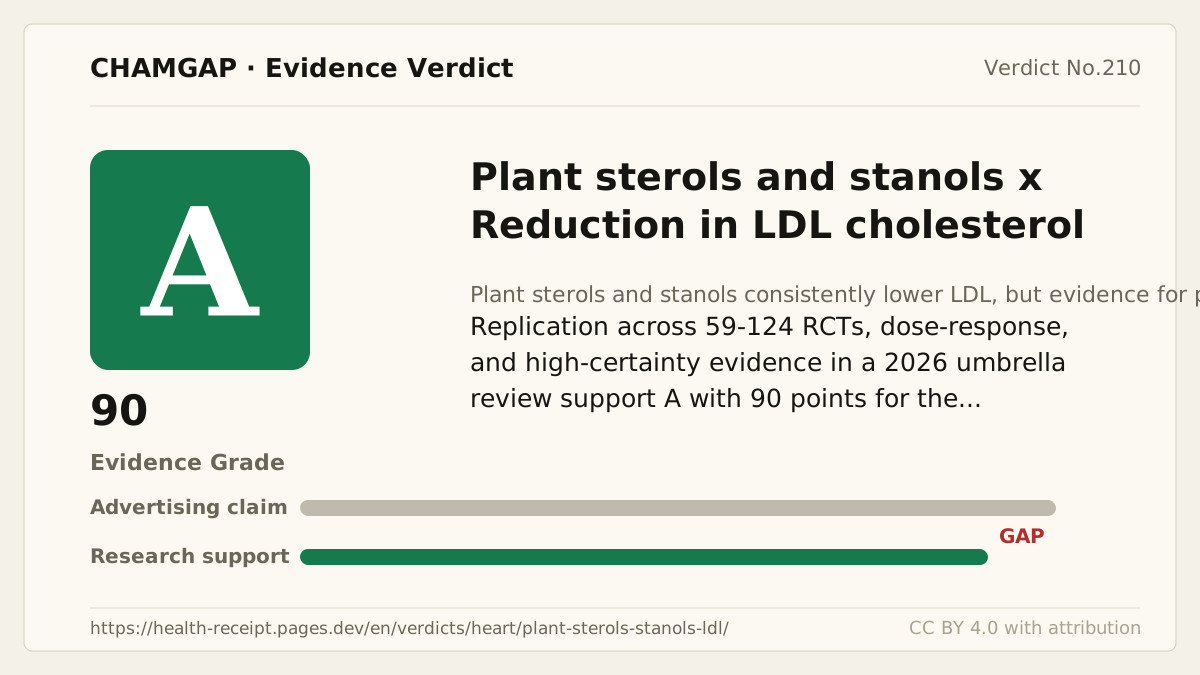
[Chamgap] Plant sterols and stanols x reduction in LDL cholesterol — Evidence Grade A·90. 5 cited sources checked. Source: https://chamgap.com/en/verdicts/heart/plant-sterols-stanols-ldl/ · CC BY 4.0CC BY 4.0 — free to use with attribution; do not distort grades, numbers, or verdict meaning.
What this document does and does not do
Chamgap is an information source. It reports what research has and has not confirmed; it does not tell readers what to take or buy. That decision belongs to readers and, when needed, medical or legal professionals. This verdict reflects literature available up to the search date and may change as new research appears. Nothing here is medical advice.