
Psyllium husk,
does it really help with Smooth bowel movements and improvement of blood cholesterol?
research showsPsyllium husk has human RCT and meta-analysis evidence for both bowel-movement and blood LDL/total cholesterol improvement claims. For bowel movements, adults with constipation show improved bowel movement frequency and stool condition, and for cholesterol the average LDL reduction is about 0.28-0.33 mmol/L (roughly 11-13 mg/dL). However, this is not a large long-term RCT directly proving reduction in cardiovascular events, so it should be read as evidence at the level of “cholesterol improvement” as used in advertising.
ads claimKorean market advertisements and informational posts repeatedly use expressions such as “easy bowel movement,” “smooth bowel activity,” “blood cholesterol improvement,” “expands 40-fold when it meets water,” “promotes intestinal movement,” “goodbye constipation,” “helps easy bowel movements from teens to people in their 80s,” and “5.5 g or more per day gives bowel movement plus cholesterol functionality.” Product names and detail pages include powders/pills/capsules that look like psyllium alone, but combination products containing mixed grain powder, rice bran, aloe, probiotics, and others are also advertised.
Useful facts when choosing a product
- Natural Plus/Ilyang Pharm listed “easy bowel movement, smooth bowel activity, cholesterol improvement” in the product name itself and displayed a price of 72,900 won for 5 boxes of 30 sachets.
- A Dong-A Ilbo product article presented MFDS functional recognition, 80% dietary fiber, 40-fold expansion, promotion of intestinal movement, and help for bowel activity and blood cholesterol improvement together.
- FOODOLOGY pharmacist magazine explained that psyllium is involved in cholesterol and constipation through bile acid excretion and water-retention mechanisms, and mentioned that under health functional food standards, at least 5.5 g gives both functionalities and at least 3.9 g gives bowel-movement functionality.
- Ople.com health information described psyllium as a bulk-forming laxative and also advised sufficient water, possible reduced drug absorption, and caution groups such as intestinal obstruction/stricture.
What the research actually shows
Separated by efficacy: bowel movements A-, cholesterol A. For bowel movements, a 2022 AJCN RCT meta-analysis combined 16 RCTs in adults with chronic constipation, n=1251, and in the psyllium subgroup the increase in bowel movement frequency was significant (+3.08 times/week, 95% CI 0.61-5.54). However, heterogeneity was high. For cholesterol, a 2018 AJCN meta-analysis combined 28 RCTs, n=1924, and found that about 10.2 g/day psyllium reduced LDL by -0.33 mmol/L, non-HDL by -0.39 mmol/L, and apoB by -0.05 g/L, and 2009, 2023, and 2025 meta-analyses also repeatedly showed reductions in total cholesterol/LDL. Many studies used psyllium alone, but some psyllium-enriched foods, cereals, product-form studies, and industry-funded studies are mixed in. A large GEM-level clinical-event RCT or psyllium-specific Cochrane review was not identified in the search.
Why this is classified as A (84)
A is assigned. For both subclaims, there are multiple human RCTs, and direction and magnitude are repeated in meta-analyses that include psyllium alone. Bowel movements use direct perceived markers such as bowel movement frequency and stool condition, but heterogeneity is large, so it is the lower end of A. Cholesterol has more RCTs and repeated recent meta-analyses, but it is limited to the directly claimed markers LDL/total cholesterol and is not expanded to prevention of cardiovascular events. Some manufacturer-funded studies are important, but not all positive evidence is manufacturer-funded, so the rule of “lack of independent replication plus all positive evidence manufacturer-funded” does not apply.
Counterpoint. The effect is moderate and depends on dose, duration, fluid intake, and baseline dietary fiber intake. If constipation is due to pelvic-floor dysfunction, medications, intestinal obstruction, or other non-fiber-deficiency causes, response may be limited. Cholesterol studies generally assessed lipid-level markers and did not directly prove reductions in myocardial infarction or death. For capsule/pill products, it must be separately checked whether actual psyllium dietary fiber g/day based on the label reaches clinical-study doses.
Rejudgment record. convergent — Draft = blind A. Consistent RCT meta-analyses for bowel movements (frequency/stool direct markers) and cholesterol lowering. Project’s first A grade.
Cross-check — Codex and Claude
Evidence Table
| Study | Design | Sample | Funding | Endpoint | Result | Weight |
|---|---|---|---|---|---|---|
| van der Schoot A, Drysdale C, Whelan K, Dimidi E 2022 | meta-analysis/RCT | 1251 | not reported | bowel movements | In 16 RCTs of chronic constipation in adults (n=1251), fiber supplementation improved response rate, bowel movement frequency, and stool condition; psyllium subgroup effect was significant but heterogeneity was large. | core |
| Ashraf W, Park F, Lof J, Quigley EMM 1995 | not specified | 22 | not reported | bowel movements | In a 22-person RCT, psyllium 5 g twice daily for 8 weeks improved bowel movement frequency (3.8 vs 2.9/week), stool weight, and stool condition. | core |
| McRorie JW, Daggy BP, Morel JG, Diersing PS, Miner PB, Robinson M 1998 | double-blind | 170 | possible manufacturer/industry involvement | moisture/bowel movements | In a 170-person multicenter double-blind RCT, psyllium 5.1 g twice daily improved week-2 bowel movement frequency and stool-water-related markers more than docusate. | core |
| Jovanovski E, Yashpal S, Komishon A et al. 2018 | meta-analysis/RCT | 1924 | possible manufacturer/industry involvement | LDL | In 28 RCTs (n=1924), median psyllium 10.2 g/day reduced LDL -0.33 mmol/L, non-HDL -0.39 mmol/L, and apoB -0.05 g/L. | core |
| Anderson JW, Davidson MH, Blonde L et al. 2000 | not specified | possible manufacturer/industry involvement | LDL/cholesterol | In adults with hypercholesterolemia after AHA Step I diet, psyllium 5.1 g twice daily for 26 weeks lowered total cholesterol by 4.7% and LDL by 6.7% versus cellulose placebo. | supporting | |
| Wei ZH, Wang H, Chen XY et al. 2009 | meta-analysis | 1717 | not reported | LDL/cholesterol | In 21 trials (n=1717), total cholesterol -0.375 mmol/L and LDL -0.278 mmol/L were reported, but DARE noted absence of study quality assessment and possible small-study bias. | supporting |
| Gholami Z, Paknahad Z 2023 | meta-analysis/RCT | 4100 | not reported | weight/LDL/cholesterol/blood pressure | Pooled 61 RCTs (n=4100) and reported that psyllium significantly lowered LDL-C and total cholesterol. | supporting |
| Gholami Z, Paknahad Z 2025 | meta-analysis/RCT | 2049 | not reported | LDL/cholesterol | In 41 articles (n=2049), LDL-C -8.55 mg/dL and total cholesterol -9.05 mg/dL were reported, but heterogeneity was high. | supporting |
| Health Canada 2011 | not specified | not reported | ALT/cholesterol/NAD | Health Canada reviewed 21 human studies and prior FDA judgments and assessed that they supported the claim linking psyllium fibre with lowered blood cholesterol. | supporting | |
| MedlinePlus 2024 | not specified | not reported | liver/gut | Psyllium is a bulk-forming laxative, and adequate liquid, spacing from medications, and caution for swallowing difficulty, bowel obstruction, and allergy are needed. | supporting | |
| Study 11 | not specified | not reported | cholesterol/bowel movements | Search results/document names confirmed that psyllium dietary fiber is presented as a functional ingredient that may help improve blood cholesterol and smooth bowel activity. | supporting | |
| Study 12 | not specified | not reported | cholesterol/bowel movements/gut | A domestic product detail page listed “easy bowel movement,” “smooth bowel activity,” and “cholesterol improvement” in product name and sales information. | supporting | |
| Study 13 | not specified | not reported | cholesterol/bowel movements/gut | Informational article/product promotion presented 40-fold expansion, promotion of intestinal movement, and help with bowel activity and blood cholesterol improvement together. | supporting | |
| FOODOLOGY | not specified | not reported | cholesterol/absorption | Brand health-information post explained psyllium mechanisms for cholesterol/constipation, at least 500 mL water, possible interference with drug absorption, and recognized functional amounts. | supporting | |
| Study 15 | not specified | not reported | cholesterol/blood sugar/bowel movements/gut | Shopping-mall health information described psyllium as a bulk-forming laxative and presented bowel movement, cholesterol, and blood sugar expressions together with cautions about water, medications, and bowel obstruction. | supporting |
Receipt — 15 References
Of 15 cited sources, 6 had limited original-page access (blocked or summary-only) and were verified via index/summary, marked partial; the rest were verified at the original page. As of 2026-07-07.
Reviewed and approved: Chamgap Editorial Team · Approval date: 2026-07-07 · Corrections: none
Cite this verdict
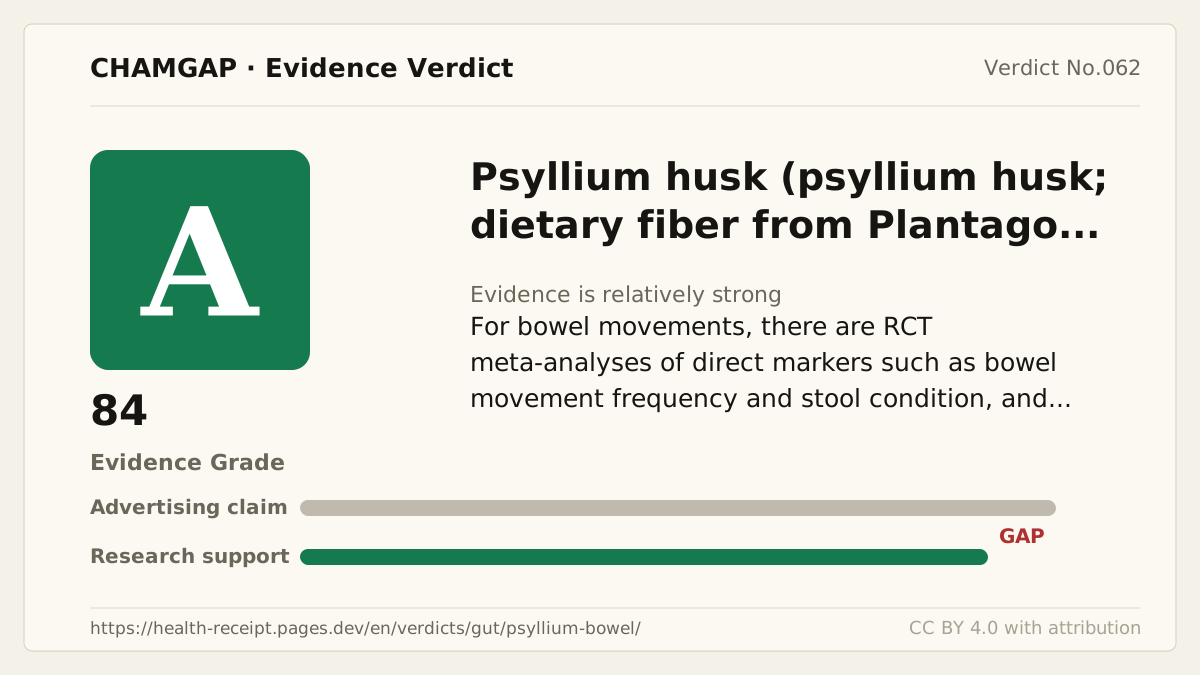
[Chamgap] Psyllium husk x smooth bowel movements and improvement of blood cholesterol — Evidence Grade A·84. 15 cited sources checked. Source: https://chamgap.com/en/verdicts/gut/psyllium-bowel/ · CC BY 4.0CC BY 4.0 — free to use with attribution; do not distort grades, numbers, or verdict meaning.
What this document does and does not do
Chamgap is an information source. It reports what research has and has not confirmed; it does not tell readers what to take or buy. That decision belongs to readers and, when needed, medical or legal professionals. This verdict reflects literature available up to the search date and may change as new research appears. Nothing here is medical advice.