
Kimchi-derived probiotics,
does it really help with gut health?
research showsThere are signals of improved gut symptoms from specific probiotic strains isolated from kimchi or from kimchi intake. However, as market wording suggests, there is insufficient strain- and product-specific evidence to say that 'kimchi-derived probiotics/plant-derived lactic acid bacteria overall' consistently improve gut health. Some surrogate markers such as increased beneficial gut bacteria appear, but clinically meaningful evidence for bowel movements and IBS improvement remains limited to small trials and constrained designs.
ads claimKorean-market advertisements and informational articles bundle kimchi-derived probiotics as 'plant-derived lactic acid bacteria,' 'probiotics suited to Koreans' intestines,' 'strong against gastric acid and bile acid and survive to the intestine,' 'increase beneficial bacteria and suppress harmful bacteria,' 'smooth bowel movements,' 'improve intestinal environment,' and 'relief of gut trouble, constipation, diarrhea, and IBS discomfort.' Some articles and videos also introduce the possibility that kimchi lactic acid bacteria adsorb and excrete microplastics, but this is difficult to view as human RCT evidence supporting current gut-health supplement efficacy. In the health-functional-food area, the standard probiotic wording 'may help increase lactic acid bacteria, suppress harmful bacteria, smooth bowel movements, and support gut health' underlies market wording, but permitted regulatory labeling and the clinical evidence grade of individual kimchi-derived probiotic products are separate.
Useful facts when choosing a product
- Kimchi-derived probiotics are not a single ingredient name but a market phrase grouping several strains isolated from kimchi or involved in kimchi fermentation. Evidence changes when strains such as Lactiplantibacillus plantarum, Leuconostoc, and Weissella differ.
- The phrase plant-derived lactic acid bacteria is closer to a marketing classification referring mainly to source or culture/fermentation background, and it does not automatically guarantee gut-health efficacy in humans.
- Health-functional-food probiotics depend on guaranteed CFU, strain, storage conditions, intake amount, and shelf life for actual exposure. Input CFU and guaranteed CFU may differ.
- Kimchi food trials include fiber, salt, vegetable and seasoning components, fermentation products, live bacteria, or dead cells together, making it difficult to directly convert them into the effect of capsule-type kimchi-derived probiotics.
- In immunocompromised people, severely ill people, people with central venous catheters, or people at high risk of gut-mucosal injury, live probiotics can rarely raise infection risk. In general adults, mild adverse events such as gas, abdominal bloating, and stool changes are mainly reported.
What the research actually shows
The core human evidence has two branches. First, a single-strain RCT of Lactiplantibacillus plantarum CJLP243 randomized 24 people with functional diarrhea and high fecal calprotectin for 2 months, and 22 completed. At 1.0e10 CFU/day, adequate relief based on reduced loose stools was more common, 9/10 vs 5/12, and fecal calprotectin and Leuconostoc increases were reported. However, the sample was very small, the study was supported by CJ CheilJedang, and there is no independent replication. Second, a trial assigning 90 IBS patients to standard kimchi, heat-killed Lactobacillus plantarum nF1-added kimchi, or functional kimchi at 210 g/day for 12 weeks had 87 completers, and all groups showed improved IBS symptoms and stool form. However, because there was no non-kimchi or placebo control group, it is hard to separate natural course, expectation effects, increased fiber, diet changes, and kimchi/strain effects. A 2023 scoping review identified 11 RCTs of kimchi or kimchi-derived probiotics with 638 total registered participants, but most involved metabolic markers, direct gut-health evidence was limited to about 1 IBS study, and the review explicitly noted a lack of adequate trials. General probiotic literature has some signals in gut symptoms, but heterogeneity by strain, dose, and disease is large, making it difficult to generalize under the source category of kimchi-derived probiotics.
Why this is classified as C (52)
Human RCTs exist, so this is not a literature-absence case. However, single-strain RCTs are very small, manufacturer-supported, and not independently replicated, while kimchi-intake RCTs lack non-kimchi placebo controls, making it difficult to separate clinical effects. Many surrogate markers such as gut microbiota changes, fecal calprotectin, and fecal enzymes are mixed in, and evidence is insufficient to generalize to all 'kimchi-derived probiotics/plant-derived lactic acid bacteria.' Applying boundary rules 1 and 2b, the maximum judgment is C.
Counterpoint. The functional diarrhea trial of the specific strain CJLP243 showed a larger response than placebo by clinical symptom criteria, and the kimchi IBS trial also reported improved symptoms and stool form. Therefore this is not an F repeatedly confirming no effect; additional independent RCTs by strain and product could raise the grade to B.
Rejudgment record. Draft and blinded review converged — Gut-health signals are confined to specific strains or small kimchi-food studies, with insufficient independent replication, non-kimchi controls, and strain generalization.
Cross-check — Codex and Claude
Evidence Table
| Study | Design | Sample | Funding | Endpoint | Result | Weight |
|---|---|---|---|---|---|---|
| Jung M, Jung S, Kim N, Ahn H, Yun H, Kim K-N 2022 | double-blind RCT | 24, | not reported | not specified | Small RCT of kimchi-derived CJLP243 1e10 CFU/day for 2 months showed a signal for relief of functional diarrhea, but n=24, CJ support, and no independent replication. | core |
| Kim H-Y, Park E-S, Choi YS, Park SJ, Kim JH, Chang HK, Park K-Y 2022 | double-blind RCT | 90 | not reported | not specified | 90 IBS patients were assigned to three kimchi groups; after 12 weeks, symptoms and stool form improved, but there was no non-kimchi placebo group. | core |
| Song E, Ang L, Lee HW, Kim MS, Kim YJ, Jang D, Lee MS 2023 | meta-analysis of RCTs | 11 | not reported | body weight/gastrointestinal | Review of 11 RCTs of kimchi and kimchi-derived probiotics, 638 registered participants; direct gut-health evidence was limited and the conclusion noted insufficient adequate trials. | core |
Receipt — 3 References
All 3 cited sources were verified for existence at the original page (as of 2026-07-07).
Reviewed and approved: Chamgap Editorial Team · Approval date: 2026-07-07 · Corrections: none
Cite this verdict
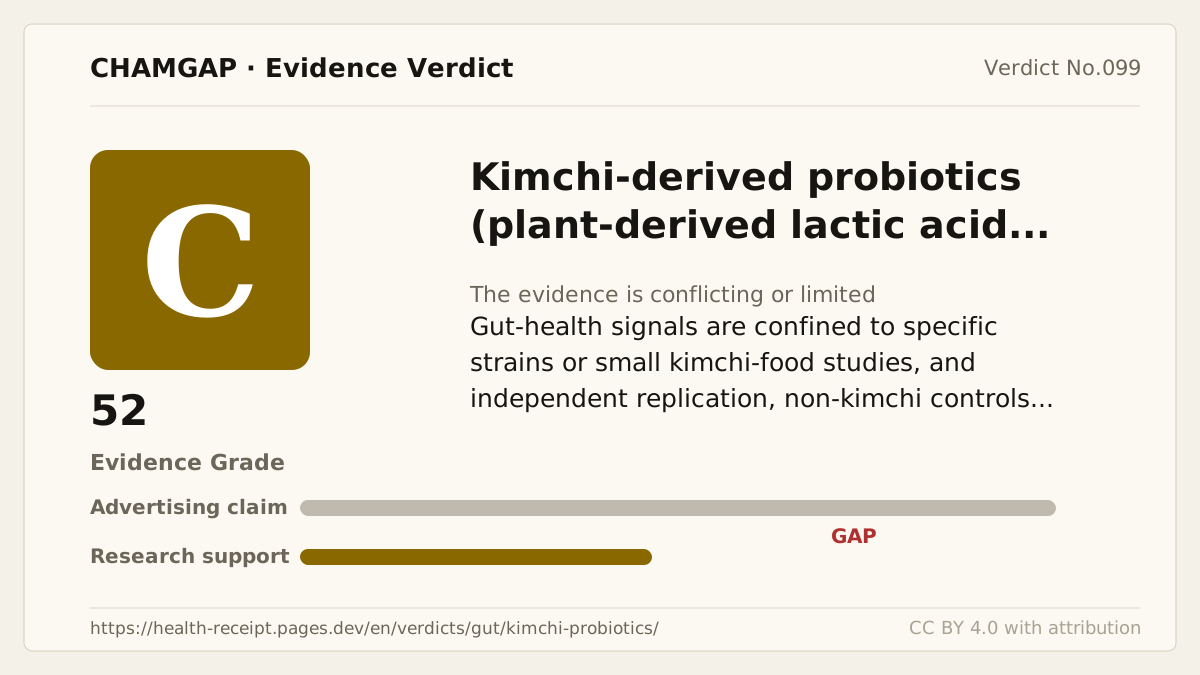
[Chamgap] Kimchi-derived probiotics (plant-derived lactic acid bacteria) × gut health — Evidence Grade C·52. 3 cited sources checked. Source: https://chamgap.com/en/verdicts/gut/kimchi-probiotics/ · CC BY 4.0CC BY 4.0 — free to use with attribution; do not distort grades, numbers, or verdict meaning.
What this document does and does not do
Chamgap is an information source. It reports what research has and has not confirmed; it does not tell readers what to take or buy. That decision belongs to readers and, when needed, medical or legal professionals. This verdict reflects literature available up to the search date and may change as new research appears. Nothing here is medical advice.