
Ginger,
does it really help with digestion, anti-inflammatory effects, and nausea?
research showsFor nausea, especially nausea in early pregnancy, there is real evidence from human RCTs and meta-analyses. However, results are mixed for chemotherapy- and postoperative nausea; dyspepsia evidence often involves surrogate markers such as gastric emptying or studies of specific combinations or individually recognized ingredients; and anti-inflammatory evidence is mostly limited to blood markers such as CRP and TNF and small effects on joint pain. Therefore, broad claims such as 'gingerol clearly solves digestion, inflammation, and nausea all together' need to be read separately by effect.
ads claimKorean advertising and informational content broadly connects gingerol/shogaol to digestive promotion, gastrointestinal motility, relief of nausea, vomiting, morning sickness, and motion sickness, anti-inflammatory effects and relief of joint pain, antioxidant effects, blood circulation, immunity, and even anticancer effects. Shopping and overseas-direct-purchase content exposes 250-1100 mg capsules, ginger tea, ginger juice, and candies together with phrases such as 'digestive health,' 'nausea relief,' and 'antioxidant/anti-inflammatory.' Korea's Food Safety Korea lists steamed ginger extract powder (GGE03) as individually recognized for 'may help stomach health by protecting gastric mucosa,' but this regulatory phrase was interpreted separately from the evidence grade.
Useful facts when choosing a product
- Food Safety Korea: steamed ginger extract powder (GGE03), recognition No. 2022-24, functional content 'may help stomach health by protecting gastric mucosa,' daily intake 480 mg/day.
- Clinical-trial doses vary by indication. Pregnancy-related nausea studies usually use about 1 g/day ginger; chemotherapy nausea RCTs used 0.5, 1.0, and 1.5 g/day; functional dyspepsia GGE03 studies used 480 mg/day; and the gastric-emptying study used a single 1.2 g dose.
- Plain ginger powder, ginger extract, steamed ginger extract, and ginger+artichoke combination products differ in marker compounds, manufacturing process, and dose, so they are difficult to equate directly as the same evidence.
- Online products and informational articles emphasize gingerol, but many products do not display actual gingerol/shogaol content or differ in level of standardization.
What the research actually shows
The evidence is strongest for nausea. In pregnancy-related nausea and vomiting, multiple RCTs and meta-analyses show improvement in nausea, while vomiting is more inconsistent. For chemotherapy-induced nausea, the NCI/URCC CCOP RCT analysis of 576 participants found that 0.5-1.0 g/day reduced Day 1 acute nausea severity, but a 2013 meta-analysis of 5 RCTs found no significant effect on acute nausea/vomiting or nausea severity. For postoperative nausea, some meta-analyses show a signal for reduced nausea, but vomiting and rescue antiemetic use are less consistent. On digestion, ginger 1.2 g shortened gastric emptying T50 in n=11 patients with functional dyspepsia but did not improve symptoms. Steamed ginger extract powder GGE03 480 mg/day for 12 weeks and a 4-week ginger+artichoke combination RCT improved functional dyspepsia symptoms, but these are specific ingredient or combination-product studies and have limited generalizability to ginger alone. Anti-inflammatory evidence includes meta-analyses showing reductions in CRP, hs-CRP, and TNF-alpha and a modest effect on osteoarthritis pain, but it is difficult to connect this directly to clinical disease improvement, and study quality and heterogeneity remain issues.
Why this is classified as B (68)
Overall B (68). Nausea, especially nausea in early pregnancy, is close to the upper B to lower A range because there are many human RCTs and meta-analyses. But for the combined claim as a whole, digestion is in the C range at most because it relies on surrogate markers or lacks independent replication for specific combinations/individual ingredients, and anti-inflammatory effects are also in the C range because they are mainly surrogate markers and small osteoarthritis effects. Positive and negative meta-analytic results also coexist for chemotherapy- and postoperative nausea. The judgment therefore recognizes real human evidence centered on nausea but finds it insufficient to speak strongly about digestion and anti-inflammatory effects at the same time.
Counterpoint. Ginger cannot be treated as having only weak evidence. There are RCT/meta-analysis signals for pregnancy-related nausea, some chemotherapy-induced acute nausea, and osteoarthritis pain. Conversely, 'digestive promotion' must distinguish gastric emptying as a surrogate marker from symptom-improvement studies, and lower blood inflammatory markers do not mean the same thing as lower pain or disease events.
Rejudgment record. Convergent — Evidence for nausea (pregnancy, postoperative, motion sickness) is real enough for B, while digestion overall is mixed with surrogate markers and combinations
Cross-check — Codex and Claude
Evidence Table
| Study | Design | Sample | Funding | Endpoint | Result | Weight |
|---|---|---|---|---|---|---|
| Hu ML et al. 2011 | double-blind RCT | 11, | possible manufacturer/industry involvement | not specified | Functional dyspepsia n=11; in a randomized double-blind crossover trial, ginger 1.2 g shortened gastric emptying T50 to 12.3 minutes vs 16.1 minutes but did not improve GI symptoms. | core |
| Wu KL et al. 2008 | not specified | 24 | not reported | not specified | In a study of healthy adults n=24, ginger was reported to promote gastric emptying and antral contraction. | supportive |
| Back HI et al. 2025 | double-blind RCT | 80, | possible manufacturer/industry involvement | not specified | Functional dyspepsia n=80; in a 12-week RCT of GGE03 480 mg/day, GSRS total and abdominal pain, constipation, indigestion, and reflux subscores reportedly improved more than placebo. | core |
| Giacosa A et al. 2015 | not specified | 126, | possible manufacturer/industry involvement | not specified | Functional dyspepsia n=126; in a 4-week RCT of a ginger+artichoke combination, primary symptom intensity improved more than placebo by day 14, and nausea, fullness, pain, and bloating also improved. | core |
| Matthews A et al. 2015 | RCT | 5449 | not reported | pregnancy | Review of 41 RCTs and 5,449 participants on interventions for nausea and vomiting in early pregnancy included ginger but pointed out an overall lack of high-quality evidence. | supportive |
| Hu Y et al. 2022 | meta-analysis | not reported | pregnancy | A pregnancy-related nausea/vomiting meta-analysis summarized that ginger significantly relieved overall symptoms and nausea versus placebo, but not vomiting. | supportive | |
| Ryan JL et al. 2012 | not specified | 576, | mixed/partly industry-related | not specified | Final analysis n=576 in chemotherapy patients; in a four-arm placebo/0.5/1.0/1.5 g/day RCT, all ginger doses reduced Day 1 acute nausea severity, with the strongest signal at 0.5-1.0 g/day. | supportive |
| Lee J, Oh H 2013 | meta-analysis of RCTs | 872 | possible manufacturer/industry involvement | not specified | Meta-analysis of 5 RCTs and n=872 cancer patients found no significant difference from controls in incidence of acute nausea, incidence of acute vomiting, or acute nausea severity. | supportive |
| Liu Y et al. 2022 | meta-analysis of RCTs | not reported | not specified | A postoperative nausea meta-analysis reported reduced postoperative nausea, but no significant differences in postoperative vomiting, overall PONV incidence, or rescue antiemetic use. | supportive | |
| Bartels EM et al. 2015 | meta-analysis of RCTs | 593 | not reported | joint/pain | In 5 osteoarthritis RCTs, n=593, there was modest benefit for pain SMD -0.30 and disability SMD -0.22, and adverse-event withdrawal RR was 2.33. | supportive |
| Santos AC et al. 2020 | meta-analysis | not reported | joint | A review of 7 knee osteoarthritis clinical trials concluded that evidence for oral ginger improving pain/function was insufficient because of study heterogeneity and low methodological quality. | supportive | |
| Sadeghi A et al. 2020 | meta-analysis of RCTs | 1010 | not reported | not specified | In 16 RCTs, n=1010, CRP, hs-CRP, and TNF-alpha decreased, but IL-6 and sICAM were not significant and heterogeneity was large. | supportive |
| NCCIH | not specified | not reported | pregnancy | NCCIH states that oral ginger was generally used safely in studies but may cause abdominal discomfort, heartburn, diarrhea, mouth/throat irritation, and possible drug interactions. | supportive | |
| Study 14 | not specified | not reported | not specified | The Korean individually recognized ingredient GGE03 is notified as 'may help stomach health by protecting gastric mucosa' at 480 mg/day, with caution wording for pregnant people and people taking coagulation-related drugs. | supportive |
Receipt — 14 References
Of 14 cited sources, 8 had limited original-page access (blocked or summary-only) and were verified via index/summary, marked partial; the rest were verified at the original page. As of 2026-07-07.
Reviewed and approved: Chamgap Editorial Team · Approval date: 2026-07-07 · Corrections: none
Cite this verdict
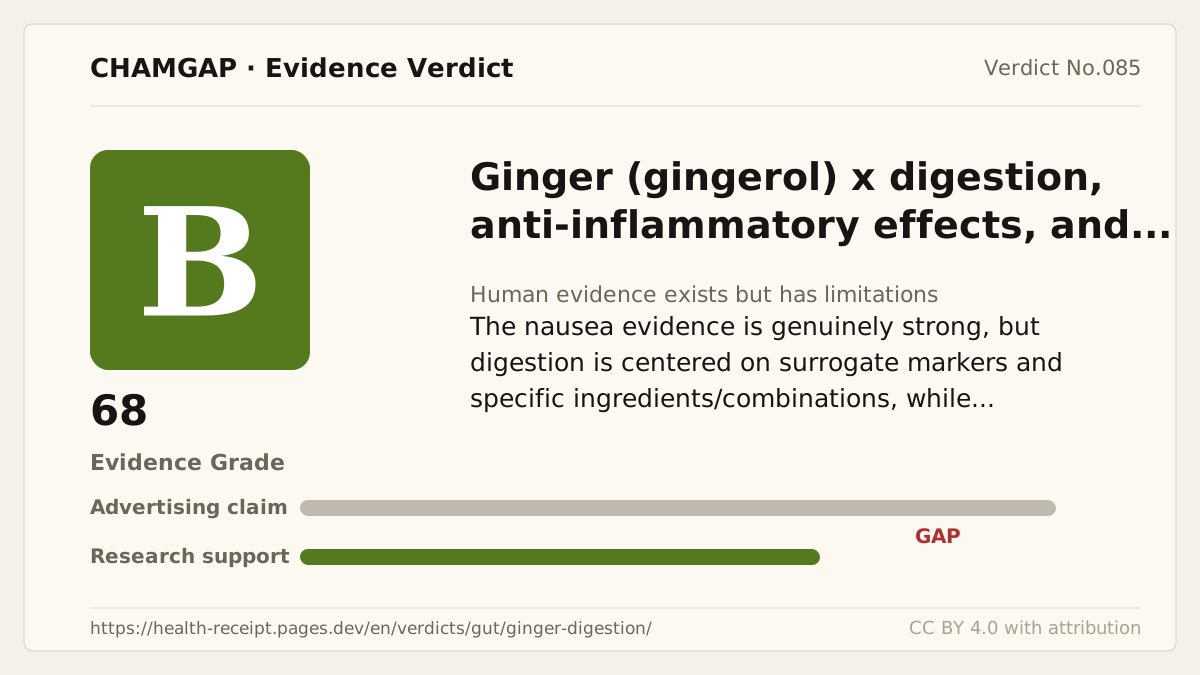
[Chamgap] Ginger × digestion, anti-inflammatory effects, and nausea — Evidence Grade B·68. 14 cited sources checked. Source: https://chamgap.com/en/verdicts/gut/ginger-digestion/ · CC BY 4.0CC BY 4.0 — free to use with attribution; do not distort grades, numbers, or verdict meaning.
What this document does and does not do
Chamgap is an information source. It reports what research has and has not confirmed; it does not tell readers what to take or buy. That decision belongs to readers and, when needed, medical or legal professionals. This verdict reflects literature available up to the search date and may change as new research appears. Nothing here is medical advice.