
Probiotics,
does it really help with gut health and improved bowel movements?
research showsBottom line: the claim that probiotics help gut health and bowel movements is within the scope of Korean MFDS generic functionality ('may help growth of beneficial bacteria and suppression of harmful bacteria, smooth bowel movements, and gut health'), and human studies on bowel movements actually exist. However, the effect size is moderate to small (about +0.9 to +1.3 bowel movements per week in constipation patients), and certainty of evidence is rated 'low to very low' in several meta-analyses. Effects differ greatly by strain, appearing only for some strains such as B. lactis and not for strains such as L. casei Shirota, so there is no evidence that 'any probiotic works.' Evidence in the advertised target, healthy general adults, is clearly weaker than in constipation patients (one meta-analysis found gut transit-time effect size 0.22 in healthy people vs 0.57 in constipation groups). Thus, people with bowel discomfort have relatively more evidence, but for 'gut health management' in people without specific problems, evidence is thin.
ads claimAdvertisements for products such as Lactofit Gold, Nutrione pro/prebiotics, and GNC 10-billion probiotics use the MFDS generic-recognition wording, 'smooth bowel movements, growth of beneficial bacteria and suppression of harmful bacteria, and may help gut health,' and this is regulatory-permissible wording (passes D2). There are three gaps. (1) Population: much of the literature comes from constipation or IBS patients, while ads target healthy general adults without specific symptoms; evidence in this group is clearly weaker (Miller 2016 SMD 0.22, Kristensen 2016 null). (2) Strain: ads emphasize counts such as guaranteed 1 billion/10 billion CFU and multi-strain formulas, but efficacy depends more on which strain than on CFU count, and only a few strains have confirmed efficacy. Treating CFU count, a content specification, like efficacy evidence confuses evidence layers. (3) Effect size: the recognized wording is a possibility phrase, 'may help,' and actual effects are about one bowel movement per week, moderate to small, with low certainty.
Useful facts when choosing a product
- MFDS generic-recognized strains total 19 species (11 Lactobacillus, 4 Bifidobacterium, 1 Lactococcus, 2 Enterococcus, and 1 Streptococcus). If the combination meets this scope, bowel-movement and gut-health wording can be displayed without individual recognition. The standard is at least 100 million (10^8) live CFU/g and daily intake about 100 million to 10 billion CFU.
- Efficacy depends more on which strain than on CFU count. Strains repeatedly confirmed for bowel/gut symptom improvement include a few such as B. lactis for constipation and B. longum 35624, L. rhamnosus GG, L. plantarum 299v, and B. coagulans lines for IBS symptoms, while L. casei Shirota, E. coli Nissle 1917, and L. gasseri BNR17 were not confirmed for the relevant endpoints. Checking the exact strain name on the label, for example HN019 or DN-173 010, makes comparison with evidence easier.
- Only products registered and labeled as 'health functional foods' may use the functionality wording. Ordinary foods such as fermented milk, yogurt drinks, and yogurt cannot use expressions such as 'helps gut health' even if they contain lactic acid bacteria.
- Additional effects such as body-fat reduction, menopausal women's health, vaginal beneficial bacteria, or improvement of skin/nasal immune hypersensitivity are separately granted to specific individually recognized strains and differ in evidence and scope from this claim, 'gut health/bowel movements' (generic).
What the research actually shows
Based on 8 verified papers. (1) Adults with functional constipation: Dimidi 2014 (Am J Clin Nutr) found bowel frequency +1.3/week (95% CI 0.7~1.9), transit time -12.4h, stool consistency improved (SMD +0.55), but significance appeared only for B. lactis while L. casei Shirota was ineffective, confirming strain specificity; many studies had high risk of bias. Ding 2024 (BMJ Open) found bowel frequency +0.93/week but GRADE evidence level 'low to very low.' (2) Differences by population/indication: Miller 2016 (World J Gastroenterol) found transit-time reduction significantly greater in constipation groups (SMD 0.57) than healthy general adults (SMD 0.22), directly supporting 'weak evidence in healthy general adults' (PMC original checked). (3) IBS patients: Maslennikov 2026 (J Clin Med) and Xie 2023 (Nutrients) network meta-analyses repeatedly confirmed that efficacy differs by strain and symptom; confirmed strains are a few such as B. longum 35624, L. rhamnosus GG, and L. plantarum 299v, while E. coli Nissle 1917, L. gasseri BNR17, and L. casei Shirota are unproven. (4) Healthy general adults: Kristensen 2016 (Genome Med) found insufficient evidence of fecal microbiota composition change in healthy adults ('lack of evidence'). (5) Authority: AGA 2020 guideline (Gastroenterology) recommends use for IBS only in a clinical-trial context, due to evidence gaps/recommendation deferral; this indication differs from claims for healthy general gut health. Overall, evidence exists but is limited, strain-specific, and centered on patient groups.
Why this is classified as D (28)
Why it is D: The confirmatory HN019 trial that directly tested bowel-movement improvement failed to show benefit on its primary weekly complete-spontaneous-bowel-movement endpoint, giving E0, and the result does not support a broad claim for probiotics in general. · Endpoint: Weekly CSBM is a patient-recorded bowel symptom and function measure rather than a hard endpoint, so it is P. · Replication and independence: There is one same-unit confirmatory trial, giving R1. Danisco China fully funded the trial and sponsor/IFF-affiliated authors participated, giving I0. · Effect: At eight weeks, change was +0.80 CSBM/week with HN019 and +0.66 with placebo, a +0.14/week difference (95% CI −0.17 to 0.45; P=0.37). Superiority was not shown, although the interval does not exclude a small benefit; E0 does not mean harm. · Design: Eight weeks of treatment is one listed flaw, duration below 12 weeks, giving B1. Why it is not A or B: The null primary endpoint in one industry-funded trial, together with strain and patient-population specificity, does not provide independent, consistent, generalizable evidence. Distinguishing D from F: D is the final grade, while F is unwarranted because meta-analyses retain positive bowel-frequency signals and the confidence interval does not exclude benefit. → Under the Chapter 2 ceiling rules, R1, I0, and B1 impose B, C, and B ceilings; with zero strength axes in the Chapter 3 baseline table, the result is D with 28 points.
Counterpoint. Higher-grade view, B: probiotics are a rare ingredient class with dozens of human RCTs in the gut-health area, constipation-patient outcomes such as increased bowel frequency and shorter transit time align across different research teams and funding sources (independent: Ding 2024/Kristensen 2016; industry: Miller 2016), and MFDS recognizes functionality, so it is close to B. Rebuttal: (1) consistency is limited to specific populations such as constipation/IBS patients, while effects are weak or null in healthy general adults targeted by ads (Miller SMD 0.22, Kristensen null), so claim and evidence population diverge. (2) Effects belong not to 'probiotics' generally but to specific strains, with many unproven strains, while market products are sold as multi-strain and nonspecific, so product efficacy is not guaranteed by the literature. (3) Meta-analyses themselves acknowledge GRADE 'low to very low' and high risk of bias. In the evidence hierarchy, 'reproduced but low certainty and population-mismatched' falls short of B's strong independent evidence, so C is accurate.
| Endpoint | P | Patient-reported treatment goal - the symptom is the goal |
| Replication | R1 | Single confirmatory trial |
| Independence | I0 | Evidence comes only from manufacturer studies |
| Effect size | E0 | Null |
| Precision | C0 | The confidence interval leaves room for benefit |
The scoring table and the verdict agree (D).
Cross-check — Codex and Claude
Evidence Table
| Study | Design | Sample | Funding | Endpoint | Result | Weight |
|---|---|---|---|---|---|---|
| Dimidi E, Christodoulides S, Fragkos KC, Scott SM, Whelan K 2014 | meta-analysis of randomized controlled trials | 1182 | possible manufacturer or industry involvement | liver / bowel movements | Adults with functional constipation (14 RCTs/1182 participants), strains and doses varied (2-4 weeks). Bowel frequency +1.3/week, transit time -12.4h, stool consistency SMD +0.55, but significance only for B. lactis. Funding: Nestec Ltd (Nestlé) PhD fellowship (confirmed through secondary source, original wording not directly checked). | key |
| Miller LE, Zimmermann AK, Ouwehand AC 2016 | meta-analysis | possible manufacturer or industry involvement | liver | Mixed population (estimated 9 constipation studies and 8 healthy-person estimates), 5x10^8 to 9.8x10^10 CFU for 10-28 days. Transit-time SMD 0.38 overall, constipation 0.57 vs healthy 0.22, directly supporting weak evidence in healthy adults. Funding: Danisco Sweeteners; authors had DuPont, Bio-K Plus and other relationships (PMC rechecked). | key | |
| Ding F, Hu M, Ding Y, Meng Y, Zhao Y 2024 | meta-analysis | possible manufacturer or industry involvement | bowel movements | Adults with Rome-diagnosed functional constipation. Bowel frequency +0.93/week (evidence 'low'), stool consistency WMD 0.38 (evidence 'very low'), PAC-SYM decreased. No funding/conflicts declared, so independence relatively good. | key | |
| Maslennikov R, Gosteeva E, Ananeva V et al. 2026 | meta-analysis of randomized controlled trials | possible manufacturer or industry involvement | Rome-defined IBS patients, strain-level judgment. Five strains had evidence (B. longum 35624, L. rhamnosus GG, L. plantarum 299v, S. cerevisiae CNCM I-3856, B. coagulans Unique IS2), and three were unproven (E. coli Nissle 1917, L. gasseri BNR17, L. casei Shirota). No funding/conflicts (PMC rechecked). | key | ||
| Xie P, Luo M, Deng X, Fan J, Xiong L 2023 | meta-analysis of randomized controlled trials | 9253 | possible manufacturer or industry involvement | IBS patients (81 RCTs/9253 participants). SUCRA ranking by outcome, such as L. acidophilus DDS-1 for overall symptoms and B. coagulans MTCC 5856 ranked first for abdominal pain. Authors had no conflicts, but 45 of 81 included studies (about 55%) had commercial funding. | supporting | |
| Almabruk BA, Bajafar AA, Mohamed AN et al. 2024 | meta-analysis | possible manufacturer or industry involvement | bowel movements / gastrointestinal | Adult IBS patients (Rome II/III). Abdominal pain MD -1.66, bloating -2.13, bowel habit -1.52, quality of life +8.77, largest in IBS-D. No funding/conflicts declared. However, Cureus is a lightweight-review journal and should be treated with lower reliability. | supporting | |
| Kristensen NB, Bryrup T, Allin KH, Nielsen T, Hansen TH, Pedersen O 2016 | systematic review of randomized controlled trials | possible manufacturer or industry involvement | bowel movements | Healthy adults (19-88 years, 7 RCTs), about 10^9-10^11 CFU for 21-42 days. No significant effect on fecal microbiota composition such as alpha diversity ('lack of evidence'), supporting weak evidence in healthy general adults. Funding: Novo Nordisk Foundation (not manufacturer), no conflicts. | supporting | |
| Su GL, Ko CW, Bercik P, Falck-Ytter Y, Sultan S, Weizman AV, Morgan RL 2020 | possible manufacturer or industry involvement | AST / gastrointestinal | Gastrointestinal disease guideline. For IBS, Crohn disease, and ulcerative colitis, recommendation is use only in the clinical-trial context (evidence gap/recommendation deferred). Conditional recommendations are limited to C. difficile prevention with antibiotics, premature infant NEC, and pouchitis, so the indication differs from 'healthy general gut health.' | supporting |
Receipt — 8 References
Of 8 cited sources, 2 had limited original-page access (blocked or summary-only) and were verified via index/summary, marked partial; the rest were verified at the original page. As of 2026-07-06.
Reviewed and approved: Chamgap Editorial Team · Approval date: 2026-07-06 · Corrections: 1
Correction log — 1
Corrections applied to this verdict, in chronological order. Changes are logged, not erased.
- 2026-08-19 · Methodology v0.7 migration (axes recorded, score derived) — Applied the seven axes and anchor table published in methodology v0.7 to this verdict. It had been graded under the pre-axis method and carried no score. The representative trial was re-established from the source, axes 1-6 recorded, and the score derived from the published anchor table. The old grade was less wrong than assigned before the rule was fully specified; the full rule is in section 2-3 of /methodology/. (grade C→D)
Cite this verdict
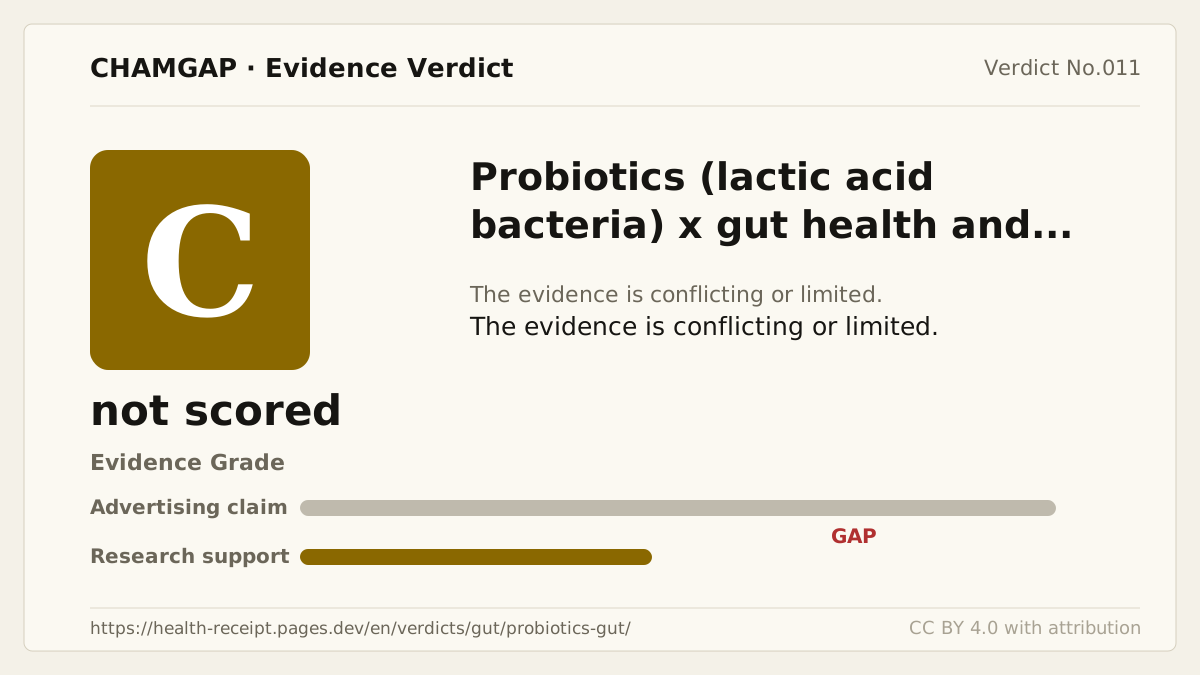
[Chamgap] Probiotics x gut health and bowel movements — Evidence Grade D·28. 8 cited sources checked. Source: https://chamgap.com/en/verdicts/gut/probiotics-gut/ · CC BY 4.0CC BY 4.0 — free to use with attribution; do not distort grades, numbers, or verdict meaning.
What this document does and does not do
Chamgap is an information source. It reports what research has and has not confirmed; it does not tell readers what to take or buy. That decision belongs to readers and, when needed, medical or legal professionals. This verdict reflects literature available up to the search date and may change as new research appears. Nothing here is medical advice.