
Heat-killed lactic acid bacteria,
does it really help with Superiority claim that they are clinically better than live probiotics?
research showsThe evidence is weak for generalizing that heat-killed lactic acid bacteria or postbiotics are overall more effective than live bacteria. Some heat-killed preparations show human RCT signals under specific conditions, but independent replication showing superiority over live bacteria for the same strain and the same efficacy is rare, and results also differ by strain and disease.
ads claimKorean market advertisements and informational posts describe them with phrases such as 'fourth-generation lactic acid bacteria,' 'dead lactic acid bacteria are also good for the body,' 'higher safety, efficacy, and processability than live bacteria,' 'reaches the intestine without being affected by gastric acid or bile,' 'can be stored at room temperature,' 'can be consumed in higher amounts than live bacteria or in trillion-unit amounts,' 'safer for immunocompromised people,' 'can be taken with antibiotics,' and 'is well absorbed and raises immunity.' Some posts use postbiotics, parabiotics, lactic acid bacterial metabolites, and heat-killed bacteria interchangeably, and extend manufacturing and safety logic such as storage stability or reduced infection risk into superiority in gut health, immunity, skin, and metabolic efficacy.
Useful facts when choosing a product
- Even if a product name contains postbiotics, the actual contents may differ, including heat-killed bacteria alone, dried lactic acid bacteria culture, lactic acid bacterial metabolites, prebiotics, or a mixture with live bacteria.
- The 'cell count' or 'trillion cells' labeling of heat-killed bacteria does not mean the same thing as CFU for live bacteria. The fact that there are many dead cells alone cannot be used to judge that the clinical effect is greater than that of live bacteria.
- If heat treatment, freeze-drying, inclusion of culture supernatant, strain name, dose, or matrix differs, the evidence also differs. It is difficult to apply an RCT of a specific strain to all arbitrary heat-killed bacterial products.
- The fact that they do not live and proliferate may be favorable for storage stability and a theoretical reduction in infection risk, but safety data are not sufficient for all high-dose uses, vulnerable groups, and combination products.
- MFDS recognition status is a regulatory classification issue, and the evidence grade is judged separately based on clinical trial design, reproducibility, and efficacy-specific results.
What the research actually shows
In a systematic literature review, among 40 RCTs of modified/heat-killed probiotics, studies that directly compared them with the same live bacteria were generally similar or mixed. There are some treatment RCTs in which they were significantly superior to live bacteria, for example heat-killed L. acidophilus LB in chronic diarrhea, but these are old single-product studies with limited information on replication and funding sources. A systematic literature review on pediatric infectious diseases reported that heat-killed L. acidophilus LB reduced acute diarrhea duration and that heat-killed L. paracasei CBA L74 reduced diarrhea and some respiratory infection incidence, but the comparator was mainly placebo, not live bacteria, and the number of studies, regions, and methods reporting were limited. There is also a pilot RCT in which a non-live form, such as pasteurized Akkermansia muciniphila, appeared better than the live arm, but it is not a heat-killed lactic acid bacterium, is centered on metabolic markers, is small, and has patent/start-up conflicts of interest, so it is difficult to transfer it to general Korean claims about heat-killed lactic acid bacteria.
Why this is classified as C (45)
Human RCTs and systematic literature reviews exist, but the target of this verdict is not efficacy for a specific disease; it is the broad superiority claim that they are better than live bacteria. Evidence directly matching this claim is small in number and heterogeneous, and many comparisons report similar or mixed effects. A substantial share of positive studies are comparisons of a specific strain, a specific disease, or placebo, or are centered on surrogate markers, and there are issues of manufacturer/patent conflicts of interest or unclear funding sources. Under the boundary rules, the lack of independent replication and the leap from mechanism and stability to clinical efficacy cap the grade at C.
Counterpoint. This does not mean heat-killed bacteria are always meaningless. There are human RCT signals for specific strains in pediatric acute diarrhea, prevention of pediatric infections, and some metabolic and immune markers. In addition, non-live formulations may have practical advantages in terms of storage, manufacturing, possible concomitant use with antibiotics, and infection risk. However, this is separate from the claim that they are overall more effective than live bacteria.
Rejudgment record. convergent — Draft = blind C. Delivery to the intestine and stability are surrogate logic for superiority; clinical superiority of heat-killed bacteria is unproven.
Cross-check — Codex and Claude
Evidence Table
| Study | Design | Sample | Funding | Endpoint | Result | Weight |
|---|---|---|---|---|---|---|
| Zorzela L, Ardestani SK, McFarland LV, Vohra S 2017 | systematic review of RCTs | 40 | not reported | not specified | In a review of 40 RCTs of modified/heat-killed probiotics (3,913 participants), superiority over the same live bacteria was limited to some cases, and an overall superiority conclusion was not possible. | core |
| Malagon-Rojas JN, Mantziari A, Salminen S, Szajewska H 2020 | systematic review of RCTs | 7 | possible manufacturer/industry involvement | not specified | In 7 RCTs on pediatric infectious diseases (1,740 participants), there were signals for diarrhea treatment and infection prevention with specific heat-killed strains, but the evidence was limited and was mainly placebo-controlled. | core |
| Xiao SD, Zhang DZ, Lu H et al. 2003 | RCT | 137 | possible manufacturer/industry involvement | bowel movements | An old direct-comparison RCT in 137 patients with chronic diarrhea reported that heat-killed L. acidophilus LB lowered bowel movement frequency at 2 and 4 weeks more than a living lactobacilli product. | core |
| Depommier C, Everard A, Druart C et al. 2019 | not specified | possible manufacturer/industry involvement | AST | In a small pilot RCT, pasteurized Akkermansia showed clearer improvement than the live arm in some metabolic markers, but it is not a heat-killed lactic acid bacterium and has major surrogate-marker and COI limitations. | core |
Receipt — 4 References
Of 4 cited sources, 4 had limited original-page access (blocked or summary-only) and were verified via index/summary, marked partial; the rest were verified at the original page. As of 2026-07-07.
Reviewed and approved: Chamgap Editorial Team · Approval date: 2026-07-07 · Corrections: none
Cite this verdict
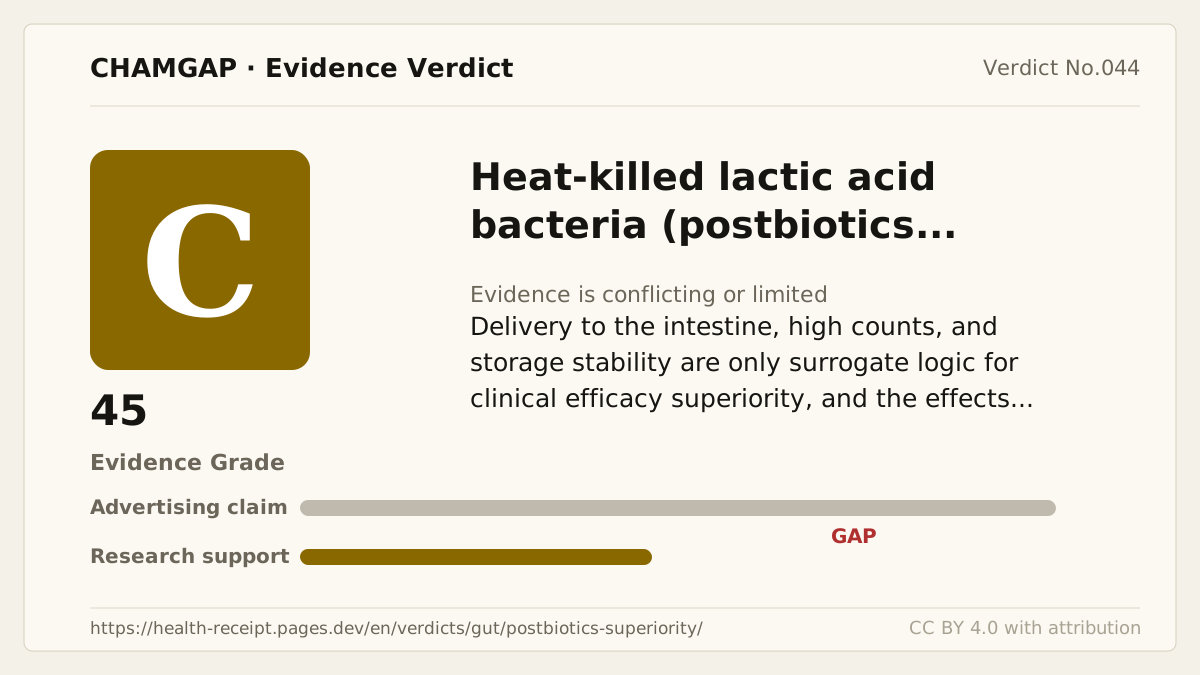
[Chamgap] Heat-killed lactic acid bacteria x superiority claim that they are clinically better than live probiotics — Evidence Grade C·45. 4 cited sources checked. Source: https://chamgap.com/en/verdicts/gut/postbiotics-superiority/ · CC BY 4.0CC BY 4.0 — free to use with attribution; do not distort grades, numbers, or verdict meaning.
What this document does and does not do
Chamgap is an information source. It reports what research has and has not confirmed; it does not tell readers what to take or buy. That decision belongs to readers and, when needed, medical or legal professionals. This verdict reflects literature available up to the search date and may change as new research appears. Nothing here is medical advice.