
Manuka honey,
does it really help with Stomach health, Helicobacter pylori, GERD symptoms, and immunity?
research showsMGO/UMF can be viewed as antibacterial-related quality indicators of Manuka honey, but human evidence that orally consumed Manuka honey clearly improves gastritis, Helicobacter pylori, or immunity remains weak. One small pilot RCT assessing GERD symptoms and esophagitis findings was positive, but the sample was 30 people, most used existing acid-suppressive drugs, and there is no independent replication. H. pylori eradication failed in an old small human trial.
ads claimKorean market advertising and informational articles often state that higher MGO/UMF indicates stronger antibacterial activity and helps with H. pylori inhibition, gastritis, heartburn, gastric mucosal protection, gut health, sore throat/pharyngitis, immune strengthening, anti-inflammatory and antioxidant effects, fatigue recovery, and skin/wound recovery. Coupang detail pages and review-style language repeat "gastrointestinal disease/H. pylori inhibition," "gastric mucosal protection," and "immune enhancement," while informational articles, blogs, iHerb/Ople-type content use broad phrases such as "natural antibiotic," "improved gastrointestinal health," "activation of beneficial bacteria," and "immune promotion." Some articles tier MGO 100/250/400/500 or higher as everyday care, gastrointestinal health, or high-intensity antibacterial power.
Useful facts when choosing a product
- MGO means methylglyoxal content and is a representative marker related to test-tube antibacterial activity of Manuka honey. The MGO value does not directly mean the size of gastritis or immune effects in humans.
- UMF is described as a certification system that considers not only MGO but also leptosperin, DHA, HMF, and other factors of quality, authenticity, and freshness. It is not a disease-treatment efficacy grade.
- Products sold in Korea include single Manuka honey, lozenges, and products combined with propolis. Claims for propolis, herbs, or vitamin combinations must be separated from evidence for Manuka honey alone.
- Human studies used 5 g three times daily for 4 weeks in the GERD pilot and 20 g/day for 4 weeks in a healthy-person safety study. Commercial MGO/UMF grades and intake amounts may differ from study conditions.
- Honey is a sugar-containing food. Separate caution is needed for people requiring glycemic control, those with bee/honey allergy history, and infants younger than 12 months.
What the research actually shows
Stomach-related evidence differs by effect. For H. pylori, Al Somal 1994 found that clinical isolates were inhibited by 20% Manuka honey and that visible growth was blocked for 72 hours in agar containing 5% honey, but in McGovern 1999, a 12-person H. pylori-positive human trial, all participants remained positive on 14C urea breath testing after 2 weeks of Manuka honey or Manuka honey plus omeprazole. For GERD, the Gośliński 2023/2024 pilot found that Manuka honey with MGO >=400 mg/kg, 5 g three times daily for 4 weeks, had higher improvement rates in symptoms, endoscopy, and histology than artificial-honey placebo, but it was n=30, a single pilot, unclear blinding, frequent concomitant PPI/H2 blocker use, and product provision. The SOOTHE functional dyspepsia study is registered as a double-blind RCT with a published protocol, but the 2025 paper is a protocol rather than results and stated that analysis was ongoing as of March 2024. For immunity, no human RCT proving reduced infections or improved immunity after oral intake was identified, and a human safety RCT found no changes in IgE or major gut bacterial groups.
Why this is classified as C (44)
When the composite claim is separated by effect, GERD has a small positive human RCT signal, so the literature is not completely absent, but independent replication and large trials are lacking. The H. pylori eradication claim failed in a human trial and does not match the core advertising claim. Immune enhancement lacks human clinical outcomes and relies mainly on test-tube, animal, and surrogate-marker logic. Therefore, this fits "insufficient human proof/lack of independent replication" and is rated C. Because a positive RCT exists, it is not lowered to F or D, but H. pylori negativity and the immune clinical gap keep it below B.
Counterpoint. For topical wound and oral-health fields, Manuka honey has a separate and larger literature, and the GERD pilot means there is not zero positive signal for gastrointestinal symptoms. However, for the target claim here, oral intake for stomach, Helicobacter, and immune effects, test-tube antibacterial activity and product grade cannot be connected directly to clinical efficacy.
Rejudgment record. Convergent — Draft = blinded C. Only test-tube antibacterial evidence and a small positive GERD pilot; insufficient human eradication evidence for H. pylori.
Cross-check — Codex and Claude
Evidence Table
| Study | Design | Sample | Funding | Endpoint | Result | Weight |
|---|---|---|---|---|---|---|
| Al Somal N, Coley KE, Molan PC, Hancock BM 1994 | Possibly manufacturer/industry related | In an in vitro study of H. pylori clinical isolates, inhibition was observed with 20% Manuka honey agar well diffusion and 5% agar inclusion conditions. | Core | |||
| McGovern DPB, Abbas SZ, Vivian G, Dalton HR 1999 | RCT | 12 | Gastrointestinal | In 12 H. pylori-positive people, all remained positive on 14C urea breath testing after 2 weeks of Manuka honey or 2 weeks of Manuka honey plus omeprazole. | Core | |
| Gośliński M, Nowak D, Mindykowski R, Kulewski W, Popławski C 2023 | 30, | Possibly manufacturer/industry related | In a 30-person GERD pilot, Manuka honey with MGO >=400 mg/kg, 5 g three times daily for 4 weeks, produced higher symptom, endoscopic, and histologic improvement rates than placebo. | Core | ||
| Wallace A, Eady S, Miles M et al. 2010 | Double-blind RCT | 20 | Possibly manufacturer/industry related | Gastrointestinal | In a randomized double-blind crossover trial of 20 healthy people, UMF 20+ at 20 g/day for 4 weeks did not significantly change IgE, CML, or major gut bacterial groups. | Core |
| Ombasa L, Miller J, Ware L et al. 2025 | Double-blind RCT | 68 | Possibly manufacturer/industry related | This is a protocol for a 3-arm double-blind RCT in functional dyspepsia; as of March 2024, initial data from 68 people were being analyzed and efficacy results were not yet published. | Supporting | |
| Mavric E, Wittmann S, Barth G, Henle T 2008 | Immune | Chemical and in vitro evidence connected Manuka honey antibacterial activity with MGO concentration, with antibacterial activity at 15-30% dilution corresponding to MGO 1.1-1.8 mM. | Supporting | |||
| Wang S, Qiu Y, Zhu F 2024 | Meta-analysis/preclinical | Gastrointestinal | An updated review of Manuka honey ingredients, bioactivity, and clinical applications noted that many functional claims rely on test-tube, animal, and formulation studies and that safety/efficacy debates remain. | Supporting | ||
| UMF Honey Association | UMF is a quality certification system assessing potency, authenticity, purity, shelf life, freshness, and other factors, not MGO alone. | Supporting | ||||
| Infant Botulism Treatment and Prevention Program | Prevention information states that honey should not be given to infants under 12 months to prevent infant botulism. | Supporting |
Receipt — 9 References
Of 9 cited sources, 1 had limited original-page access (blocked or summary-only) and were verified via index/summary, marked partial; the rest were verified at the original page. As of 2026-07-07.
Reviewed and approved: Chamgap Editorial Team · Approval date: 2026-07-07 · Corrections: none
Cite this verdict
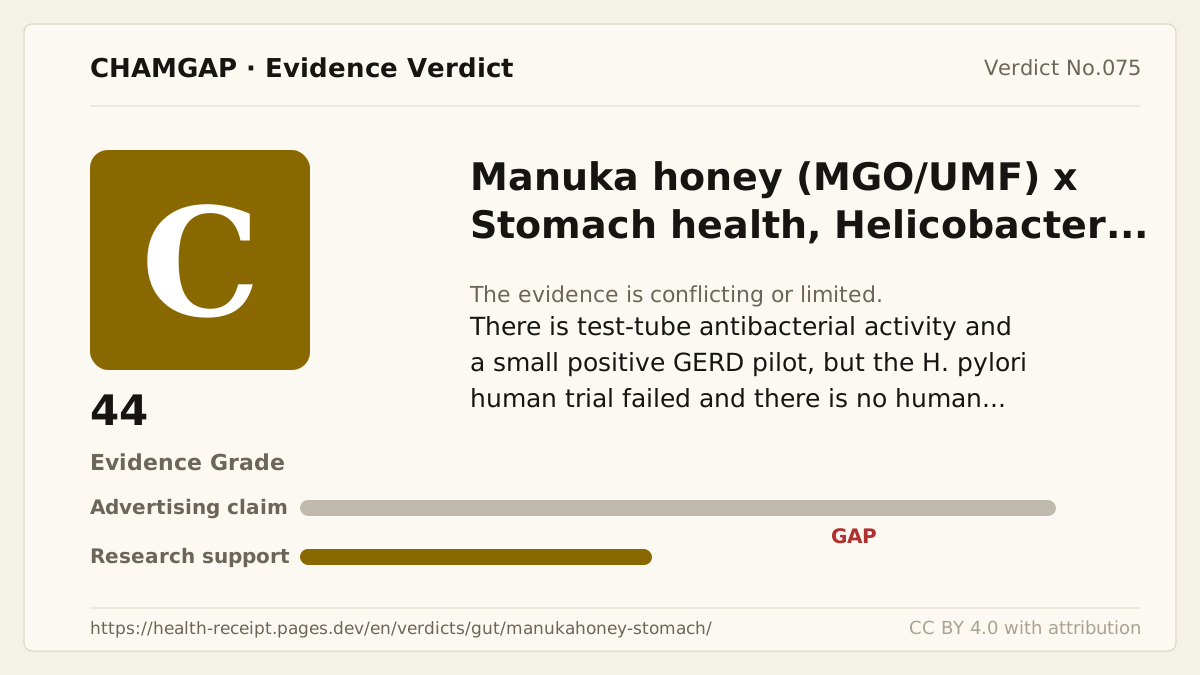
[Chamgap] Manuka honey (MGO/UMF) × stomach health, Helicobacter pylori, GERD symptoms, and immunity — Evidence Grade C·44. 9 cited sources checked. Source: https://chamgap.com/en/verdicts/gut/manukahoney-stomach/ · CC BY 4.0CC BY 4.0 — free to use with attribution; do not distort grades, numbers, or verdict meaning.
What this document does and does not do
Chamgap is an information source. It reports what research has and has not confirmed; it does not tell readers what to take or buy. That decision belongs to readers and, when needed, medical or legal professionals. This verdict reflects literature available up to the search date and may change as new research appears. Nothing here is medical advice.