
Bromelain,
does it really help with Digestive support and relief of inflammation/edema?
research showsIt is correct that bromelain is a proteolytic enzyme. However, no human RCT was identified that proves bromelain alone improves ordinary digestive discomfort, and inflammation evidence is centered on small studies, surrogate markers, and narrow settings such as postoperative pain/edema.
ads claimIn the Korean market, products are sold under names such as 'pineapple enzyme,' 'bromelain swelling enzyme,' and 'diet digestive enzyme,' and claims that proteolysis helps digest meat and reduces abdominal bloating are broadly linked with reduced inflammation, arthritis/edema relief, swelling after surgery/procedures, rhinitis/respiratory issues, immunity, and calming skin trouble. Coupang search results and product pages repeat phrases such as 'digestive health,' 'reduced inflammation in the body,' 'swelling-reducing diet digestive enzyme,' and 'proteolytic enzyme for digestion and joint health.' Informational posts also present use distinctions such as taking it after meals for digestion and on an empty stomach for anti-inflammatory/immunity purposes, but no standardized clinical evidence was identified to confirm such purpose-specific dosing methods.
Useful facts when choosing a product
- Bromelain is not a single low-molecular-weight compound but a group of proteolytic enzymes obtained from pineapple stem and fruit.
- Supplements are often labeled not only by mg content but also by enzyme-activity units such as GDU, MCU, and FIP, making simple mg comparisons between products difficult.
- Domestic products are commonly combinations with papain, quercetin, potassium, probiotics, fruit/vegetable enzymes, or grain enzymes rather than standalone bromelain.
- The fact that it breaks down protein in food preparation is separate from evidence that it clinically improves digestive discomfort.
- The word 'inflammation' in domestic advertising mixes blood markers, postoperative edema/pain, arthritis, rhinitis, skin, and diet-related swelling, so separation by effect is needed.
What the research actually shows
Digestion: although there is the mechanism of a proteolytic enzyme and some studies of combined digestive enzymes, no independent RCT was found showing that standalone bromelain supplements improve bloating or dyspepsia in the general population. Inflammation: a 2023 overall meta-analysis reported that pain reduction with oral bromelain was small but significant versus control (MD -0.27). A 2023 systematic review of inflammatory markers included 7 RCTs, of which 4 used combination products and 3 used standalone bromelain, and concluded that general effects were inconsistent because populations, doses, durations, and markers differed. Among standalone bromelain RCTs, the single-dose healthy-male study used changes in stimulated-blood cytokines such as IFN-gamma as primary evidence, not clinical symptoms. An independent knee osteoarthritis RCT was not significant for the WOMAC primary endpoint. A 2025 UC RCT showed a signal for reduced SCCAI disease activity, but it was a single small study and was not supported by QoL, endoscopy, or biochemical markers.
Why this is classified as C (45)
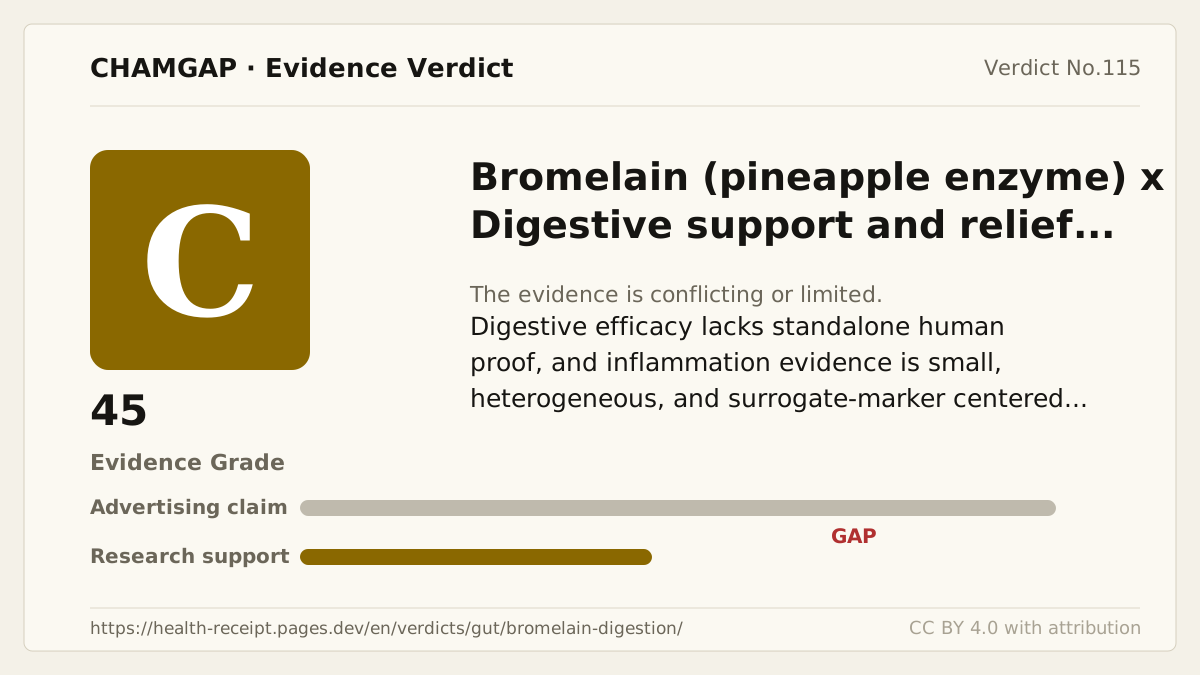
It remains C. Human RCTs and meta-analyses exist, but digestive efficacy lacks standalone human confirmation, and inflammation efficacy often involves surrogate markers, small samples, combination products, or disease-specific outcomes. Studies with inflammatory markers as primary endpoints are capped at C by the boundary rule, and positive signals do not directly support broad 'inflammation reduction' advertising. Conversely, the evidence is not only repeatedly null, so F or D is not appropriate.
Counterpoint. Clinical signals exist in specific settings such as postoperative pain/edema, sinusitis, and UC disease activity. Therefore, there is insufficient basis to declare 'no effect.' But extending these signals to general digestive support or systemic anti-inflammatory/edema management is difficult because the studies are small and examine different outcomes. Evidence for topical bromelain drugs for burn debridement is separate from oral supplement assessment.
Rejudgment record. Draft=blinded convergent — Digestion lacks standalone human proof, and inflammation evidence consists of small, heterogeneous, surrogate-marker-centered signals, so C is the limit for broad advertising claims
Cross-check — Codex and Claude
Evidence Table
| Study | Design | Sample | Funding | Endpoint | Result | Weight |
|---|---|---|---|---|---|---|
| NCCIH 2024 | U.S. NCCIH summarizes that oral bromelain research is limited to some sinusitis and wisdom-tooth-surgery symptoms, and for other indications studies are few or use combination products, making standalone effects unclear. | Core | ||||
| Leelakanok N, Petchsomrit A, Janurai T, Saechan C, Sunsandee N 2023 | Meta-analysis | pain | In 54 qualitative summaries and 39 meta-analyzed studies, oral bromelain slightly lowered pain scores (MD -0.27; 95% CI -0.45 to -0.08), but the main conclusions were limited to possible pain control and safety signals. | Core | ||
| Pereira IC, Vieira EES, Torres LRO et al. 2023 | Systematic review of RCTs | Possible manufacturer/industry involvement | inflammatory markers | Reviewed 7 RCTs of inflammatory markers; 4 were combination products and 3 were standalone bromelain. The conclusion was that overall effects were inconsistent because populations, doses, durations, and markers differed. | Core | |
| Brien S, Lewith G, Walker AF, Middleton R, Prescott P, Bundy R 2006 | RCT | 47 | Possible manufacturer/industry involvement | joints | In a knee osteoarthritis RCT (n=47), bromelain 800 mg/day for 12 weeks was not significant versus placebo for change in the WOMAC total score primary endpoint (p=0.27; 95% CI -8.86 to 31.18). | Core |
| Müller S, März R, Schmolz M, Drewelow B, Eschmann K, Meiser P 2013 | RCT | Possible manufacturer/industry involvement | In a single-dose 3-way crossover study in healthy men, 3000 FIP changed the stimulated whole-blood IFN-gamma circadian profile (p=0.043), but IL-2/6/8/13 and MCP-1 were not significant. | Supporting | ||
| Delgarm P, Mokhtare M, Ebrahimi Daryani N et al. 2025 | RCT | 70 | In mild-to-moderate UC RCT (n=70), 400 mg/day for 8 weeks lowered SCCAI change more than placebo (-3.29 vs -1.11; p<0.001), but QoL change did not differ (p=0.90). | Supporting |
Receipt — 6 References
Of 6 cited sources, 5 had limited original-page access (blocked or summary-only) and were verified via index/summary, marked partial; the rest were verified at the original page. As of 2026-07-07.
Reviewed and approved: Chamgap Editorial Team · Approval date: 2026-07-07 · Corrections: none
Cite this verdict
[Chamgap] Bromelain x digestive support and relief of inflammation/edema — Evidence Grade C·45. 6 cited sources checked. Source: https://chamgap.com/en/verdicts/gut/bromelain-digestion/ · CC BY 4.0CC BY 4.0 — free to use with attribution; do not distort grades, numbers, or verdict meaning.
What this document does and does not do
Chamgap is an information source. It reports what research has and has not confirmed; it does not tell readers what to take or buy. That decision belongs to readers and, when needed, medical or legal professionals. This verdict reflects literature available up to the search date and may change as new research appears. Nothing here is medical advice.