
Aloe,
does it really help with gut health, bowel movements, and skin health?
research showsShort-term IBS/ulcerative-colitis studies of aloe gel have small positive signals, but they are not robust enough to support Korean-market bundled advertising for 'gut health, bowel movements, and skin health' as written. Bowel-movement effects are closer to the stimulant-laxative action of aloin/barbaloin-type compounds in aloe whole leaf/latex, and that part raises substantial long-term intake safety concerns.
ads claimIn the Korean market, phrases such as 'aloe gel = skin health, gut health, immunity,' 'total polysaccharides,' 'reduced stomach acidity,' 'improved stool water retention,' and 'improved skin wrinkles/elasticity' recur in informational articles and product advertising. Some shopping/article wording puts bowel improvement directly forward with phrases such as 'aloe for gut, skin, and immunity,' 'smooth bowel movements,' 'how to poop well,' 'old stool, residual stool sensation, and abdominal bloating.' The Korea Consumer Agency noted that aloe whole-leaf products may be consumed long-term for constipation and dieting, and MFDS removed aloe whole leaf from the list of functional ingredients in 2022. Aloe gel remains as an ingredient made by removing peel/latex, but advertising claims for gut, bowel movements, and skin can easily mix the actions of gel and whole leaf/latex.
Useful facts when choosing a product
- Aloe gel is an ingredient using the gel portion after removing the outer aloe leaf rind, and under the Korean Health Functional Food Code its functional wording is distributed as helping skin health, gut health, and immune enhancement.
- Aloe whole leaf/latex may contain hydroxyanthracene derivatives such as barbaloin/aloin, and these compounds are closer to inducing colonic motility and water secretion like stimulant laxatives.
- MFDS Notice No. 2022-69 stated that aloe whole leaf, which contains aloe peel including latex, was removed from the functional ingredient list because human-harm concerns had been raised.
- In 2002, the U.S. FDA classified aloe as an OTC stimulant-laxative ingredient lacking sufficient general recognition of safety and effectiveness (GRASE) and moved it to non-monograph status.
- NCCIH summarizes that short-term oral use of aloe gel has research safety data up to 42 days, whereas aloe latex is associated with abdominal pain, cramps, and diarrhea, and oral aloe leaf extract has been associated with acute hepatitis cases.
What the research actually shows
The effects must be separated. (1) Gut/IBS: a 2018 IBS meta-analysis reported short-term positive signals across 3 RCTs and 151 total participants, with symptom score SMD 0.41 (95% CI 0.07-0.75) and response RR 1.69 (95% CI 1.05-2.73). However, among individual RCTs, Davis 2006 was industry-funded, n=58, and found no significant difference at 1- and 3-month follow-up, while Størsrud 2015 had n=68 and missed its primary endpoint, with primary response 55% vs 31%, p=0.093. A 2025 clinical review summarized that, when larger follow-up studies are included, response-rate results are no longer significant. For ulcerative colitis, a single small Langmead 2004 RCT (n=44) found clinical response 47% vs 14% significant, but clinical remission 30% vs 7% was p=0.09. (2) Bowel movements/constipation: Odes 1991 was an RCT of a celandine+aloe vera+psyllium combination that improved bowel frequency and stool consistency, but it was not an aloe-alone effect. EMA assessment also states that aloe-alone constipation clinical trials are insufficient and that efficacy judgment relies mainly on anthranoid laxative pharmacology and experience. (3) Skin: oral aloe/aloe sterols show hydration, elasticity, and collagen-marker signals in some Japanese research-group/company-based RCTs, but a 2025 systematic review/meta-analysis (4 RCTs, n=284) could not confirm a significant overall effect versus placebo for hydration, TEWL, elasticity, or collagen, and rated certainty as low. Topical aloe for wounds/burns is a separate area, and the Cochrane wound review withheld conclusions because high-quality clinical evidence was absent.
Why this is classified as C (48)
Gut-disease symptom studies include real human RCTs and meta-analyses, so this is not '?' or F. However, they are hard to extrapolate to general 'gut health' in healthy adults, and even positive results are small, short-term studies in disease groups with n=44 to 151. Bowel-movement claims depend more on combination products, pharmacology, or traditional laxative action than on aloe alone, and safety lowers confidence for health-functional-food-style long-term use claims. For skin, overall significant effects are uncertain in meta-analysis of oral aloe, and positive single studies are often from the same region, same research group, or company-affiliated authors, weakening independent reproducibility. Under the combined-claim boundary rule, gut/IBS is at the C-B boundary, bowel movements are C with safety warnings, and skin is C or lower, so an overall C with 48 points is appropriate.
Counterpoint. There are signals for specific subclaims. The IBS short-term symptom-score meta-analysis was statistically positive, and a single ulcerative-colitis RCT also showed improved clinical response and histology scores. Some skin RCTs of aloe sterols reported improvements in subgroups or individual indicators. Therefore an F judgment saying that effect is repeatedly absent would be excessive.
Rejudgment record. No re-adjudication/convergent — Only short-term RCTs in aloe-gel disease groups; whole leaf/latex has safety warnings. Safety warning
Cross-check — Codex and Claude
Evidence Table
| Study | Design | Sample | Funding | Endpoint | Result | Weight |
|---|---|---|---|---|---|---|
| Hong SW et al. 2018 | meta-analysis of RCTs | 151 | not reported | not specified | Meta-analysis of 3 IBS RCTs (n=151) reported short-term positive signals, with symptom score SMD 0.41 and response RR 1.69. | core |
| Davis K et al. 2006 | double-blind RCT | 58, | possible manufacturer/industry involvement | not specified | IBS n=58 industry-funded RCT; an aloe polysaccharide formulation did not significantly improve symptom scores versus placebo. | core |
| Størsrud S et al. 2015 | RCT | 68, | possible manufacturer/industry involvement | not specified | IBS n=68, 4-week RCT; the primary response rate was 54.5% vs 31.4%, p=0.093, missing the primary endpoint. | core |
| Langmead L et al. 2004 | double-blind RCT | 44 | not reported | gastrointestinal | Active ulcerative colitis n=44 RCT; clinical response 47% vs 14% was significant, while remission 30% vs 7% was p=0.09. | core |
| Odes HS, Madar Z 1991 | double-blind trial | not reported | bowel movements | In a chronic-constipation combination-product RCT, bowel frequency and stool consistency improved; aloe's independent contribution could not be separated. | supportive | |
| Mirzayeh Fashami F et al. 2025 | meta-analysis of RCTs | 284 | mixed/partly industry-related | hydration/elasticity/skin | Meta-analysis of 4 oral aloe skin-aging RCTs (n=284); overall significant effects on hydration, TEWL, elasticity, and collagen were uncertain and evidence was low. | supportive |
| Tanaka M et al. 2016 | RCT | 48, | possible manufacturer/industry involvement | hydration/elasticity | Healthy Japanese men n=48, 12-week RCT; overall hydration/elasticity differences were limited, and only R5/R7 in the <46-year subgroup were significant versus placebo. | supportive |
| Dat AD et al. 2012 | not specified | not reported | skin/gastrointestinal | Cochrane review of topical aloe for wounds/burns judged that high-quality evidence was absent because of clinical heterogeneity and low quality. | supportive | |
| U 2002 | not specified | not reported | not specified | FDA classified aloe as an OTC stimulant-laxative ingredient lacking general recognition of safety and effectiveness and subject to removal. | supportive | |
| NCCIH 2025 | not specified | not reported | liver | NCCIH states that short-term oral aloe gel has safety signals up to 42 days, whereas latex/leaf extract is associated with diarrhea, acute hepatitis, and carcinogenicity concerns. | supportive |
Receipt — 10 References
Of 10 cited sources, 5 had limited original-page access (blocked or summary-only) and were verified via index/summary, marked partial; the rest were verified at the original page. As of 2026-07-07.
Reviewed and approved: Chamgap Editorial Team · Approval date: 2026-07-07 · Corrections: none
Cite this verdict
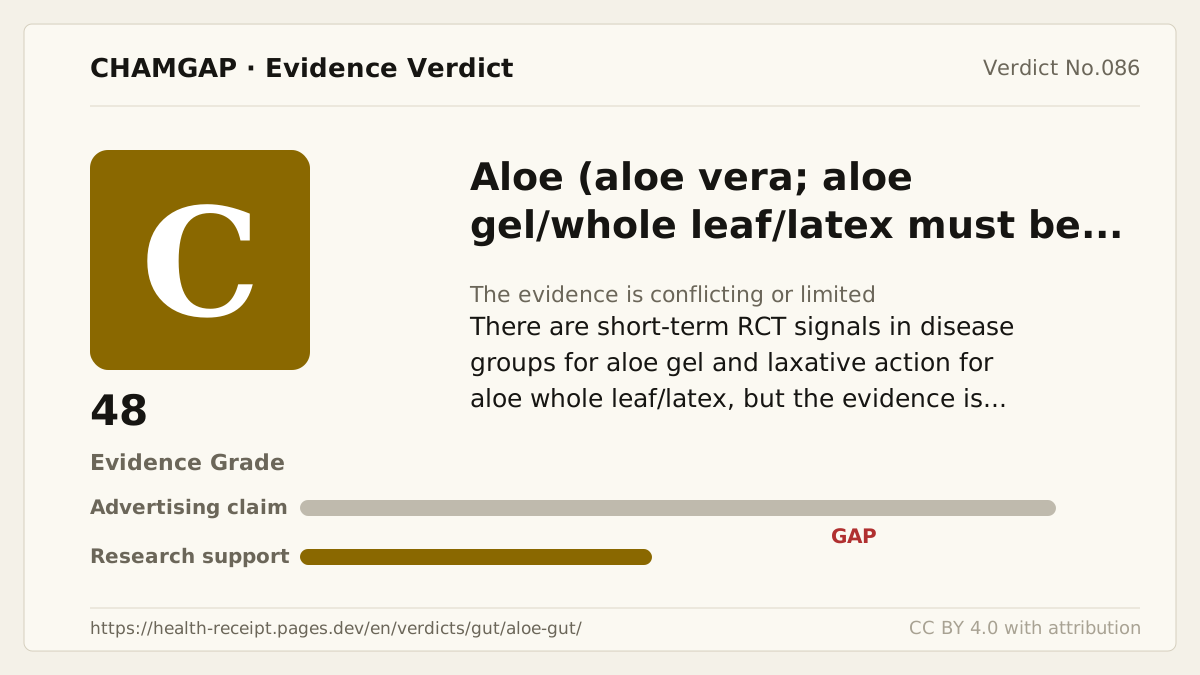
[Chamgap] Aloe × gut health, bowel movements, and skin health — Evidence Grade C·48. 10 cited sources checked. Source: https://chamgap.com/en/verdicts/gut/aloe-gut/ · CC BY 4.0CC BY 4.0 — free to use with attribution; do not distort grades, numbers, or verdict meaning.
What this document does and does not do
Chamgap is an information source. It reports what research has and has not confirmed; it does not tell readers what to take or buy. That decision belongs to readers and, when needed, medical or legal professionals. This verdict reflects literature available up to the search date and may change as new research appears. Nothing here is medical advice.