
Balloon flower root,
does it really help with bronchial health, cough, and phlegm?
research showsBalloon flower root and platycodin-series compounds have traditional use for phlegm, mucus, and airway inflammation and signals from cell and animal experiments. However, it is difficult to find independent RCTs confirming, with balloon flower root alone or standardized platycodin alone, whether people actually experience less cough, phlegm, or bronchial symptoms. Healthy-person immune-marker RCTs and complex herbal RCTs containing balloon flower root are reference materials only and do not prove the bronchial efficacy of balloon flower root alone.
ads claimIn the Korean market, foods, drinks, and herbal products such as pear-balloon-flower juice, balloon flower syrup, soaked balloon flower, fermented balloon flower, red balloon flower, and balloon-flower-pear ssanghwa products say 'bronchial health,' 'phlegm removal,' 'scratchy throat,' 'cough relief,' 'seasonal throat health,' 'enhanced platycodin D,' '8 times more saponin,' and 'relief of lung and bronchial inflammation' together. Some informational/advertising articles connect cell/animal studies or traditional use of balloon flower root to human cough/phlegm improvement, and 2026 articles showed wording such as '73% reduction in cough after balloon flower root intake,' but the product, design, control group, and original paper for the supporting trial could not be confirmed. Some products are also sold together with Chrysanthemum/Jeju Ecklonia cava extract complex, echinacea, pear, ginger, honey, licorice, and other ingredients, so human trials or MFDS-labeling possibilities for those complex ingredients do not become evidence for balloon flower root alone.
Useful facts when choosing a product
- The main compounds of interest in balloon flower root are oleanane-type triterpenoid saponins, and platycodin D, platycodin D3, deapi-platycodin, platycoside E, and others are mentioned together. Even when a product says 'platycodin,' actual standardized compounds and content can differ by product.
- MUC5AC inhibition in cell tests is a mechanistic signal related to mucus hypersecretion, but it is distant from clinical endpoints people feel, such as cough frequency, sputum expectoration, or bronchitis recovery.
- Balloon flower extract, fermented balloon flower, red balloon flower, and soaked balloon flower use different manufacturing methods and may have different saponin compositions. Cell/animal results from one manufacturing method are hard to transfer unchanged to another product.
- Pear-balloon-flower products often contain pear, balloon flower root, honey, ginger, licorice, ssanghwa ingredients, and more, making it difficult to separate effects of a specific ingredient.
- Advertising often mentions examples such as Ryukakusan medicines containing Platycodon root, but use experience with a drug combination prescription is separate from the efficacy grade for balloon flower root alone as a health food.
What the research actually shows
Direct human evidence is weak. A 2021 8-week double-blind RCT of red balloon flower root extract (RPGE) randomized 100 healthy people and 87 completed; NK cell activity and IFN-gamma were higher than placebo, but the primary endpoint was an immune surrogate marker, not cough, phlegm, or bronchial symptoms. Core positive respiratory evidence is mainly preclinical: inhibition of MUC5AC mucin expression/production in NCI-H292 human airway epithelial cells, changes in mucin secretion in SO2-induced bronchitis rats, and anti-inflammatory and cough-reflex-reducing effects of fermented balloon flower extract in LPS/OVA asthma mice and citric-acid cough guinea-pig models. As a human RCT, there is a Japanese Kampo complex prescription containing balloon flower root (kakkonto + shosaikotokakikyosekko) in COVID-19, but the primary endpoint of total symptom relief was not significant, and cough/sputum/shortness of breath were not significant in the main or adjusted analyses. A 2023 chronic-cough herbal-medicine meta-analysis summarized that Platycodon appeared in 41 of 80 RCT prescriptions, but because of prescription complexity, high risk of bias, and almost no placebo control, it cannot be converted into a balloon flower root-alone effect. Cochrane's herbal-medicine review for acute bronchitis reviewed 74 reports and 6,877 participants but concluded that no eligible true RCT could be found.
Why this is classified as C (42)
This is not a state of complete absence of human RCT literature, but no independent RCT or consistent meta-analysis directly testing the claim itself, namely that 'balloon flower root/platycodin improves human bronchial symptoms, cough, and phlegm,' was identified. Human studies are immune surrogate-marker studies in healthy people or complex prescriptions containing balloon flower root, and preclinical studies show mechanistic plausibility but cannot substitute for clinical effect. Applying boundary rule 1 (surrogate-marker-centered evidence capped at C) and the combined-claim separation rule, the judgment is at the lower end of C.
Counterpoint. Traditional use, mucus-regulating mechanisms, reduced cough reflex in animals, and improved immune-marker signals in healthy humans all create biological plausibility in the same direction. If sufficient independent RCTs using standardized balloon flower root/platycodin preparations and cough/phlegm as primary endpoints are produced, the grade could rise.
Rejudgment record. Draft and blinded review converged — There is no RCT showing that balloon flower root/platycodin alone reduces cough or phlegm in humans; evidence remains preclinical, surrogate-marker, or complex-prescription evidence.
Cross-check — Codex and Claude
Evidence Table
| Study | Design | Sample | Funding | Endpoint | Result | Weight |
|---|---|---|---|---|---|---|
| Lee HJ, Lee SY, Jeon BK, Lee JW, Kim YS, Lee MN, Lee CJ 2010 | preclinical | not reported | not specified | In human airway epithelial NCI-H292 cells, platycodin D inhibited EGF/PMA/TNF-alpha-induced MUC5AC mucin protein production and gene expression. | supportive | |
| Ryu J, Lee HJ, Park SH, Kim J, Lee D, Lee SK, Kim YS, Hong JH, Seok JH, Lee CJ 2014 | preclinical | not reported | bronchial | In SO2-induced bronchitis rats and NCI-H292 cell models, balloon flower water extract and platycodin D3/deapi-platycodin showed airway mucin regulation signals. | supportive | |
| Lee S, Han EH, Lim MK, Lee SH, Yu HJ, Lim YH, Kang S 2020 | preclinical | not reported | cough | Preclinical study reporting that fermented balloon flower extract reduced BALF inflammatory cells in LPS/OVA mice and cough counts in citric-acid guinea pigs. | supportive | |
| Park EJ, Jung AJ, Lee SH, Kang SK, Lee HJ 2021 | double-blind RCT | 87 | not reported | immune/respiratory/cough/phlegm | Healthy-person RCT with 100 randomized and 87 completed; RPGE increased NK cell activity and IFN-gamma, but these were not clinical endpoints for cough or phlegm. | core |
| Takayama S, Namiki T, Arita R et al. 2022 | RCT | not reported | not specified | In a COVID-19 RCT of a Kampo complex prescription containing balloon flower root, primary total symptom relief and cough/sputum improvement were not significant. | supportive | |
| Lee B, Kwon CY, Suh HW, Kim YJ, Kim KI, Lee BJ, Lee JH 2023 | meta-analysis of RCTs | 80 | not reported | gastrointestinal/cough | Meta-analysis of 80 chronic-cough herbal RCTs; Platycodon appeared in 41 prescriptions, but complexity of prescriptions, high risk of bias, and clinical heterogeneity were large. | supportive |
| Jiang L, Li K, Wu T 2022 | systematic review | 6877 | not reported | bronchial | Cochrane review of herbal medicine for acute bronchitis reviewed 74 reports and 6,877 participants but found no eligible true RCT. | supportive |
| Zhang L, Wang Y, Yang D, Zhang C, Zhang N, Li M, Liu Y 2015 | preclinical | not reported | not specified | Review summarizing traditional cough/phlegm use, pharmacology, and toxicity data for balloon flower root, and leaving the need for clinical trials. | supportive |
Receipt — 8 References
All 8 cited sources were verified for existence at the original page (as of 2026-07-07).
Reviewed and approved: Chamgap Editorial Team · Approval date: 2026-07-07 · Corrections: none
Cite this verdict
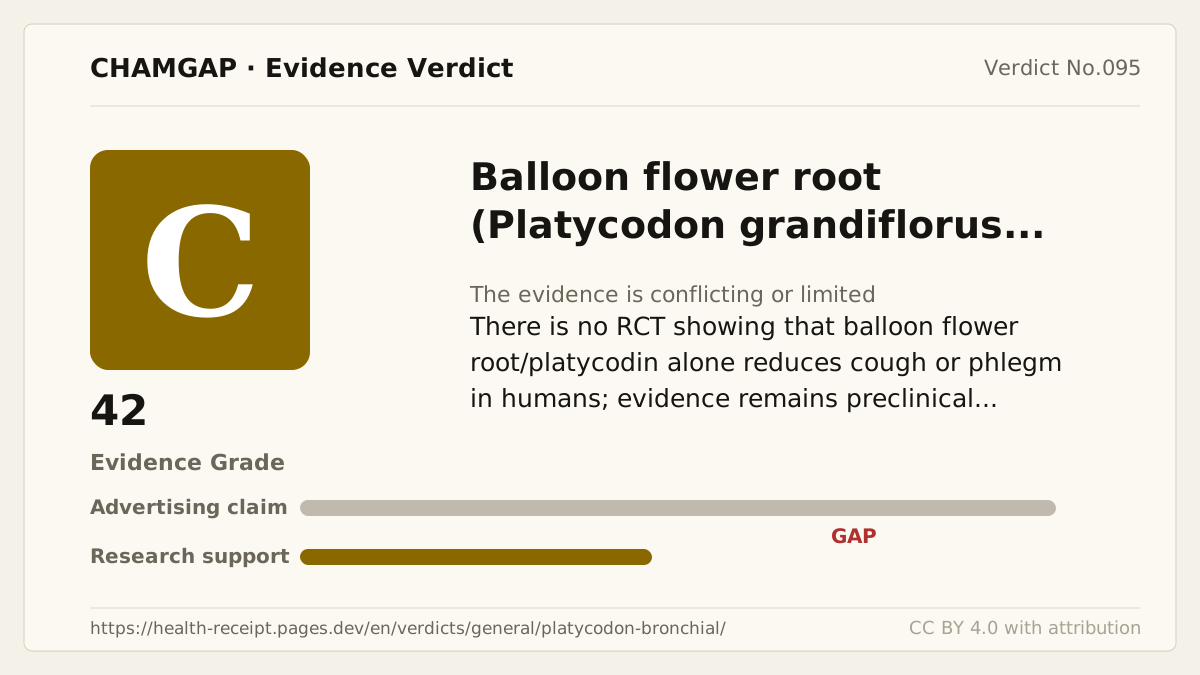
[Chamgap] Balloon flower root (Platycodon grandiflorus, platycodin/platycodin D-series saponins) × bronchial health, cough, and phlegm — Evidence Grade C·42. 8 cited sources checked. Source: https://chamgap.com/en/verdicts/general/platycodon-bronchial/ · CC BY 4.0CC BY 4.0 — free to use with attribution; do not distort grades, numbers, or verdict meaning.
What this document does and does not do
Chamgap is an information source. It reports what research has and has not confirmed; it does not tell readers what to take or buy. That decision belongs to readers and, when needed, medical or legal professionals. This verdict reflects literature available up to the search date and may change as new research appears. Nothing here is medical advice.