
Cranberry,
does it really help with Urinary tract and bladder health: inhibition of harmful bacterial adhesion in the urinary tract and reduced risk of recurrent urinary tract infection?
research showsCranberry/PAC products are not supported as “treating cystitis,” but there is preventive-support evidence that they reduce symptomatic, culture-confirmed UTI occurrence in some groups at risk of recurrent urinary tract infection. The 2023 Cochrane update showed reductions in women with recurrent UTI, children, and risk groups after bladder-related procedures, but benefits were not clear in elderly people in care facilities, pregnant women, or adults with bladder-emptying dysfunction.
ads claimIn the Korean market, expressions such as “may help urinary tract health by inhibiting adhesion of harmful bacteria in the urinary tract,” “bladder/urethra health,” “women’s urinary tract health,” “cystitis prevention,” “supplements/Pacran are more effective than cranberry juice,” and “reduced antibiotic use” are repeated. Food Safety Korea ingredient information lists functional wording for Cran-Max/CJ cranberry extract 500 mg/day, and online sales pages display the same functional phrase along with Pacran cranberry powder, total anthocyanosides 1.45 mg, zinc, and similar ingredients. Some advertorials use a strong treatment or replacement nuance, such as “a method that can replace antibiotics,” which goes beyond the current evidence.
Useful facts when choosing a product
- Food Safety Korea ingredient information: cranberry extract (Cran-Max) No. 2010-39 and CJ cranberry extract No. 2011-39 list the functional content as “may help urinary tract health by inhibiting adhesion of harmful bacteria in the urinary tract,” with daily intake 500 mg/day.
- Domestic product example: NutriOne/Onnuri Store pages display 2 capsules/day 1000 mg, total anthocyanosides 1.45 mg, zinc 2.55 mg, and “Pacran cranberry powder: may help urinary tract health by inhibiting adhesion of harmful bacteria in the urinary tract.”
- Domestic product names and detail names mix broad-looking expressions about target groups and effects, such as “bladder supplement,” “inhibition of harmful bacterial adhesion,” and “women, pregnant women, and men’s health.”
- PAC content is often not labeled by product, and “total anthocyanosides” is not the same marker as PAC mg.
- The effects of juice studies and those of 500 mg whole-fruit powder/extract capsule studies are difficult to treat as the same because formulation, sugar, fluid intake, and PAC analytical methods differ.
What the research actually shows
The largest body of evidence is the Cochrane 2023 prevention review. When 26 of 50 RCTs with 8,857 participants were meta-analyzed for symptomatic, culture-confirmed UTI, cranberry products had an overall RR of 0.70 (95% CI 0.58-0.84), and the women with recurrent UTI subgroup had RR 0.74 (0.55-0.99). A later 2024 PAC-dose meta-analysis suggested a significant reduction only at PAC >=36 mg/day (RR 0.82, 0.69-0.98), but this analysis also leaves issues of product-specific PAC measurement methods and study quality. A 2025 Pacran 500 mg/day RCT reduced the primary endpoint, culture-confirmed UTI, by 52% in 150 healthy women with recurrent UTI, but it had a sponsor. Conversely, Barbosa-Cesnik 2011 found that cranberry juice did not reduce 6-month recurrence in 319 female college students, and Juthani-Mehta 2016 found that 72 mg PAC capsules did not reduce the primary endpoint bacteriuria plus pyuria or symptomatic UTI in 185 elderly women in nursing facilities. A Cochrane review for treatment purpose found no treatment RCTs.
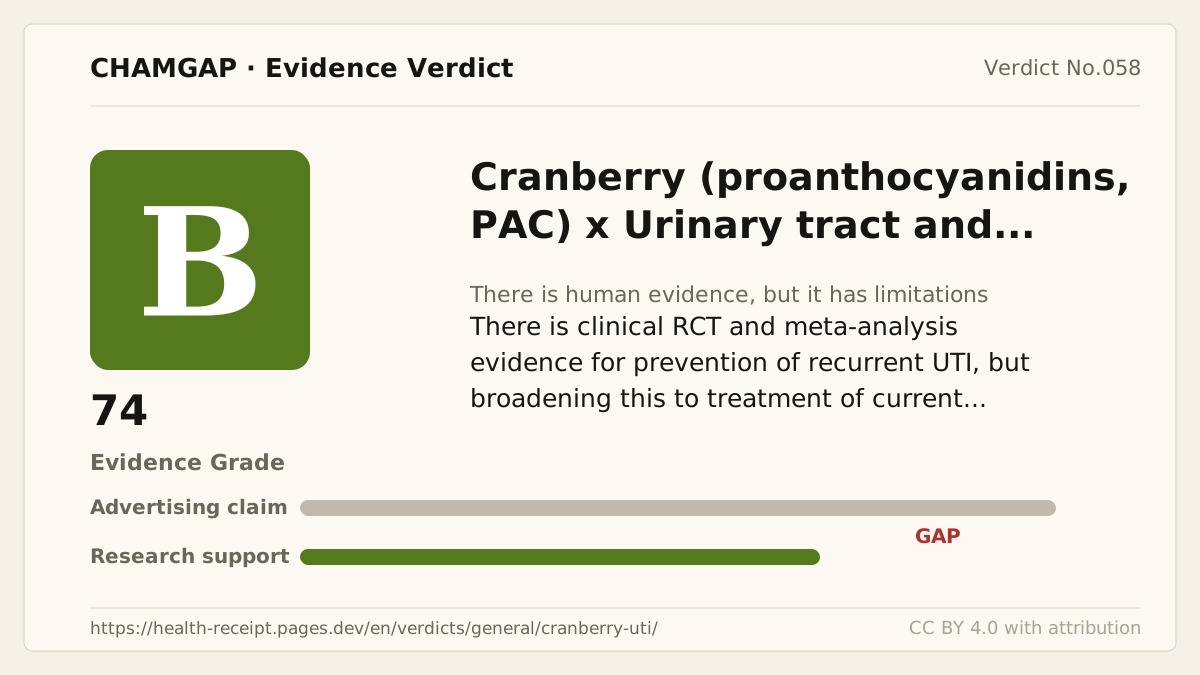
Why this is classified as B (74)
B (74 points). There are many human RCTs, and the 2023 Cochrane review and later meta-analyses confirmed reductions in clinical endpoints (symptomatic, culture-confirmed UTI), so there is no basis to lower it to C or below. However, effects are mainly limited to women with recurrent UTI, children, and post-procedure risk groups, and effects are unclear in elderly people in care facilities, pregnant women, and people with bladder-emptying dysfunction. Some large positive RCTs involved industry funding or product provision from Ocean Spray, Swisse/Givaudan, and others, and independent non-industry RCTs include null results, so it does not meet A-level “consistent multiple RCTs plus meta-analysis.”
Counterpoint. If the advertising phrase “urinary tract/bladder health” is broadened to “treatment of current cystitis,” “replacement for antibiotics,” “overall improvement in frequent urination/residual urine sensation,” or “applicable to all women, pregnant women, and older adults,” it is outside the evidence. Product standards such as PAC 36 mg/day or whole-fruit powder 500 mg/day are also difficult to treat as a fixed dose because analytical methods differ by study.
Rejudgment record. convergent — Draft = blind B. RCT and meta-analysis evidence for recurrent UTI prevention. Limited to prevention, not treatment of current cystitis.
Cross-check — Codex and Claude
Evidence Table
| Study | Design | Sample | Funding | Endpoint | Result | Weight |
|---|---|---|---|---|---|---|
| Williams G, Stothart CI, Hahn D, Stephens JH, Craig JC, Hodson EM 2023 | RCT | 8857 | not reported | not specified | 50 RCTs/8,857 participants; overall symptomatic, culture-confirmed UTI RR 0.70; women with recurrent UTI RR 0.74. | core |
| Cochrane 2023 | not specified | not reported | not specified | There are no treatment-purpose RCTs, so there is no evidence that cranberry treats current UTI. | core | |
| Maki KC, Kaspar KL, Khoo C, Derrig LH, Schild AL, Gupta K 2016 | not specified | 373 | possible manufacturer/industry involvement | liver | 373 women, 240 mL/day beverage for 24 weeks; clinician-diagnosed UTI 39 vs 67, IRR 0.61; no difference in time to culture positivity. | core |
| Barbosa-Cesnik C, Brown MB, Buxton M, Zhang L, DeBusscher J, Foxman B 2011 | not specified | 319 | possible manufacturer/industry involvement | not specified | 319 female college students, 27% cranberry juice 8 oz bid for 6 months; no reduction in recurrence rate. | core |
| Juthani-Mehta M, Van Ness PH, Bianco L et al. 2016 | not specified | 185 | possible manufacturer/industry involvement | not specified | 185 elderly women in nursing facilities, 72 mg PAC/day for 1 year; bacteriuria+pyuria 29.1% vs 29.0%, OR 1.01. | supporting |
| Stonehouse W, Benassi-Evans B, Bednarz J, Vincent AD 2025 | not specified | 150 | possible manufacturer/industry involvement | not specified | 150 women with recurrent UTI, Pacran 500 mg/day for 6 months; primary endpoint culture-confirmed UTI RR 0.48. | supporting |
| Vostalova J, Vidlar A, Simanek V et al. 2015 | not specified | 182 | possible manufacturer/industry involvement | not specified | 182 women with recurrent UTI, whole cranberry fruit powder 500 mg/day for 6 months; UTI 10.8% vs 25.8%. | supporting |
| Xiong Z, Gao Y, Yuan C, Jian Z, Wei X 2024 | meta-analysis/RCT | 2438 | mixed/partly industry-related | not specified | 10 RCTs/2,438 participants; PAC >=36 mg/day RR 0.82, 12-24 weeks intake RR 0.75. | supporting |
| Moro C, Phelps C, Veer V et al. 2024 | meta-analysis/RCT | 3091 | not reported | gut | 20 RCTs/3,091 participants; cranberry juice lowered UTI by 54% versus no treatment and 27% versus placebo liquid. | supporting |
| EFSA NDA Panel 2025 | not specified | not reported | not specified | For a Pacran-related health claim, concluded causality was insufficient, citing one positive study and one inconsistent study. | supporting | |
| FDA 2020 | not specified | not reported | not specified | FDA allowed qualified claims: cranberry juice evidence limited/inconsistent, supplement 500 mg/day supported by limited evidence wording. | supporting | |
| Study 12 | not specified | not reported | not specified | Domestic individually recognized wording: “may help urinary tract health by inhibiting adhesion of harmful bacteria in the urinary tract,” 500 mg/day. | supporting | |
| Study 13 | not specified | not reported | gut | Domestic product example: confirmed Pacran cranberry powder function information, daily intake, and total anthocyanoside labeling. | supporting | |
| Study 14 | not specified | not reported | gut | Advertorial promotion confirmed expressions such as “cranberry extract supplements are more effective than juice” and “promotes urine excretion.” | supporting | |
| Study 15 | not specified | not reported | gut | Market-quality reference showing that commercial supplements may lack PAC content and that the minimum 36 mg PAC discussion exists. | supporting |
Receipt — 15 References
Of 15 cited sources, 4 had limited original-page access (blocked or summary-only) and were verified via index/summary, marked partial; the rest were verified at the original page. As of 2026-07-07.
Reviewed and approved: Chamgap Editorial Team · Approval date: 2026-07-07 · Corrections: none
Cite this verdict
[Chamgap] Cranberry x urinary tract and bladder health: inhibition of harmful bacterial adhesion in the urinary tract and reduced risk of recurrent urinary tract infection — Evidence Grade B·74. 15 cited sources checked. Source: https://chamgap.com/en/verdicts/general/cranberry-uti/ · CC BY 4.0CC BY 4.0 — free to use with attribution; do not distort grades, numbers, or verdict meaning.
What this document does and does not do
Chamgap is an information source. It reports what research has and has not confirmed; it does not tell readers what to take or buy. That decision belongs to readers and, when needed, medical or legal professionals. This verdict reflects literature available up to the search date and may change as new research appears. Nothing here is medical advice.