
Low-molecular collagen “absorption rate”,
does it really help with claims of superior absorption rate and molecular weight?
research showsThe statement that “hydrolyzed collagen (peptides) is absorbed better than intact, uncut collagen or gelatin” is supported by human blood data. After collagen is ingested, small peptides such as Pro-Hyp actually appear in blood. However, the claim that “the smaller the molecular weight, the better the absorption/effect in a stepwise way” (e.g., 1000 Da is better than 3000 Da, 500 Da is better than 1000 Da) has limited human evidence. In a well-controlled crossover trial comparing low-molecular-weight (2000 Da) and high-molecular-weight (5000 Da) hydrolysates, absorption of the key active peptides Pro-Hyp and Hyp-Gly did not differ significantly, and only total hydroxyproline absorption was slightly higher with the low-molecular-weight product (about 1.2-fold). Numbers often appearing in advertising, such as “42-fold absorption,” are known to be values comparing gastric-acid solubility rather than direct absorption measurement, but the primary source was not confirmed; in a domestic survey, some products’ advertised molecular weight differed from measured molecular weight by up to 7.5-fold. In addition, no human trial was confirmed that connected absorption amount and effect size in the same participants to prove the causal chain “because it is small, absorption is good -> therefore skin effect is large.”
ads claimDomestic detail pages and health-functional-food advertisements foreground numbers such as “ultra-low molecular weight,” “molecular weight 500 Da or less,” “100 Da,” “42-fold absorption compared with ordinary collagen,” and “7.2-fold improvement in moisturization.” The framing is consistently the stepwise logic that “the smaller the molecular weight, the better the absorption, and because absorption is better, the effect is better.” However, (a) “42-fold” is known to compare gastric-acid solubility rather than absorption rate, but the primary source was not confirmed; (b) “7.2-fold moisturization” is the result of an efficacy trial comparing a low-molecular-weight group with placebo, not proof by direct comparison with a high-molecular-weight product that the result occurred “because it was low molecular weight”; and (c) in a 2021 Korea Consumer Federation survey (14 products), 7 of 11 other-processed-food products had advertised molecular weights that differed from measured values, by up to 7.5-fold. This survey shows the market reality that advertised molecular-weight labels and measured values can diverge.
Useful facts when choosing a product
- Examples of commercial appeal numbers: “molecular weight 500 Da or less,” “100 Da ultra-low molecular weight,” “42-fold absorption,” “7.2-fold moisturization improvement” (actual advertising-text types).
- Actual intake amounts in human efficacy RCTs are usually around 1~10 g/day (e.g., Kim 2018 used LMWCP 1000 mg/day for 12 weeks). Molecular-weight labeling itself does not guarantee dose or effect.
- The “42-fold absorption” number is known not as direct absorption measurement but as comparison of gastric-acid solubility (acid solubility), but the primary source for the raw data (manufacturer test report, paper, etc.) was not confirmed.
- Korea Consumer Federation 2021 survey: among 14 products, 7 of 11 other-processed-food products had advertised molecular weight differing from measured molecular weight by at least 1.1-fold to at most 7.5-fold (7 differed from advertising).
- Many collagen products are classified as ordinary foods rather than health functional foods; individually recognized functional ingredients (e.g., specific LMWCP) and ordinary-food collagen differ in regulatory and evidentiary status.
- Safety: good (few serious safety signals reported at general intake amounts. Allergies to ingredients such as fish/porcine skin and sodium/sugar content differ by product label).
What the research actually shows
The literature falls into three categories. (1) Absorption studies: when collagen is hydrolyzed, di-/tripeptides such as Pro-Hyp and Hyp-Gly are absorbed intact through the PEPT1 transporter and reach blood peak concentrations 1~2 hours after intake (Shigemura 2018). There is also human comparison showing that blood Hyp-related components are higher with low-molecular-weight hydrolysate than high-molecular-weight gelatin (about 100,000 Da) (Iwasaki 2022, reporting increases in free Hyp and other Hyp-containing components). Thus “intact collagen/gelatin < hydrolyzed peptides” is true. (2) However, the molecular-weight step effect within hydrolysates is weak: in a double-blind crossover trial comparing 2000 Da and 5000 Da hydrolysates, absorption profiles of the key active peptides Pro-Hyp and Hyp-Gly did not differ significantly, and only total Hyp absorption (iAUC) was significantly about 1.2-fold higher for the low-molecular-weight product (Virgilio 2024). The authors concluded that “molecular weight did not influence the bioavailability of the investigated peptides.” (3) Efficacy studies: 12-week RCTs of low-molecular-weight collagen peptide (LMWCP) report significant improvements in skin hydration, elasticity, and wrinkle indicators (Kim 2018, etc.), but these are all “low molecular weight vs placebo” designs, not “low molecular weight vs high molecular weight head-to-head.” No trial was confirmed that measured absorption amount and effect size in the same participants and connected them. Mechanistic evidence that Pro-Hyp promotes skin fibroblast proliferation is at the cell/mouse level (Shigemura 2018 cell experiment).
Why this is classified as C (46)
Grade C (score 46). The target of judgment is not “does it affect skin?” (that is addressed separately as B in 001), but the marketing claim itself that “because it is low molecular weight, absorption and effect are superior.” The minimal proposition that “hydrolyzed peptides are absorbed better than intact gelatin” is real in human blood data, and efficacy RCTs also exist, so this is not D/F where evidence is absent. However, the core advertising claims, “the smaller the molecular weight, the better” and “because it absorbs better, the effect is larger,” have not been proven in humans: there is no head-to-head efficacy RCT directly comparing collagens of different molecular weights in humans, and no human evidence connecting absorption amount and effect size within one study. Even in the trial comparing low- and high-molecular-weight hydrolysates, absorption of key active peptides did not differ, and only total Hyp had a small advantage. In summary, this is a compound claim mixing a true part (“absorption is real”) with an unproven/exaggerated part (“smaller is better, therefore effect is bigger”). It is not B because human superiority evidence is absent, not D because absorption is real, and within C it scores 46, the mid-lower C range, because key evidence for the superiority claim (head-to-head comparison, absorption<->efficacy connection) is empty.
Counterpoint. Supportive side: “It is confirmed in humans that peptides are absorbed intact, and comparison shows they absorb better than gelatin, so low molecular weight is superior.” -> Answer: The absorption advantage of “hydrolyzed peptides > high-molecular-weight gelatin” is accepted as data-supported. However, advertising claims more than that: the stepwise superiority that “the smaller, the better” and the causal claim “absorption -> effect.” The former is substantially weakened by a low- vs high-molecular-weight hydrolysate comparison showing no difference in key peptides (only a small total-Hyp advantage), and the latter lacks human trials linking absorption amount to effect size. Skeptical side: “Everything is digested into amino acids anyway, so absorption marketing has no evidence at all.” -> Answer: That also does not match the facts. Pro-Hyp and Hyp-Gly are repeatedly detected in blood as intact peptides, so the statement “everything breaks down into amino acids” is false. The issue is not whether absorption occurs, but whether the molecular-weight number guarantees superiority in absorption/effect; on that point, the human evidence is limited.
Cross-check — Codex and Claude
Evidence Table
| Study | Design | Sample | Funding | Endpoint | Result | Weight |
|---|---|---|---|---|---|---|
| Shigemura Y, Iwasaki Y, Tateno M et al. 2018 | preclinical study | mixed/partly industry-related | hydration, skin, liver, and gastrointestinal | Absorption study (+cell efficacy): after collagen hydrolysate intake, Pro-Hyp (linear/cyclic) was detected in human blood (peak about 2 hours; cyclic 0.14~0.34 nmol/mL). A separate cell experiment promoted proliferation of mouse skin fibroblasts. Absorption is human evidence; efficacy is separated at the cell level. | supporting | |
| Iwasaki Y, Nakatogawa M, Shimizu A, Sato Y, Shigemura Y 2022 | not specified | hydration, skin, and absorption | Absorption study: directly compared blood Hyp, Pro-Hyp, and Hyp-Gly in humans after high-molecular-weight gelatin versus low-molecular-weight gelatin hydrolysate; low molecularization by hydrolysis increased blood concentrations of Hyp-containing components. Human evidence for the minimal proposition “intact gelatin < hydrolyzed peptides.” Skin efficacy was not measured. | core | ||
| Virgilio N, Schön C, Mödinger Y et al. 2024 | double-blind randomized controlled trial | manufacturer/industry involvement possible | hydration, skin, gastrointestinal, and absorption | Absorption study (core evidence): in a double-blind crossover design comparing bovine hydrolysates of 2000 Da and 5000 Da, there was no significant difference in absorption profiles of key active peptides Pro-Hyp and Hyp-Gly, and only total Hyp iAUC was significantly about 1.2-fold higher with the low-molecular-weight product (p=0.0262). Authors concluded “no influence of molecular weight on bioavailability of the investigated peptides.” This weakens stepwise superiority claims, while showing a small low-molecular advantage for total Hyp. Skin efficacy was not measured. | core | |
| Kim DU, Chung HC, Choi J, Sakai Y, Lee BY 2018 | double-blind randomized controlled trial | 64 | mixed/partly industry-related | hydration, elasticity, wrinkles, and skin | Efficacy study (absorption not measured): LMWCP 1000 mg/day for 12 weeks, 64 participants, significantly improved skin hydration, elasticity, and wrinkles versus placebo. However, it was “low molecular weight vs placebo,” not “low vs high molecular weight” head-to-head, and did not measure blood absorption amount to connect it to effect; a typical absence of absorption<->efficacy linkage. | core |
| Study 5 | not specified | gastrointestinal and absorption | Market/labeling evidence: in a domestic survey of 14 products, 7 of 11 other-processed-food products had advertised molecular weights different from measured values, with differences from at least 1.1-fold to at most 7.5-fold (e.g., measured 2232 Da, 2465 Da, etc.). Evidence of the market reality that “advertised molecular-weight label = measured value” is not guaranteed. | supporting |
Receipt — 5 References
Of 5 cited sources, 1 had limited original-page access (blocked or summary-only) and were verified via index/summary, marked partial; the rest were verified at the original page. As of 2026-07-06.
Reviewed and approved: Chamgap Editorial Team · Approval date: 2026-07-06 · Corrections: none
Cite this verdict
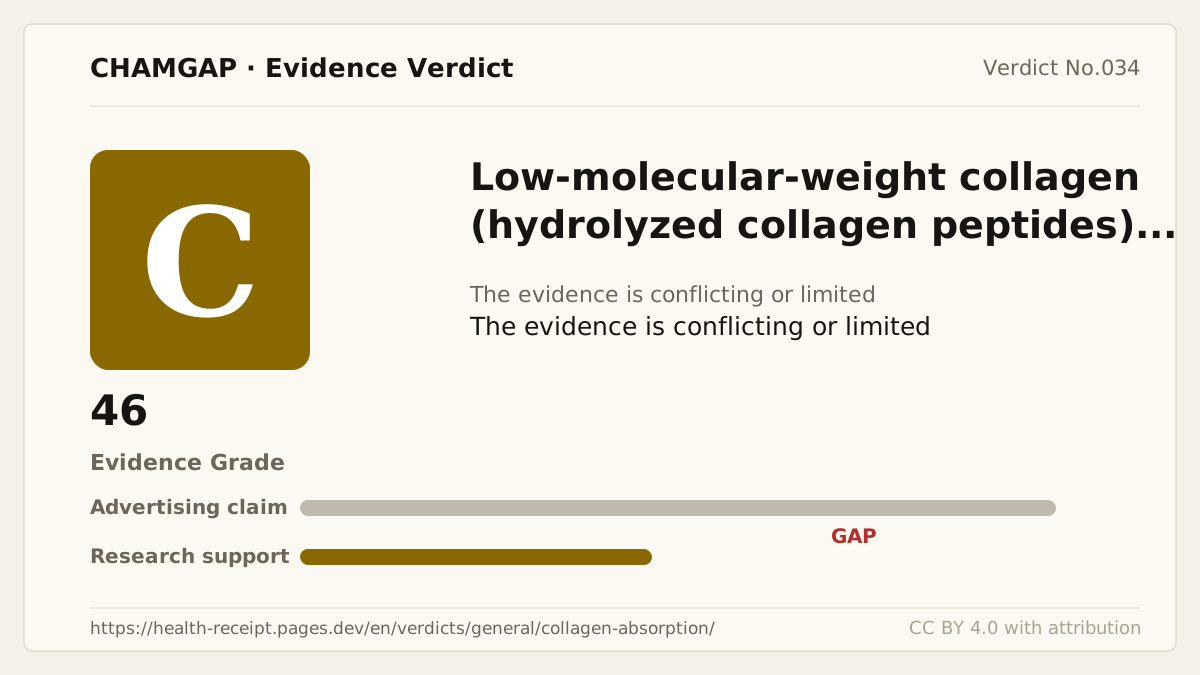
[Chamgap] Low-molecular collagen “absorption rate” x molecular-weight marketing — Evidence Grade C·46. 5 cited sources checked. Source: https://chamgap.com/en/verdicts/general/collagen-absorption/ · CC BY 4.0CC BY 4.0 — free to use with attribution; do not distort grades, numbers, or verdict meaning.
What this document does and does not do
Chamgap is an information source. It reports what research has and has not confirmed; it does not tell readers what to take or buy. That decision belongs to readers and, when needed, medical or legal professionals. This verdict reflects literature available up to the search date and may change as new research appears. Nothing here is medical advice.