
Multivitamin,
does it really help with General health, fatigue, and disease prevention?
research showsDeficiency repletion or specific life-stage/diet-restriction situations should be separated from broad claims of general health, fatigue relief, and disease prevention in healthy adults. Long-term RCTs and meta-analyses repeatedly do not show clear prevention of cardiovascular disease or mortality, and cancer incidence is slightly lower in some studies but is difficult to generalize to overall disease prevention. Fatigue/vitality has short RCT signals for high-dose B-vitamin/mineral products, but these are centered on subjective fatigue, mood, and cognitive tasks and include manufacturer sponsorship.
ads claimIn the Korean market, phrases that bundle many functions into one product are seen, such as 'one tablet a day,' '23 vitamins and minerals,' and 'all-in-one fatigue, energy, immunity, bone, and blood health.' Bayer Korea's Berocca materials use messages such as 11 vitamins and minerals, 7 high-dose B vitamins, 'double the passion, double the energy,' and 'energy vitamin.' Informational posts tend to connect nutrient-specific physiologic functions, such as B vitamins for energy metabolism, vitamins C/E for antioxidant/immunity, and vitamin D/calcium for bone health, to the context of general health and vitality. MFDS functional recognition and this evidence grade were considered separately.
Useful facts when choosing a product
- Multivitamin-mineral products differ greatly by composition. The definition of 'MVM' also differs across studies, making it difficult to generalize one product's result to all domestic products.
- Basic MVMs around recommended intakes are generally safe in healthy adults, but if combined with fortified foods or single-nutrient supplements, some nutrients such as vitamin A, niacin, iron, and zinc may approach upper intake levels.
- Smokers, former smokers, and people exposed to asbestos need caution with products containing beta-carotene or high-dose vitamin A.
- People using anticoagulants such as warfarin may have interaction potential with MVMs containing vitamin K.
- Pregnancy preparation/pregnancy, specific needs such as folic acid/iron/iodine, vitamin B12 after age 50, vegetarian diets, low-calorie diets, and malabsorption are separate issues of 'specific deficiency/need supplementation' and should be distinguished from broad disease-prevention claims in healthy adults.
What the research actually shows
Disease prevention: PHS II was a randomized double-blind trial that followed 14,641 male physicians for 11.2 years. Total cancer incidence was slightly lower, HR 0.92 (95% CI 0.86-0.998), but individual cancers such as prostate and colorectal cancer and cancer mortality were not significant. The cardiovascular primary endpoint in the same PHS II was major cardiovascular events, and HR was 1.01 (95% CI 0.91-1.10), nonsignificant. The 2022 USPSTF evidence review included 84 studies and 739,803 people; multivitamins had a small association with cancer incidence, OR 0.93 (95% CI 0.87-0.99), but cardiovascular disease and mortality prevention were summarized as little or no benefit. General health: nutrient-intake adequacy can increase, but direct evidence that this translates into improved clinical health status in healthy adults is weak. Fatigue/vitality: the Berocca high-dose B vitamins + vitamin C + minerals RCT (215 men, 33 days) reported improvements in stress, GHQ-12, POMS vigour, and mental tiredness, but it was Bayer-sponsored and centered on subjective scales and cognitive tasks, not primary clinical disease endpoints. Additional fatigue RCTs such as Haskell 2010 were found, but PubMed/PMC full-text access was blocked by reCAPTCHA during this gate check, so they were not included as core verdict evidence.
Why this is classified as C (43)
It was graded C. Human RCTs and meta-analyses exist, but the central broad claims of cardiovascular disease and mortality prevention are repeatedly negative, while cancer-incidence reduction is small and limited to some studies/populations. Fatigue/vitality has human RCT signals, but these are centered on subjective scales and laboratory tasks and include product/manufacturer-sponsored studies, so the boundary rule prevents a high grade. Large independent RCTs are not entirely null, so C is higher than D/F, but consistent clinical evidence supporting general health, fatigue, and disease prevention as one package is lacking.
Counterpoint. Evidence and purpose differ for people with restricted diets or specific nutrient deficits, for periconceptional folic acid/iron/iodine needs, and for B12 in older adults. Also, COSMOS cognitive substudy signals in older adults exist, but they do not directly support the core advertising claim of broad general health, fatigue, and disease prevention.
Rejudgment record. Draft=blinded convergent — Deficiency correction is a separate issue, and consistent clinical evidence does not support healthy adults' general health, fatigue, and disease-prevention claims as one bundle
Cross-check — Codex and Claude
Evidence Table
| Study | Design | Sample | Funding | Endpoint | Result | Weight |
|---|---|---|---|---|---|---|
| O'Connor EA et al. 2022 | 739,803 | Mixed; some industry-related involvement | USPSTF evidence review: 84 studies, 739,803 people; multivitamins slightly lowered cancer incidence with OR 0.93, but CVD and mortality prevention were little or none/uncertain. | Core | ||
| Gaziano JM et al. 2012 | RCT | 14,641 | Possible manufacturer/industry involvement | PHS II male physicians, 14,641 people, 11.2 years; total cancer incidence HR 0.92, but individual cancers and cancer death were not significant. | Core | |
| Sesso HD et al. 2012 | RCT | PHS II cardiovascular primary endpoint: major cardiovascular events HR 1.01, and MI, stroke, and CVD death were also not significant. | Core | |||
| Kennedy DO et al. 2010 | RCT | 215 | Possible manufacturer/industry involvement | stress | Berocca high-dose B vitamins + vitamin C + minerals 33-day RCT, 215 men: some improvements in subjective stress, vigour, and mental tiredness, Bayer-sponsored. | Core |
| NIH Office of Dietary Supplements 2024 | NIH ODS professional fact sheet summarizing MVM composition diversity, disease-prevention evidence, safety, and interaction information. | Supporting | ||||
| Bayer Korea 2019 | gut/gastrointestinal | Korean advertising/promotional context: confirmed messages such as 'energy vitamin,' high-dose B vitamins, and 'double the passion, double the energy.' | Supporting | |||
| Study 7 | immunity/gut/gastrointestinal | Korean sales page: confirmed claims of 'all-in-one fatigue, energy, immunity, bone, and blood health' and 23 vitamins/minerals. | Supporting |
Receipt — 7 References
Of 7 cited sources, 2 had limited original-page access (blocked or summary-only) and were verified via index/summary, marked partial; the rest were verified at the original page. As of 2026-07-07.
Reviewed and approved: Chamgap Editorial Team · Approval date: 2026-07-07 · Corrections: none
Cite this verdict
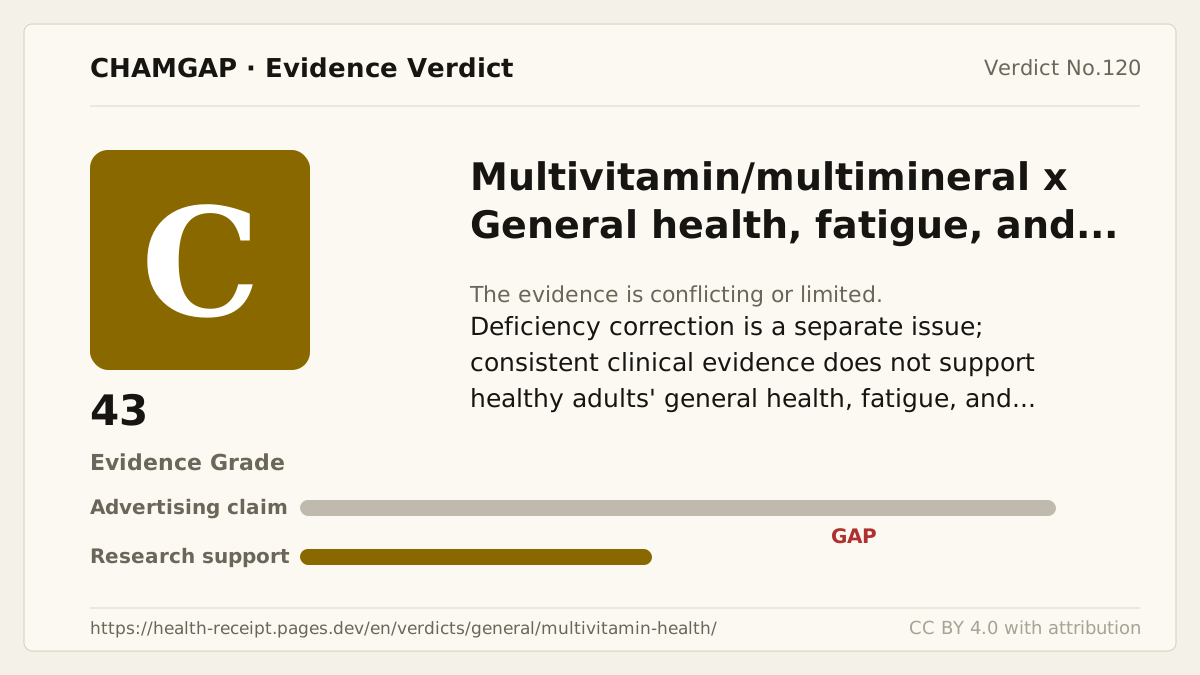
[Chamgap] Multivitamin x general health, fatigue, and disease prevention — Evidence Grade C·43. 7 cited sources checked. Source: https://chamgap.com/en/verdicts/general/multivitamin-health/ · CC BY 4.0CC BY 4.0 — free to use with attribution; do not distort grades, numbers, or verdict meaning.
What this document does and does not do
Chamgap is an information source. It reports what research has and has not confirmed; it does not tell readers what to take or buy. That decision belongs to readers and, when needed, medical or legal professionals. This verdict reflects literature available up to the search date and may change as new research appears. Nothing here is medical advice.