
Krill oil,
does it really help with superior absorption and blood markers versus omega-3?
research showsThe evidence for krill oil is small and varies by product, but it is not repeatedly null in humans. A meta-analysis of 7 RCTs with 662 participants found reductions in LDL-C and triglycerides, and an updated meta-analysis of 14 trials with 1,458 participants also reported favorable results for total cholesterol, LDL-C, and triglycerides. Grade C, representing limited and conflicting human evidence, is therefore fairer than grade D, which implies repeated human ineffectiveness. Some data suggest that phospholipid formulations may have higher bioavailability, but this does not prove that 'better absorption than omega-3' leads to clinical superiority.
ads claimAdvertising and promotion use multiplier/percentage claims as sales points, such as 'phospholipid-type krill oil has 8 times bioavailability and 2 times absorption versus triglyceride-type omega-3' (NatureBF/Superssen, Ilyo Seoul i), 'absorbs far better than fish oil' (Ople/Now Foods), 'about 50% higher absorption' (bodinfo), and 'krill 1000mg = ordinary omega-3 2,000-5,000mg.' These numbers (8x, 2x, 50%) are not supported by any confirmed study with matched doses and were not matched to original papers in this verification. Same-dose studies show no significant difference (p=0.052), and superiority-direction results concentrate in manufacturer-funded studies, not reproduced independently. Ads generally do not reveal that (a) the measured item was only a blood surrogate marker and not a clinical health effect, and (b) actual pure EPA+DHA content in krill products may be unstated or low. On regulation, confirmed domestic krill oil products are ordinary foods, and public reports say MFDS detected/blocked many unfair krill-oil ads (misleading as health functional foods, consumer deception, false/exaggerated claims, disease claims) and that some collected products failed tests; concrete counts are follow-up items. Ordinary-food expressions such as 'superior absorption/blood markers compared with omega-3' may confuse consumers with health functional food functionalities [D2].
Useful facts when choosing a product
- Within the confirmed scope, the advertised product group in Korea is ordinary food (fish oil/other processed food/other seafood processed food, etc.), not health functional foods with MFDS-recognized omega-3 functionality for blood triglyceride or blood-flow improvement.
- Superssen krill oil (NatureBF): promotional materials show phospholipid 58% and astaxanthin 420ppm. Pure EPA+DHA content is not stated in the promotional article, making it hard to verify the dose basis for absorption-multiplier claims.
- Now Foods krill oil 500mg/60 softgels (sold by Ople): emphasizes phospholipid-bound form, but separately stated pure EPA/DHA content was not confirmed and it is an ordinary food.
- In a manufacturer-recommended-dose comparison study (Laidlaw 2014), EPA+DHA in the recommended krill oil dose was about 240mg, about one-quarter of the fish oil product (about 1,100mg). Before 'absorption rate,' total intake may be low.
- Public reports say MFDS detected/blocked many unfair krill-oil ads and that some collected products were nonconforming; exact counts/ratios are outside this verification.
- All confirmed absorption-comparison studies were in healthy adult volunteers, and no clinical-benefit data in omega-3-deficient people or patients were confirmed.
What the research actually shows
The 2017 meta-analysis of 7 RCTs with 662 participants reported that krill oil lowered LDL-C by 15.52 mg/dL and triglycerides by 14.03 mg/dL and raised HDL-C by 6.65 mg/dL. The 2023 updated meta-analysis of 14 trials with 1,458 participants also reported improvements in total cholesterol, LDL-C, and triglycerides, while blood pressure, glycemic control, body composition, and inflammatory markers were null and cardiovascular events and mortality were not evaluated. Absorption-comparison trials were small and conflicting. Ramprasath 2013 reported a higher red-blood-cell omega-3 index with krill at the same dose, but had manufacturer funding and employee authors. In contrast, Yurko-Mauro 2015 found no significant difference between krill and fish oil when EPA+DHA doses were matched, and adding phospholipid to fish oil produced absorption similar to krill. Krill oil therefore has limited evidence for lipid-marker effects, but the evidence does not show that its phospholipid formulation is clinically superior to fish oil.
Why this is classified as C (44)
C. A meta-analysis of 7 RCTs with 662 participants and an updated meta-analysis both reported favorable effects on lipid markers including LDL-C and triglycerides, so this is not the repeated human ineffectiveness denoted by grade D. However, studies are small, product variation and conflicting findings are substantial, and clinical outcomes are unproven; the evidence therefore fits grade C. Some phospholipid-bioavailability data exist, but they do not establish clinical superiority over fish oil.
Counterpoint. Some evidence suggests that krill oil may be absorbed better than fish oil, but the studies are small, often industry-linked, and include dose-matched trials in which the difference disappears. Still, two meta-analyses were positive for lipid markers, so the overall human evidence should not be classified as repeatedly null. Grade C appropriately reflects product variation, conflicting findings, and the absence of clinical-outcome evidence.
Rejudgment record. Reassessment (calibration realignment) — Repeatedly positive lipid-marker meta-analyses make grade C more appropriate than D, while small studies, product variation, conflicting findings, and unproven clinical superiority limit the grade.
Cross-check — Codex and Claude
Evidence Table
| Study | Design | Sample | Funding | Endpoint | Result | Weight |
|---|---|---|---|---|---|---|
| Ursoniu S et al. 2017 | systematic review and meta-analysis | 662 | not reported | LDL-C, triglycerides, and HDL-C | Reported LDL-C -15.52 mg/dL, triglycerides -14.03 mg/dL, and HDL-C +6.65 mg/dL. Cardiovascular events were not evaluated. | key |
| Huang H et al. 2023 | updated systematic review and meta-analysis | 1,458 | not reported | cardiovascular risk factors | Total cholesterol, LDL-C, and triglycerides improved, while blood pressure, glycemic control, body composition, and inflammatory markers were null. Clinical-event and mortality studies remain needed. | key |
| Köhler A, Sarkkinen E, Tapola N et al. 2015 | randomized controlled trial | 15 | possible manufacturer or industry involvement | gastrointestinal / cognition / absorption | Single-dose crossover RCT in 15 healthy people: plasma phospholipid iAUC krill oil 89.08 > fish oil 59.15 (p=0.003) > phospholipid-type krill meal 44.97 (p<0.001). Krill meal, despite phospholipid-bound form, was lowest, countering the 'phospholipid means superior absorption' mechanism (oil form may matter more than binding form). Only surrogate markers, no clinical outcomes. Funding: krill manufacturer Olympic Seafood AS. | key |
| Yurko-Mauro K, Kralovec J, Bailey-Hall E et al. 2015 | double-blind randomized controlled trial | 66 | possible manufacturer or industry involvement | liver / gastrointestinal | 66 healthy people (22 per group), EPA+DHA 1.3g/day same-dose matched 4-week parallel RCT. At week 4 total plasma EPA+DHA fish oil EE 90.9 / fish oil TG 108 / krill 118.5 µg/mL, no significant between-group difference (p=0.052, difference under 24%): at same dose, krill and fish oil bioavailability equivalent. Funding: fish-oil manufacturer/seller DSM. | key |
| Ramprasath VR, Eyal I, Zchut S, Jones PJH 2013 | randomized controlled trial | 24 | possible manufacturer or industry involvement | 24 healthy people, crossover RCT with placebo, krill and fish oil both n-3 600mg/day for 4 weeks. Krill increased RBC omega-3 index significantly more than fish oil (p=0.0143), placebo p<0.0001. Clinical outcomes not measured. Later commentary criticized the fish oil as atypical because linoleic acid was high and n-6:n-3 >1. | key | |
| Schuchardt JP, Schneider I, Meyer H et al. 2011 | 12 | liver / gastrointestinal / cognition | 12 healthy men, single-dose crossover EPA+DHA 1,680mg. Plasma phospholipid AUC krill 80.03 > fish oil rTAG 59.78 > fish oil EE 47.53, but large SD meant EPA+DHA total and DHA were not significantly different between groups (EPA alone p=0.057 trend). Authors stated large long-term replication was needed. Surrogate markers only. | key | ||
| Laidlaw M, Cockerline CA, Rowe WJ 2014 | randomized controlled trial | 32 | possible manufacturer or industry involvement | gastrointestinal / absorption | 35 healthy people (32 analyzed), crossover RCT comparing 4 types at manufacturer recommended doses (dose mismatch): whole-blood omega-3 increase concentrated rTG fish oil > EE fish oil > TG salmon oil > PL krill oil (last). But EPA+DHA in krill recommended dose was 240mg, about one-quarter of fish oil rTG (EPA650+DHA450=1,100mg), so this is dose confounding rather than lower absorption. | supporting |
| Guarneiri LL, Wilcox ML, Maki KC 2023 | double-blind randomized controlled trial | 24 | possible manufacturer or industry involvement | liver / cognition / absorption | 24 healthy people, single acute crossover RCT: phospholipid-enriched fish oil (EPA+DHA 337mg/capsule) vs krill (206mg); 24-hour cumulative EPA+DHA absorption was similar with no clear total-absorption superiority, while phospholipid-enriched fish oil had Cmax 25% higher and faster time to peak (p<0.05). Adding phospholipid to fish oil reproduced krill-level results, suggesting phospholipid rather than krill-specific effect. | supporting |
| Ulven SM, Holven KB 2015 | systematic review and preclinical evidence | possible manufacturer or industry involvement | liver / absorption | Systematic review (PubMed search to 2015.1, total 14 papers): two same-dose human trials made krill absorption look higher, but some studies suggested structural form may not matter; actual health effects on lipid/inflammatory markers were 'limited,' cardiovascular clinical endpoints not assessed, and dose/duration inconsistency made interpretation difficult. Authors concluded human evidence was insufficient to establish krill superiority. | supporting |
Receipt — 9 References
All 9 cited sources were verified for existence at the original page (as of 2026-07-06).
Reviewed and approved: Chamgap Editorial Team · Approval date: 2026-07-06 · Corrections: 1
Correction log — 1
Corrections applied to this verdict, in chronological order. Changes are logged, not erased.
- 2026-07-11 · Calibration realignment (grade changed) — Krill oil showed LDL-C and triglyceride reductions in a 7-RCT, 662-person meta-analysis with positive follow-up meta-analyses, so a limited/conflicting C fits better than D (which implies repeated human null). 2026-07-11 calibration realignment. (grade D→C)
Cite this verdict
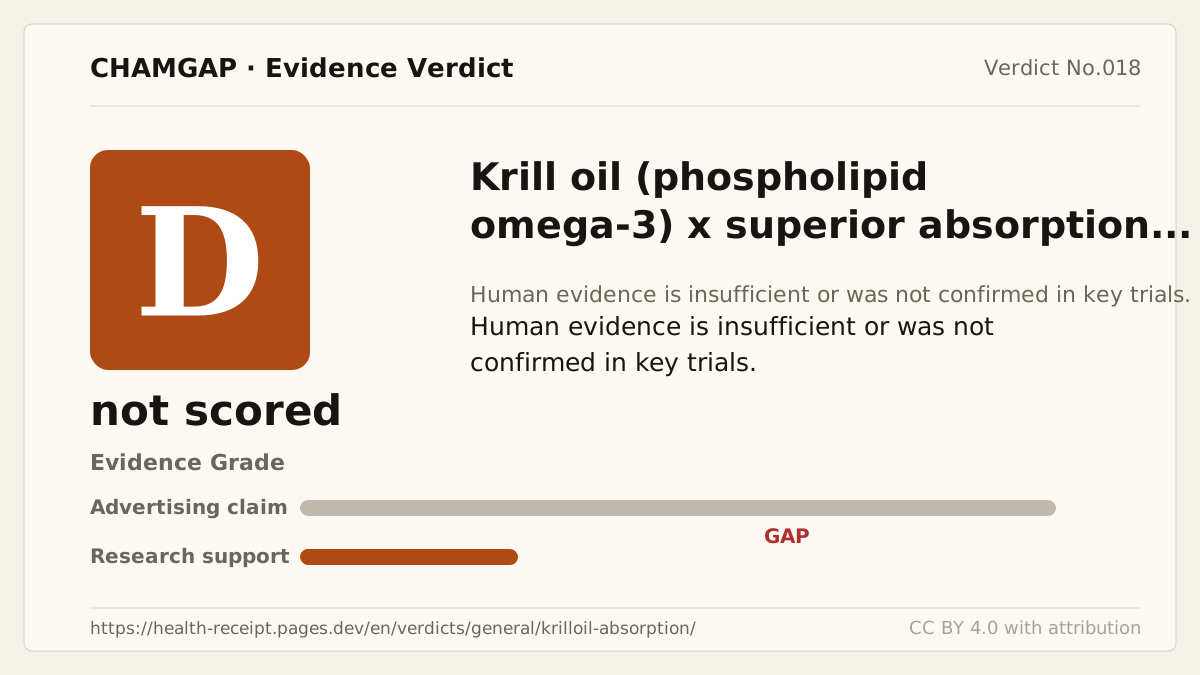
[Chamgap] Krill oil x 'better absorbed than omega-3' claim — Evidence Grade C·44. 9 cited sources checked. Source: https://chamgap.com/en/verdicts/general/krilloil-absorption/ · CC BY 4.0CC BY 4.0 — free to use with attribution; do not distort grades, numbers, or verdict meaning.
What this document does and does not do
Chamgap is an information source. It reports what research has and has not confirmed; it does not tell readers what to take or buy. That decision belongs to readers and, when needed, medical or legal professionals. This verdict reflects literature available up to the search date and may change as new research appears. Nothing here is medical advice.