
PeakATP,
does it really help with Improved strength and exercise performance?
research showsA meta-analysis of five RCTs and 121 participants found a positive maximal-strength effect of 8.13 kg, but repetitions and maximum anaerobic power were null. Individual trials were small, with conflicting endpoints, resulting in C with 55 points.
ads claimMarketing describes oral ATP as directly recharging muscle ATP and broadly improving strength, power, and recovery. Human data concern one 400 mg formulation and small resistance or sprint protocols, and a continuous maximal-effort test was null.
Useful facts when choosing a product
- Most exercise trials used PeakATP 400 mg/day.
- The 12-week training trial analyzed 11 ATP and 10 placebo participants.
- Positive and null key trials were linked to TSI funding or product support.
- Short-term trials reported no clinically meaningful blood-test abnormalities.
What the research actually shows
The 2024 González-Marenco meta-analysis of five RCTs and 121 men found an 8.13 kg maximal-strength benefit, but no effect on repetitions or maximum anaerobic power. The 21-person Wilson 2013 RCT reported greater total-strength gains, and the 42-person Purpura 2017 RCT reported late-bout repeated-Wingate signals. The 20-person Dufner 2023 crossover trial was null across three-minute all-out performance variables. The 18-person Fambrini 2024 crossover trial, supported by a CAPES public scholarship, did not improve maximal strength and reported only reduced fatigue later in exercise.
Why this is classified as C (55)
The maximal-strength signal across five RCTs and 121 participants is recognized, but repetitions, maximum power, the three-minute all-out trial, and maximal strength in the public-scholarship-supported 18-person trial were null. Small samples and endpoint conflict support C with 55 points.
Counterpoint. With the specific 400 mg formulation and repeated resistance exercise, total work or late-bout power decline may improve.
Rejudgment record. Reassessment (cross-check reflected) — A five-RCT, 121-person meta-analysis found a maximal-strength benefit of 8.13 kg but null repetitions and maximum power; a CAPES-supported 18-person trial also found null maximal strength and only less late-exercise fatigue, so small samples and endpoint conflict are central
Sub-claim grades by effect
This ingredient is marketed for several effects. A single overall grade blends strong and weak claims together, so each effect is graded separately here. The overall grade reflects the strongest disconfirming or core claim.
| Effect (sub-claim) | Grade | Basis |
|---|---|---|
| Strength and resistance-training adaptation | C | A five-RCT, 121-person meta-analysis found an 8.13 kg maximal-strength benefit, but individual trials were small |
| Exercise performance and power | C | A positive late-bout repeated-sprint signal coexists with a null three-minute all-out trial |
Cross-check — Codex and Claude
Evidence Table
| Study | Design | Sample | Funding | Endpoint | Result | Weight |
|---|---|---|---|---|---|---|
| González-Marenco R et al. 2024 | Systematic review and meta-analysis | 121 | Public and academic research teams | Maximal strength, maximum repetitions, and maximum anaerobic power | Maximal strength was positive by 8.13 kg, while repetitions and maximum anaerobic power were null. | Key synthesis |
| Wilson JM et al. 2013 | Randomized double-blind placebo- and diet-controlled 12-week trial | 21 | Products supplied by TSI USA; some authors had ingredient-industry links | Total strength, vertical-jump power, muscle thickness, and recovery | Total strength, jump power, and muscle-thickness gains were greater with 400 mg/day than placebo. | Key |
| Purpura M et al. 2017 | Randomized double-blind placebo-controlled trial | 42 | Funded by TSI USA | Repeated-Wingate power, muscle activation, and ATP metabolites | Late-bout declines in power and muscle excitability were attenuated versus placebo. | Supportive |
| Freitas MC et al. 2019 | Randomized double-blind crossover trial | 11 | PeakATP product used; funding unclear | Squat repetitions, total weight lifted, and oxygen consumption | A single 400 mg dose increased total weight lifted over four sets versus placebo. | Supportive |
| Dufner TJ et al. 2023 | Double-blind counterbalanced crossover trial | 20 | Funded by TSI Group | Peak power, end power, and fatigue index during a three-minute all-out test | Two weeks of 400 mg/day produced no between-treatment difference in any three-minute all-out performance variable. | Key |
| Fambrini DL et al. 2024 | Randomized double-blind placebo-controlled crossover trial | 18 | CAPES public scholarship | Isokinetic strength and fatigue resistance | A single 400 mg dose did not improve maximal strength and only attenuated strength decline later in exercise. | Direct, small, publicly supported |
Receipt — 6 References
All 6 cited sources were verified for existence at the original page (as of 2026-07-11).
Reviewed and approved: Chamgap Editorial Team · Approval date: 2026-07-11 · Corrections: none
Cite this verdict
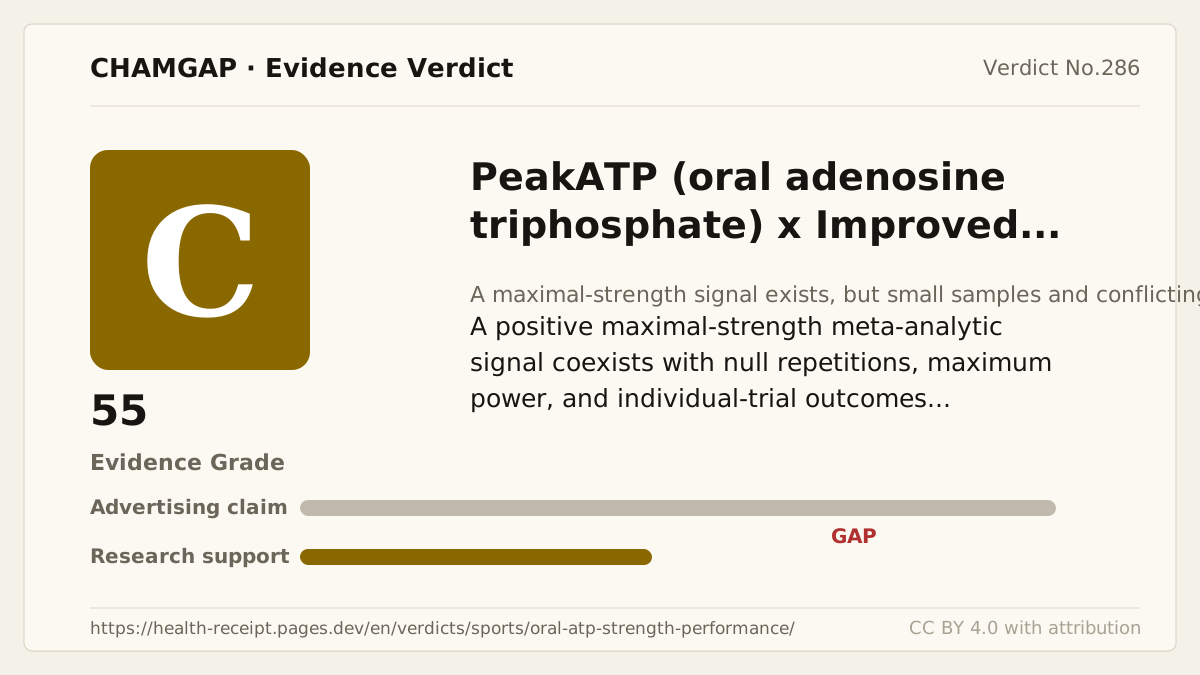
[Chamgap] PeakATP (oral adenosine triphosphate) x Improved strength and exercise performance — Evidence Grade C·55. 6 cited sources checked. Source: https://chamgap.com/en/verdicts/sports/oral-atp-strength-performance/ · CC BY 4.0CC BY 4.0 — free to use with attribution; do not distort grades, numbers, or verdict meaning.
What this document does and does not do
Chamgap is an information source. It reports what research has and has not confirmed; it does not tell readers what to take or buy. That decision belongs to readers and, when needed, medical or legal professionals. This verdict reflects literature available up to the search date and may change as new research appears. Nothing here is medical advice.