
Betaine,
does it really help with Exercise performance and homocysteine?
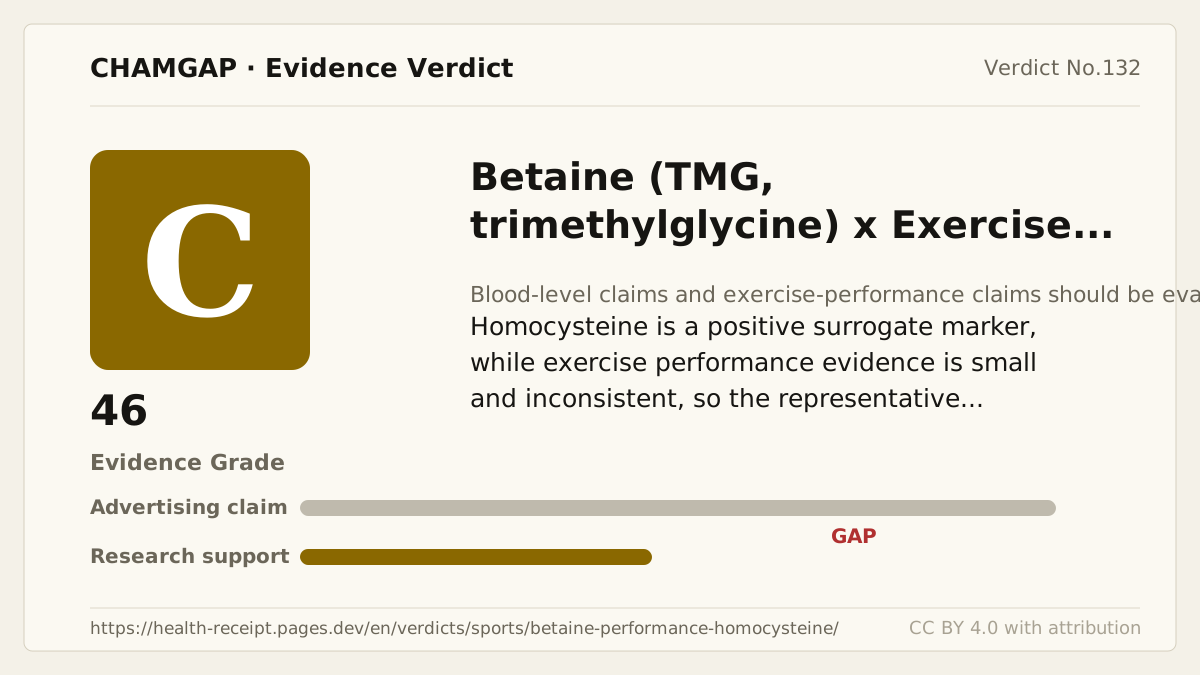
research showsThe evidence that betaine lowers blood homocysteine is relatively clear, but this is a surrogate marker, not a reduction in cardiovascular events. For exercise performance, small RCTs show some signals for strength, repetitions, and body composition, but results are mixed; when the two claims are combined, the grade is C.
ads claimKorean products combine phrases such as 'TMG,' 'methylation,' 'homocysteine care,' 'liver and exercise performance,' and 'power output.' The actual evidence is divided between blood surrogate markers and small exercise trials, making it difficult to combine them into one confirmed efficacy claim as product copy often does.
Useful facts when choosing a product
- Sports studies usually used around 2.5 g/day.
- Homocysteine reduction is a blood surrogate marker and does not directly prove reductions in myocardial infarction or stroke.
- High-dose betaine has been reported to raise LDL cholesterol, so people with lipid abnormalities need caution in interpretation.
- Stomach-acid and digestion claims for betaine HCl products are separate from the evidence for TMG.
What the research actually shows
For exercise performance, many studies use 1.25 g twice/day for 2-6 weeks. Lee 2010 reported improvements in some power and repetition measures after short-term intake, but the sample was small. Cholewa 2013 reported body-composition and training-volume signals in resistance-trained men, but it was small. Negative or limited results, including Del Favero 2012, also exist, so consistency is low. For homocysteine, randomized studies such as Olthof 2005 show that betaine lowers levels, but an increase in LDL cholesterol was also reported. EFSA recognizes a claim for contribution to normal homocysteine metabolism, with a condition of 1.5 g/day and wording about cholesterol increases when intake exceeds 4 g/day.
Why this is classified as C (46)
Human RCTs exist, so this is not D, but among the representative claims, homocysteine is a surrogate marker and exercise performance evidence is small and inconsistent. Applying the surrogate-marker maximum of C and the composite-claim separation rule, it is judged C, 46 points.
Counterpoint. There may be strength or repetition signals under specific training conditions, but large independent RCTs are lacking to confirm a perceptible exercise-performance improvement in healthy adults.
Rejudgment record. Draft — No upgrading based on surrogate markers alone; exercise-performance RCTs are inconsistent.
Cross-check — Codex and Claude
Evidence Table
| Study | Design | Sample | Funding | Endpoint | Result | Weight |
|---|---|---|---|---|---|---|
| Lee EC et al. 2010 | Randomized placebo-controlled trial | Unknown/supplement context | Strength and power | Reported signals for improvement in some repetition and power measures. | Supporting | |
| Cholewa JM et al. 2013 | Randomized placebo-controlled trial | Possibly supplement related | Body composition, strength, and exercise volume | Reported signals in body composition and some performance measures, but the sample was small. | Supporting | |
| Del Favero S et al. 2012 | Randomized placebo-controlled trial | Unknown | Strength and power | Betaine did not consistently improve major strength and power measures. | Core counterexample | |
| Olthof MR et al. 2005 | 4 randomized placebo-controlled trials | Public/unknown | Homocysteine and blood lipids | Betaine lowered homocysteine, but an increase in LDL cholesterol was also reported. | Core |
Receipt — 5 References
All 5 cited sources were verified for existence at the original page (as of 2026-07-09).
Reviewed and approved: Chamgap Editorial Team · Approval date: 2026-07-09 · Corrections: none
Cite this verdict
[Chamgap] Betaine (TMG) x exercise performance and homocysteine — Evidence Grade C·46. 5 cited sources checked. Source: https://chamgap.com/en/verdicts/sports/betaine-performance-homocysteine/ · CC BY 4.0CC BY 4.0 — free to use with attribution; do not distort grades, numbers, or verdict meaning.
What this document does and does not do
Chamgap is an information source. It reports what research has and has not confirmed; it does not tell readers what to take or buy. That decision belongs to readers and, when needed, medical or legal professionals. This verdict reflects literature available up to the search date and may change as new research appears. Nothing here is medical advice.