
Agmatine sulfate,
does it really help with Improved workout pump, blood flow, and endurance?
research showsA standalone human exercise trial of agmatine sulfate exists. Physically active college-age men received 1 g or a 1 g cornstarch placebo in randomized counterbalanced crossover conditions before repeated Wingate tests. Mean power (p=.44), peak power (p=.93), anaerobic capacity (p=.42), fatigue index (p=.77), lactate (p=.40), and perceived exertion (p=.24) were all null. Direct human evidence therefore supports D with 25 points rather than an unknown grade. Because this was a single acute conference abstract with incomplete sample reporting, it does not amount to replicated refutation warranting F.
ads claimAdvertising presents possible nitric-oxide modulation and subjective pump as increased blood flow, longer pump, and better endurance. Mechanistic plausibility is not an exercise-performance, ultrasound blood-flow, or training-adaptation outcome.
Useful facts when choosing a product
- In Korea, agmatine is mainly available through cross-border powder or capsules and in pre-workout combinations; a standalone powder label recommends about 1 g per serving.
- Combination pre-workouts containing caffeine, citrulline, or beta-alanine cannot isolate an agmatine effect.
- The 2.67 g/day used in the radiculopathy trial is not an exercise-efficacy dose, and diarrhea and nausea occurred during higher-dose escalation.
- Interactions with blood-pressure drugs, glucose-lowering drugs, nitrates, erectile-dysfunction medication, and neurologic drugs, and long-term exercise-use safety, remain insufficiently studied.
What the research actually shows
The 2022 direct exercise study by Helton and colleagues gave physically active college-age men 1 g of agmatine sulfate or a 1 g cornstarch placebo in randomized counterbalanced crossover conditions, separated by a 72-hour washout, before three 15-second Wingate tests. Mean power (p=.44), peak power (p=.93), anaerobic capacity (p=.42), anaerobic power (p=.97), fatigue index (p=.77), heart rate (p=.31), lactate (p=.40), and perceived exertion (p=.24) were all nonsignificant. Acute anaerobic performance and fatigue claims are therefore directly negative. However, this was one acute study available only as a conference abstract, and the displayed abstract did not report sample size, so it does not repeatedly refute long-term endurance or exercise muscle blood flow. The Keynan 2.67 g/day trial concerned pain, not exercise efficacy.
Why this is classified as D (25)
A randomized counterbalanced crossover human trial directly tested standalone agmatine sulfate at 1 g and found every reported repeated-Wingate, fatigue, lactate, and perceived-exertion outcome null, so the grade is D rather than unknown. A single acute conference abstract with incomplete sample reporting does not constitute replicated refutation, limiting the verdict to 25 points within D rather than F. Interaction safety is separately rated caution.
Counterpoint. Mechanistic and human-exposure data from another indication support testability. An adequately powered independent RCT should prospectively specify ultrasound blood flow, training volume, time trial, and repeated-performance outcomes.
Rejudgment record. Reassessment (cross-check reflected) — A randomized counterbalanced crossover human trial of 1 g versus cornstarch placebo was null across repeated Wingate outcomes; its single acute conference-abstract format and incomplete sample reporting support D rather than F
Cross-check — Codex and Claude
Evidence Table
| Study | Design | Sample | Funding | Endpoint | Result | Weight |
|---|---|---|---|---|---|---|
| Kerksick et al. 2018 ISSN review | Sports-nutrition research and recommendations review | ISSN; authors disclosed diverse industry relationships | Human evidence for exercise blood flow, strength, body composition, and muscular performance | Stated that relevant human trials were absent and no scientific evidence supported lean-mass or muscular-performance benefits. | Key | |
| Keynan et al. 2010 | Dose escalation followed by a randomized double-blind placebo-controlled pain trial | 61 | Unknown | Radiculopathy pain, disability, quality of life, and safety | Pain signals at 2.67 g/day; workout pump, blood flow, and endurance were not evaluated. | Indirect |
| Helton et al. 2022 conference abstract | Randomized counterbalanced single-dose crossover conference abstract | Unknown | Three 15-second Wingate tests, fatigue, heart rate, lactate, and perceived exertion | All outcomes were null: mean power p=.44, peak power .93, anaerobic capacity .42, anaerobic power .97, fatigue index .77, heart rate .31, lactate .40, and perceived exertion .24. | Direct and null |
Receipt — 3 References
All 3 cited sources were verified for existence at the original page (as of 2026-07-17).
Reviewed and approved: Chamgap Editorial Team · Approval date: 2026-07-17 · Corrections: none
Cite this verdict
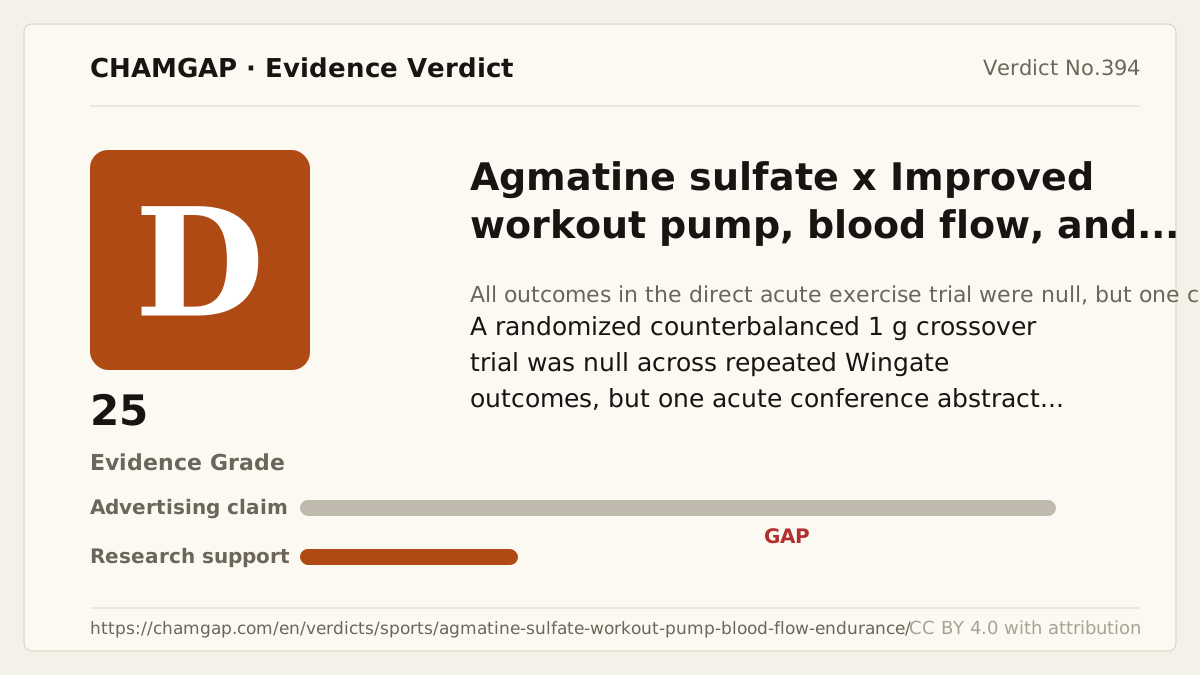
[Chamgap] Agmatine sulfate x workout pump, blood flow, and endurance — Evidence Grade D·25. 3 cited sources checked. Source: https://chamgap.com/en/verdicts/sports/agmatine-sulfate-workout-pump-blood-flow-endurance/ · CC BY 4.0CC BY 4.0 — free to use with attribution; do not distort grades, numbers, or verdict meaning.
What this document does and does not do
Chamgap is an information source. It reports what research has and has not confirmed; it does not tell readers what to take or buy. That decision belongs to readers and, when needed, medical or legal professionals. This verdict reflects literature available up to the search date and may change as new research appears. Nothing here is medical advice.