
Amla,
does it really help with Improvement in female pattern hair loss and hair growth?
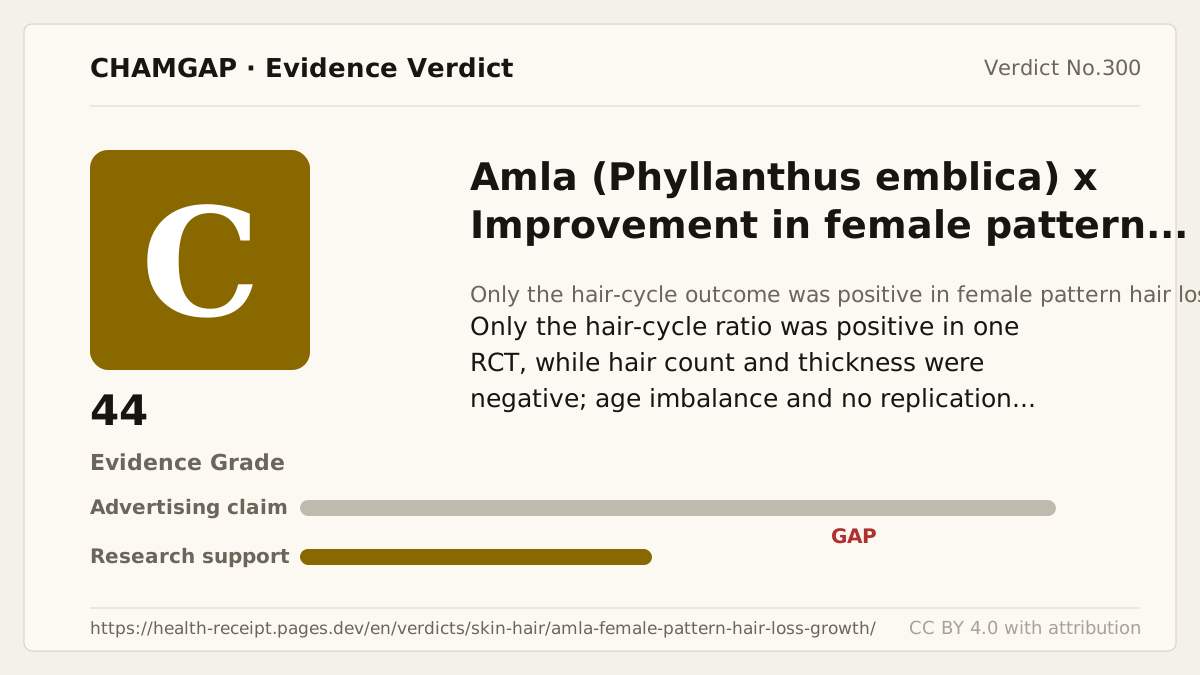
research showsIn a single RCT with 60 randomized and 52 completing, only the anagen-to-telogen ratio was positive at p=0.002. Direct hair count (p=0.382) and thickness (p=0.244) were negative, and baseline age was imbalanced at 33.1 years in the amla group versus 41.8 years with placebo, making the result dependent on adjustment. The amla, honey, and rosewater syrup used honey- and rosewater-matched placebo, allowing attribution to amla, but no independent replication exists. Female pattern hair loss is low C with 44 points.
ads claimAdvertisements use phrases such as 'strengthens roots,' 'prevents hair loss,' 'hair growth,' and 'DHT management.' Direct human data consist of one 12-week trial of a specific syrup in female androgenetic alopecia.
Useful facts when choosing a product
- The trial used 10 mL of amla syrup three times daily, totaling 30 mL/day.
- The anagen-to-telogen ratio was positive, but direct hair count and thickness were negative.
- The syrup contained amla, honey, and rosewater; placebo matched honey and rosewater.
- One mild constipation case and no notable adverse effects were reported over 12 weeks.
What the research actually shows
Akhbari 2024 assigned 60 women with female androgenetic alopecia to amla, honey, and rosewater syrup or a honey- and rosewater-matched placebo, and 52 completed. After 12 weeks, the anagen-to-telogen ratio was positive at p=0.002, but direct hair count was negative at p=0.382 and thickness at p=0.244. Baseline age differed at 33.1 years in the amla group versus 41.8 years with placebo, requiring adjusted analysis, and there is no independent replication.
Why this is classified as C (44)
The positive anagen-to-telogen ratio supports C for the hair-cycle subclaim in female pattern hair loss, while negative direct hair count and thickness support D for general growth. Fifty-two completers, baseline age imbalance requiring adjustment, one specific syrup, and no independent replication yield low C with 44 points. Other alopecia types and general hair growth lack evidence.
Counterpoint. A hair-cycle signal remains for a specific oral amla syrup in female pattern hair loss. Honey and rosewater matching permits attribution to amla, but the finding does not extend to direct count or thickness, other alopecia types, formulations, or long-term outcomes.
Rejudgment record. Reassessment (cross-check reflected) — In one RCT with 60 randomized and 52 completing, only the anagen-to-telogen ratio was positive, while count and thickness were negative; baseline age imbalance required adjustment and independent replication is absent
Sub-claim grades by effect
This ingredient is marketed for several effects. A single overall grade blends strong and weak claims together, so each effect is graded separately here. The overall grade reflects the strongest disconfirming or core claim.
| Effect (sub-claim) | Grade | Basis |
|---|---|---|
| Female pattern hair loss (hair cycle) | C | A single RCT found a positive anagen-to-telogen ratio at p=0.002 |
| General hair count and thickness | D | Negative in the single RCT |
Cross-check — Codex and Claude
Evidence Table
| Study | Design | Sample | Funding | Endpoint | Result | Weight |
|---|---|---|---|---|---|---|
| Akhbari M et al. 2024 | Triple-blind randomized placebo-controlled RCT | 52 | Unknown | TrichoScan anagen-to-telogen ratio, hair count and thickness, CGI-I, and PGI-I | The ratio was positive at p=0.002, while hair count at p=0.382 and thickness at p=0.244 were negative; baseline age was imbalanced at 33.1 versus 41.8 years. | Key, single trial |
Receipt — 1 References
All 1 cited sources were verified for existence at the original page (as of 2026-07-11).
Reviewed and approved: Chamgap Editorial Team · Approval date: 2026-07-11 · Corrections: none
Cite this verdict
[Chamgap] Amla (Phyllanthus emblica) x improvement in female pattern hair loss and hair growth — Evidence Grade C·44. 1 cited sources checked. Source: https://chamgap.com/en/verdicts/skin-hair/amla-female-pattern-hair-loss-growth/ · CC BY 4.0CC BY 4.0 — free to use with attribution; do not distort grades, numbers, or verdict meaning.
What this document does and does not do
Chamgap is an information source. It reports what research has and has not confirmed; it does not tell readers what to take or buy. That decision belongs to readers and, when needed, medical or legal professionals. This verdict reflects literature available up to the search date and may change as new research appears. Nothing here is medical advice.