
SAMe,
does it really help with Relief of depressive symptoms and antidepressant augmentation?
research showsFor SAMe monotherapy, one 2024 meta-analysis found a moderate improvement over placebo, but heterogeneity was substantial, another 2024 meta-analysis found no significant difference, and a 189-participant RCT was negative. For antidepressant augmentation, a 73-participant RCT was positive but the latest pooled estimate was negative. The overall grade is C.
ads claimAdvertising calls SAMe a 'natural antidepressant,' says it 'creates serotonin,' or 'amplifies antidepressant effects.' Research mainly uses 2-12-week depression rating scales; long-term suicide, relapse, and functional-recovery endpoints are limited.
Useful facts when choosing a product
- Trial doses range from 200 to 3,200 mg/day and mix oral and injected formulations.
- Salt form, enteric coating, and storage stability can differ across oral products.
- Gastrointestinal discomfort, insomnia, and anxiety may occur.
- Mania induction in bipolar disorder and interactions with serotonergic medicines are safety concerns.
What the research actually shows
Galizia 2016 Cochrane reviewed eight RCTs with 934 participants and found insufficient high-quality evidence. Papakostas 2010 enrolled 73 SRI partial responders and reported HAM-D response of 36.1% vs 17.6% and remission of 25.8% vs 11.7% with adjunctive SAMe 800-1,600 mg/day. Mischoulon 2014 compared SAMe 1,600-3,200 mg/day, escitalopram, and placebo for 12 weeks in 189 participants and found similar HDRS-17 changes. Two 2024 meta-analyses reached different conclusions.
Why this is classified as C (49)
HDRS scores and remission rates are clinical symptom endpoints. RCTs using these clinical endpoints exist, but the positive monotherapy result across 23 RCTs, SMD -0.58 with I²=68%, conflicts with the analysis of 14 trials and 1,522 participants that was negative for monotherapy and augmentation; the latest pooled augmentation estimate was also negative. Formulation, dose, and older-trial heterogeneity result in C with 49 points.
Counterpoint. A positive 2024 monotherapy meta-analysis and a positive augmentation RCT mean that absence of effect is not established.
Rejudgment record. Reassessment (cross-validation incorporated) — HDRS and remission are clinical symptom endpoints; the positive 23-RCT monotherapy meta-analysis conflicts with the 14-trial, 1,522-participant analysis negative for monotherapy and augmentation, and the latest pooled augmentation estimate is negative
Sub-claim grades by effect
This ingredient is marketed for several effects. A single overall grade blends strong and weak claims together, so each effect is graded separately here. The overall grade reflects the strongest disconfirming or core claim.
| Effect (sub-claim) | Grade | Basis |
|---|---|---|
| Monotherapy for depressive symptoms | C | Conflicting 2024 meta-analyses and a negative primary endpoint in a 189-participant trial |
| Antidepressant augmentation | C | A 73-participant RCT was positive, but the latest meta-analysis was negative with high heterogeneity |
Cross-check — Codex and Claude
Evidence Table
| Study | Design | Sample | Funding | Endpoint | Result | Weight |
|---|---|---|---|---|---|---|
| Limveeraprajak et al. 2024 | Systematic review and meta-analysis of RCTs | 2183 | Unverified | Depressive symptoms and all-cause dropout | Monotherapy SMD -0.58 positive; augmentation SMD -0.22, 95% CI -0.63 to 0.19, negative. | Key |
| Peng et al. 2024 | Systematic review and meta-analysis | 1522 | Authors declared no conflict | Depressive symptoms | No significant difference for monotherapy, active comparison, or augmentation. | Key |
| Mischoulon et al. 2014 | 12-week double-blind three-arm RCT | 189 | NIH/NCCAM; SAMe and placebo supplied by Pharmavite | Primary HDRS-17 | No significant difference among SAMe, escitalopram, and placebo. | Key limitation |
| Papakostas et al. 2010 | 6-week double-blind augmentation RCT | 73 | NIMH support | HAM-D response and remission | Response 36.1% vs 17.6%; remission 25.8% vs 11.7%. | Positive supportive |
Receipt — 5 References
All 5 cited sources were verified for existence at the original page (as of 2026-07-11).
Reviewed and approved: Chamgap Editorial Team · Approval date: 2026-07-11 · Corrections: none
Cite this verdict
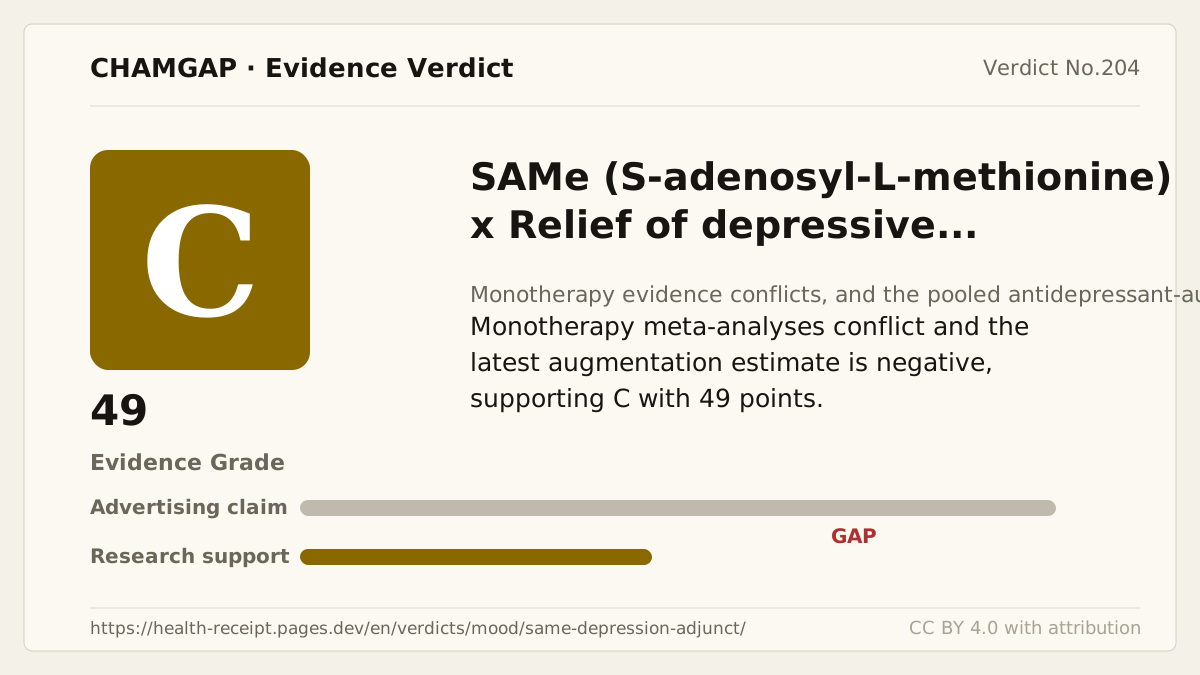
[Chamgap] SAMe (S-adenosyl-L-methionine) x relief of depressive symptoms and antidepressant augmentation — Evidence Grade C·49. 5 cited sources checked. Source: https://chamgap.com/en/verdicts/mood/same-depression-adjunct/ · CC BY 4.0CC BY 4.0 — free to use with attribution; do not distort grades, numbers, or verdict meaning.
What this document does and does not do
Chamgap is an information source. It reports what research has and has not confirmed; it does not tell readers what to take or buy. That decision belongs to readers and, when needed, medical or legal professionals. This verdict reflects literature available up to the search date and may change as new research appears. Nothing here is medical advice.