
Kava,
does it really help with Relief of anxiety symptoms?
research showsA Cochrane review of 12 double-blind RCTs and 700 participants found that kava significantly reduced anxiety versus placebo, with a small effect in the HAM-A meta-analysis of seven trials and 380 participants. Later trials using STAI in 391 participants and a 16-week study in 171 people with generalized anxiety disorder were negative, indicating formulation- and population-dependent inconsistency. Efficacy is rated at the bottom of B with 62 points, while hepatotoxicity is handled separately as a safety caution.
ads claimMarketing presents traditional calming, tension relief, and natural anxiety management. The evidence contains both an average effect from early small trials and later negative large trials in diagnosed anxiety, while liver safety is a separate axis from efficacy.
Useful facts when choosing a product
- The 2005 trial used the equivalent of 300 mg/day of total kavalactones for four weeks.
- The 2020 trial used 120 mg of kavalactones twice daily, totaling 240 mg/day for 16 weeks.
- Aqueous and organic-solvent extracts, cultivars, and plant parts may differ in composition.
- Hepatotoxicity reports and product and extraction differences support a safety rating of caution.
What the research actually shows
The Pittler 2003 Cochrane review included 12 double-blind RCTs with 700 participants; a meta-analysis of seven trials with 380 participants reported a 3.9-point HAM-A difference favoring kava but low robustness. The Jacobs 2005 trial randomized 391 participants and found similar STAI reductions with kava and placebo. The Sarris 2020 trial gave standardized aqueous kava for 16 weeks to 171 people with generalized anxiety disorder; the anxiety difference favored placebo by 1.37 points with p=0.25, and remission rates did not differ.
Why this is classified as B (62)
The significant small effect in a Cochrane synthesis of 12 double-blind RCTs and 700 participants is balanced against negative STAI and generalized-anxiety trials of 391 and 171 participants, supporting the bottom of B with 62 points. Hepatotoxicity is separated as a safety caution rather than an efficacy downgrade.
Counterpoint. Research questions remain for situational anxiety and formulation-specific effects, but they do not establish efficacy for diagnosed generalized anxiety disorder.
Rejudgment record. Reassessment (cross-check reflected) — A significant small effect in a Cochrane synthesis of 12 double-blind RCTs and 700 participants is balanced against negative STAI and generalized-anxiety trials of 391 and 171 participants
Cross-check — Codex and Claude
Evidence Table
| Study | Design | Sample | Funding | Endpoint | Result | Weight |
|---|---|---|---|---|---|---|
| Pittler MH, Ernst E. 2003 | Cochrane systematic review and meta-analysis | 380 | Academic review | Hamilton Anxiety Rating Scale | The meta-analysis found a significant 3.9-point difference favoring kava, but the effect was small and not robust. | Supportive |
| Jacobs BP et al. 2005 | Randomized double-blind placebo-controlled Internet trial | 391 | Academic institutions; otherwise unknown | State-Trait Anxiety Inventory and insomnia score at four weeks | Anxiety reduction was similar with kava and placebo, showing no efficacy over placebo. | Key |
| Sarris J et al. 2020 | Multicenter randomized double-blind placebo-controlled phase III trial | 171 | Australian NHMRC and Integria co-funding | Anxiety reduction and remission at 16 weeks | Neither anxiety reduction nor remission differed significantly from placebo. | Key |
Receipt — 3 References
All 3 cited sources were verified for existence at the original page (as of 2026-07-11).
Reviewed and approved: Chamgap Editorial Team · Approval date: 2026-07-11 · Corrections: none
Cite this verdict
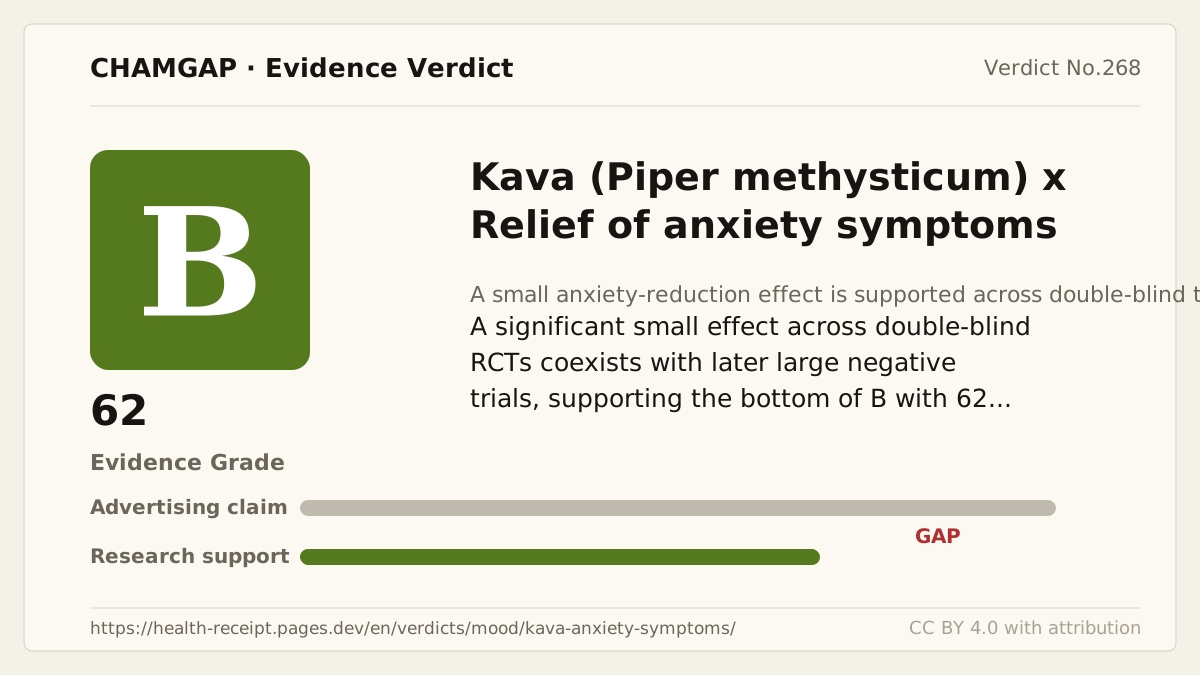
[Chamgap] Kava (Piper methysticum) x Relief of anxiety symptoms — Evidence Grade B·62. 3 cited sources checked. Source: https://chamgap.com/en/verdicts/mood/kava-anxiety-symptoms/ · CC BY 4.0CC BY 4.0 — free to use with attribution; do not distort grades, numbers, or verdict meaning.
What this document does and does not do
Chamgap is an information source. It reports what research has and has not confirmed; it does not tell readers what to take or buy. That decision belongs to readers and, when needed, medical or legal professionals. This verdict reflects literature available up to the search date and may change as new research appears. Nothing here is medical advice.