
Gynostemma pentaphyllum leaf extract,
does it really help with Relief of tension caused by stress?
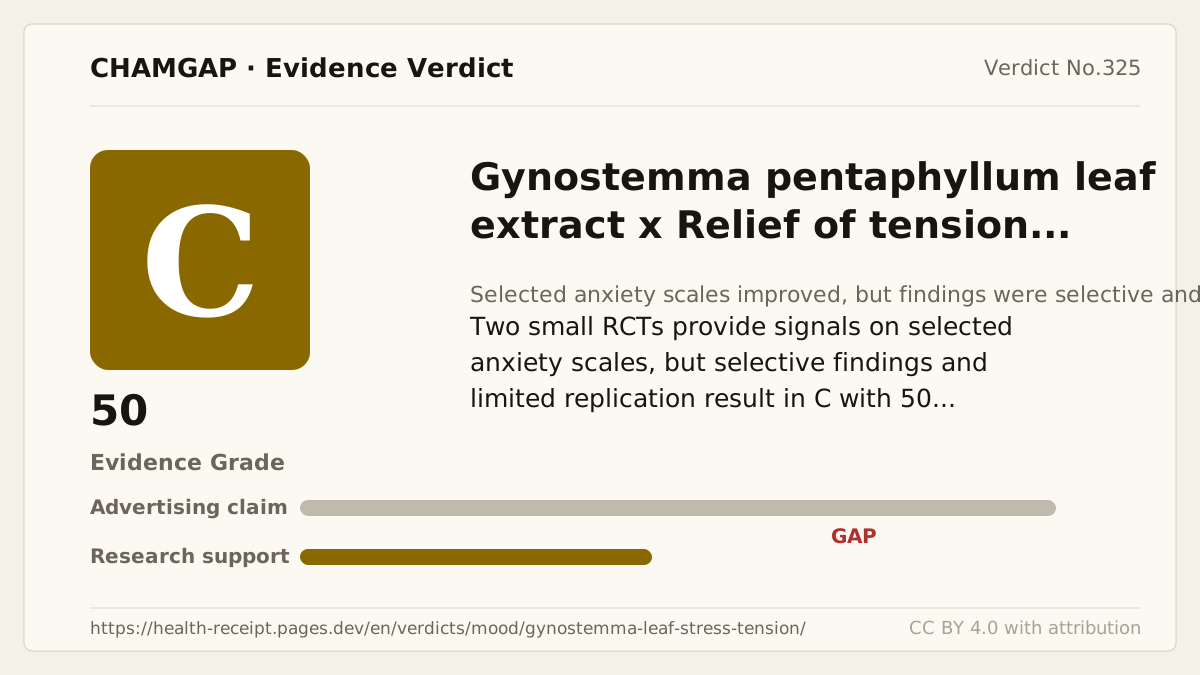
research showsTwo Korean randomized trials of standardized Gynostemma ethanol extract at 400 mg/day for six to eight weeks reported improvement in a high-anxiety subgroup or on the trait-anxiety scale. However, state anxiety, Hamilton and Beck anxiety scales, cortisol, and most secondary outcomes were negative in the 2019 trial, and independent multi-region replication is limited, so the grade is C.
ads claimProduct descriptions may translate selected questionnaire changes in healthy stressed adults into broad relief of daily stress, tension, or anxiety. Published evidence is limited to a specific extract at 400 mg/day and six- to eight-week questionnaire outcomes, not treatment outcomes in clinical anxiety disorders.
Useful facts when choosing a product
- The trials used a standardized ethanol extract of Gynostemma leaves, which is not interchangeable with tea, generic powder, or differently processed extracts.
- Both key trials used 200 mg twice daily, totaling 400 mg/day.
- Key positive findings were self-reported STAI-family anxiety scales, while several other anxiety scales and biomarkers were negative.
- No serious safety signal appeared in the trials, and the 2011 study mainly reported mild gastrointestinal events.
What the research actually shows
The 2011 trial by Chung and colleagues assigned 102 healthy adults to Gynostemma ethanol extract 200 mg twice daily or placebo for six weeks. Trait-anxiety reduction was most apparent in subgroups meeting high baseline anxiety criteria rather than across the full population. The 2019 trial by Choi and colleagues assigned 72 healthy adults with chronic stress and STAI scores of 40 to 60 to the same 400 mg/day dose or placebo for eight weeks. The primary T-STAI endpoint decreased by 16.8% versus placebo with p=0.041, total STAI had p=0.067, and S-STAI, HAM-A, BAI, norepinephrine, ACTH, salivary cortisol, alpha-amylase, and autonomic tests showed no between-group difference. A 2023 systematic review of adaptogenic plants included Gynostemma, but the number of Gynostemma studies was too small for a separate meta-analysis.
Why this is classified as C (50)
Regulatory recognition is not grading evidence. Selected anxiety-scale signals from two small RCTs of one extract are acknowledged, but the first trial depended on a high-anxiety subgroup, the second had T-STAI at p=0.041 with most other endpoints null, and independent multi-region replication is lacking, resulting in C with 50 points.
Counterpoint. A six- to eight-week anxiety-scale signal was observed in two trials using the exact standardized extract at 400 mg/day. This judgment does not include treatment of clinical anxiety disorders or long-term tension relief.
Rejudgment record. Reassessment (cross-check reflected) — Two small RCTs of a specific standardized Gynostemma leaf extract were positive on selected anxiety scales, but findings depended on subgroups or borderline results, many secondary scales and biomarkers were negative, independent multi-region replication is lacking, and regulatory recognition was not used as evidence
Cross-check — Codex and Claude
Evidence Table
| Study | Design | Sample | Funding | Endpoint | Result | Weight |
|---|---|---|---|---|---|---|
| Chung SH et al. 2011 | Randomized double-blind placebo-controlled trial | 6 | Not clearly reported in the publicly available article information | Anxiety Sensitivity Index, state STAI, and trait STAI | Trait-anxiety reduction was more apparent in high-baseline-anxiety subgroups than in the full population. | Supportive |
| Choi EK et al. 2019 | Randomized double-blind placebo-controlled trial | 8 | Not stated in the published abstract | Primary T-STAI; S-STAI, HAM-A, BAI, and stress biomarkers | T-STAI improved by 16.8% with p=0.041; total STAI showed a trend with p=0.067, while other anxiety scales and biomarkers did not differ between groups. | Key |
| Tóth-Mészáros A et al. 2023 | Systematic review and partial meta-analysis | 25 | Academic and public research support | Subjective stress, cortisol, and ACTH | Included Gynostemma studies, but their number was insufficient for a separate Gynostemma meta-analysis. | Context |
Receipt — 3 References
All 3 cited sources were verified for existence at the original page (as of 2026-07-11).
Reviewed and approved: Chamgap Editorial Team · Approval date: 2026-07-11 · Corrections: none
Cite this verdict
[Chamgap] Gynostemma pentaphyllum leaf extract × Relief of tension caused by stress — Evidence Grade C·50. 3 cited sources checked. Source: https://chamgap.com/en/verdicts/mood/gynostemma-leaf-stress-tension/ · CC BY 4.0CC BY 4.0 — free to use with attribution; do not distort grades, numbers, or verdict meaning.
What this document does and does not do
Chamgap is an information source. It reports what research has and has not confirmed; it does not tell readers what to take or buy. That decision belongs to readers and, when needed, medical or legal professionals. This verdict reflects literature available up to the search date and may change as new research appears. Nothing here is medical advice.