
Tauroursodeoxycholic acid,
does it really help with Improvement in fatty liver and liver enzymes?
research showsIn a pharmaceutical trial of 199 patients with primary biliary cholangitis, TUDCA improved ALP, AST, and bilirubin over 24 weeks similarly to UDCA. This was not a fatty-liver trial and was not designed to establish efficacy against placebo. A trial in 20 adults with obesity improved only the surrogate outcome of hepatic and muscle insulin sensitivity, so the claim for fatty liver and liver enzymes from ordinary supplements is rated C.
ads claimAdvertisements connect 'bile flow,' 'hepatocyte endoplasmic-reticulum stress,' and 'liver detoxification' to reduced fatty liver and normalized enzymes. Direct human evidence consists of a pharmaceutical comparison in cholestatic disease and a small insulin-sensitivity study, not equivalent evidence for ordinary fatty-liver supplements.
Useful facts when choosing a product
- The primary biliary cholangitis trial used 250 mg three times daily, totaling 750 mg/day.
- The obesity insulin-sensitivity trial used 1,750 mg/day for four weeks.
- TUDCA, UDCA, and norUDCA are related bile acids but are not the same ingredient.
- Equivalence between the purity and content of marketed supplements and pharmaceutical trial formulations requires separate verification.
What the research actually shows
The Ma 2016 multicenter double-blind trial gave 199 patients with primary biliary cholangitis either TUDCA 250 mg or UDCA 250 mg three times daily. The proportions achieving at least a 25% ALP reduction were 75.97% and 80.88%, with no difference, and both groups had similar improvements in ALP, AST, and total bilirubin. The Kars 2010 trial gave 1,750 mg/day for four weeks to 20 insulin-resistant adults with obesity and reported an approximately 30% increase in hepatic and muscle insulin sensitivity, while several metabolic variables including glucose, insulin, and free fatty acids did not change significantly.
Why this is classified as C (43)
Randomized human trials and biochemical signals for TUDCA itself mean the evidence is not ungradable, but the absence of a direct fatty-liver trial, active-drug control, small short-term metabolic study, and formulation extrapolation limit the rating to C with 43 points.
Counterpoint. Pharmacologic effects on liver biochemical markers were observed in cholestatic disease. This does not establish reduced liver fat or long-term clinical benefit in ordinary fatty liver.
Rejudgment record. Reassessment (cross-check reflected) — Biochemical signals from a TUDCA pharmaceutical formulation in PBC and a small insulin-sensitivity trial, but no direct fatty-liver trial, placebo comparison, or clinical outcome evidence
Sub-claim grades by effect
This ingredient is marketed for several effects. A single overall grade blends strong and weak claims together, so each effect is graded separately here. The overall grade reflects the strongest disconfirming or core claim.
| Effect (sub-claim) | Grade | Basis |
|---|---|---|
| Liver enzymes in cholestasis | C | Limited to an active-drug comparison with UDCA in PBC |
| Fatty liver itself | ? | No direct placebo-controlled efficacy trial |
Cross-check — Codex and Claude
Evidence Table
| Study | Design | Sample | Funding | Endpoint | Result | Weight |
|---|---|---|---|---|---|---|
| Ma H et al. 2016 | Multicenter randomized double-blind active-controlled trial | 199 | Unknown | At least 25% ALP reduction at 24 weeks, AST, and total bilirubin | ALP response and biochemical improvements were similar with TUDCA and UDCA, with no significant between-group difference. | Key |
| Kars M et al. 2010 | Randomized placebo-controlled metabolic trial | 20 | U.S. National Institutes of Health | Hepatic, muscle, and adipose insulin sensitivity | Hepatic and muscle insulin sensitivity increased by about 30%, while adipose sensitivity and several circulating metabolic variables did not change. | Supportive |
Receipt — 2 References
All 2 cited sources were verified for existence at the original page (as of 2026-07-11).
Reviewed and approved: Chamgap Editorial Team · Approval date: 2026-07-11 · Corrections: none
Cite this verdict
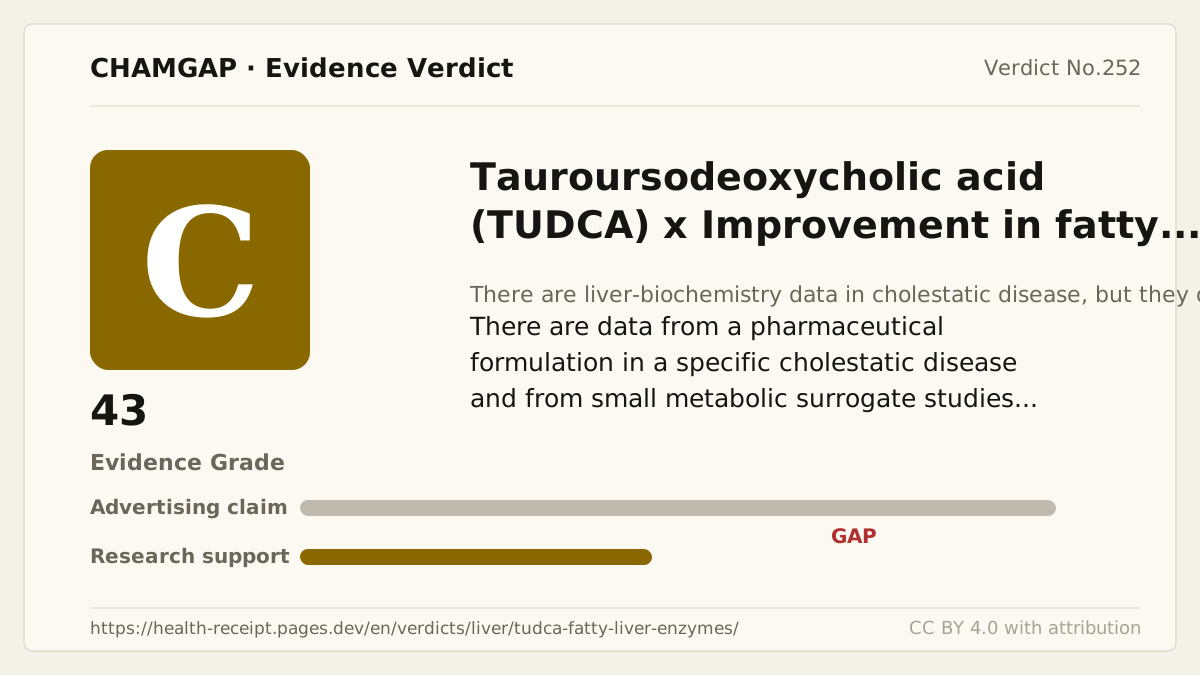
[Chamgap] Tauroursodeoxycholic acid (TUDCA) x improvement in fatty liver and liver enzymes — Evidence Grade C·43. 2 cited sources checked. Source: https://chamgap.com/en/verdicts/liver/tudca-fatty-liver-enzymes/ · CC BY 4.0CC BY 4.0 — free to use with attribution; do not distort grades, numbers, or verdict meaning.
What this document does and does not do
Chamgap is an information source. It reports what research has and has not confirmed; it does not tell readers what to take or buy. That decision belongs to readers and, when needed, medical or legal professionals. This verdict reflects literature available up to the search date and may change as new research appears. Nothing here is medical advice.