
Dihydromyricetin,
does it really help with Hangover prevention and relief?
research showsNo RCT of purified DHM alone for hangover was identified. Human monotherapy research on DHM does exist: Chen 2016 randomized 60 patients with NAFLD to purified DHM at 300 mg/day for three months, but that trial cannot be repurposed as evidence for hangover. Hovenia dulcis combinations, A. indica, and other ingredients are also not evidence for DHM alone, so the hangover claim remains rated ?.
ads claimAdvertisements state that DHM rapidly clears acetaldehyde and prevents intoxication and hangover. Published human hangover evidence concerns Hovenia extracts or combinations, and the NAFLD monotherapy RCT cannot establish this hangover mechanism.
Useful facts when choosing a product
- DHM is a flavonoid also known as ampelopsin.
- The DHM content of Hovenia extracts can vary by raw material and standardization method.
- Results from extract or combination-beverage trials are not the same as results for purified DHM alone.
- An effective hangover dose and long-term safety range for DHM alone have not been established in published human trials.
What the research actually shows
The hangover-related clinical evidence in the Skinner 2026 systematic review consisted of a Hovenia dulcis extract trial in 26 healthy men and a combination-beverage trial in 25 adults; neither tested purified DHM alone for hangover. In contrast, Chen 2016 was a three-month RCT of purified DHM at 300 mg/day in 60 patients with NAFLD, confirming that human DHM monotherapy research exists, but it did not assess hangover and cannot be repurposed for that claim. Hovenia dulcis combinations and A. indica are separate ingredients.
Why this is classified as ?
A purified-DHM RCT exists in NAFLD, but there is no monotherapy efficacy trial for hangover. Under the boundary rule, another disease, extracts, combinations, and preclinical data are not transferred to the ingredient-specific hangover claim, so the rating is ? without a score.
Counterpoint. Small hangover signals from Hovenia fruit extract can support future DHM-only trials but do not evaluate the same target ingredient.
Rejudgment record. Reassessment (cross-check reflected) — A purified-DHM RCT exists in NAFLD, but there is no monotherapy RCT for hangover, and results from Hovenia dulcis combinations, A. indica, and other ingredients cannot be transferred to that claim
Cross-check — Codex and Claude
Evidence Table
| Study | Design | Sample | Funding | Endpoint | Result | Weight |
|---|---|---|---|---|---|---|
| Chen S et al. 2016 | Randomized controlled trial | 60 | Unknown | Metabolic and liver-related outcomes in NAFLD | Purified DHM at 300 mg/day was tested for three months, but the trial did not assess hangover. | Scope-defining |
| Skinner SG et al. 2026 | Systematic review | 2 | Unknown | Preclinical and clinical alcohol-related outcomes | The two hangover studies tested Hovenia dulcis extracts; no hangover trial of purified DHM alone was found. | Key |
| Verster JC et al. 2021 | Market-product and evidence evaluation | 82 | Unknown | Ingredients, marketing claims, and independent safety and efficacy evidence | DHM was common, but independent human safety and efficacy evidence for product ingredients was not identified. | Supportive |
Receipt — 3 References
All 3 cited sources were verified for existence at the original page (as of 2026-07-11).
Reviewed and approved: Chamgap Editorial Team · Approval date: 2026-07-11 · Corrections: none
Cite this verdict
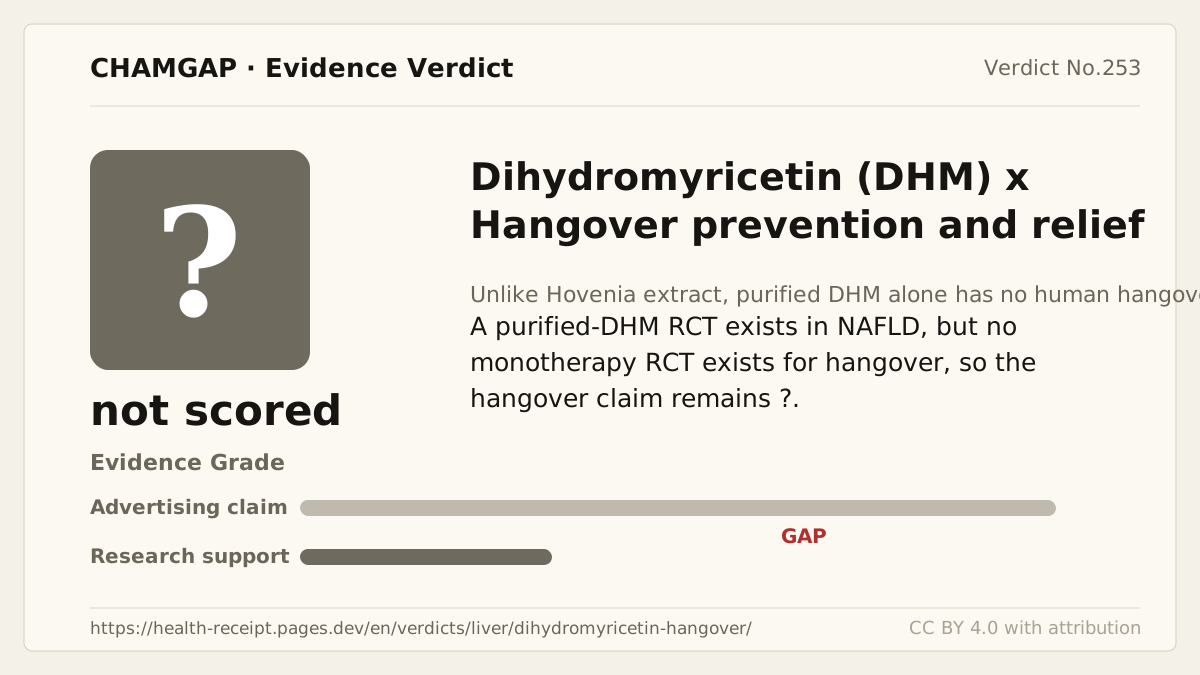
[Chamgap] Dihydromyricetin (DHM) x hangover prevention and relief — Evidence Grade ?. 3 cited sources checked. Source: https://chamgap.com/en/verdicts/liver/dihydromyricetin-hangover/ · CC BY 4.0CC BY 4.0 — free to use with attribution; do not distort grades, numbers, or verdict meaning.
What this document does and does not do
Chamgap is an information source. It reports what research has and has not confirmed; it does not tell readers what to take or buy. That decision belongs to readers and, when needed, medical or legal professionals. This verdict reflects literature available up to the search date and may change as new research appears. Nothing here is medical advice.