
Calcium D-glucarate,
does it really help with Enhanced liver detoxification and toxin elimination?
research showsA Phase I dose-escalation trial gave healthy smokers and nonsmokers calcium D-glucarate at 1.5 to 9.0 g/day for six weeks and found lower beta-glucuronidase with higher blood D-glucaric acid. However, it was not a randomized placebo-controlled efficacy trial and did not measure elimination of a specified toxin, liver function, symptoms, or clinical outcomes, so this is a very low C based only on a mechanistic surrogate.
ads claimAdvertising may use phrases such as 'phase II liver detoxification,' 'hormone and environmental-toxin elimination,' and 'estrogen detoxification' as if they were specific clinical effects. The public evidence mainly consists of an enzyme-inhibition hypothesis and animal metabolism or tumor models; human toxin removal and health outcomes are not established.
Useful facts when choosing a product
- Calcium D-glucarate is the calcium salt of D-glucaric acid, and the glucarate component rather than calcium is the proposed active part.
- The Phase I trial used 1.5 to 9.0 g/day over six weeks.
- Beta-glucuronidase inhibition is a biochemical surrogate and is not equivalent to elimination of a specified toxin or improvement of liver disease.
- Long-term human safety, effects on enterohepatic recirculation of medicines and hormones, and pregnancy or lactation data are limited.
What the research actually shows
A Phase I trial gave healthy male and female smokers and nonsmokers escalating doses of calcium D-glucarate from 1.5 to 9.0 g/day over six weeks. Blood D-glucaric acid rose with dose, beta-glucuronidase was consistently suppressed at measurements every two weeks, and no unusual toxicity was reported even at the highest dose. The study was not a randomized placebo-controlled efficacy trial and did not measure excretion of a specified toxin, clinical liver function, symptoms, or liver-disease outcomes. Human evidence therefore exists, ruling out an unknown rating, but it supports only a very low C based on a mechanistic surrogate.
Why this is classified as C (40)
A six-week Phase I dose-escalation trial in healthy smokers and nonsmokers used 1.5 to 9.0 g/day and found lower beta-glucuronidase with higher blood D-glucaric acid, so the rating is not unknown. However, it was not a randomized placebo-controlled efficacy trial and did not measure specified-toxin elimination, liver function, symptoms, or clinical outcomes. Mechanistic-surrogate evidence alone supports a very low C with 40 points.
Counterpoint. A measurable mechanistic signal exists in humans and can support future placebo-controlled excretion and clinical trials, but it does not establish actual liver detoxification or toxin-elimination efficacy.
Rejudgment record. Reassessment (cross-check reflected) — A six-week Phase I dose-escalation trial in healthy smokers and nonsmokers at 1.5 to 9.0 g/day found lower beta-glucuronidase and higher blood D-glucaric acid, but it was nonrandomized and uncontrolled and did not measure specified-toxin elimination, liver function, symptoms, or clinical outcomes
Sub-claim grades by effect
This ingredient is marketed for several effects. A single overall grade blends strong and weak claims together, so each effect is graded separately here. The overall grade reflects the strongest disconfirming or core claim.
| Effect (sub-claim) | Grade | Basis |
|---|---|---|
| Beta-glucuronidase mechanistic surrogate | C | Lowered in a six-week Phase I dose-escalation trial at 1.5 to 9.0 g/day |
| Actual liver detoxification and toxin elimination | ? | Clinical efficacy outcomes were not measured |
Cross-check — Codex and Claude
Evidence Table
| Study | Design | Sample | Funding | Endpoint | Result | Weight |
|---|---|---|---|---|---|---|
| Walaszek Z et al. 2002 Phase I | Phase I dose-escalation human trial in healthy smokers and nonsmokers; not randomized or placebo-controlled | Not stated in the public abstract or review | Blood D-glucaric acid and beta-glucuronidase at baseline and every two weeks | Calcium D-glucarate at 1.5 to 9.0 g/day for six weeks increased blood D-glucaric acid and consistently lowered beta-glucuronidase, but toxin elimination, liver function, and symptoms were not measured. | Key human mechanistic-surrogate evidence | |
| Dwivedi C et al. 1990 | Animal pharmacology and food-analysis study | Unknown | Serum, liver, lung, and intestinal beta-glucuronidase and food glucaric acid | Calcium glucarate inhibited beta-glucuronidase activity in animal tissues. | Key preclinical evidence | |
| Walaszek Z et al. 1997 | Radiolabeled pharmacokinetic animal study | Unknown | Absorption, tissue distribution, metabolism, and excretion | The metabolism of an oral D-glucarate salt and formation of D-glucaro-1,4-lactone were evaluated in rats. | Preclinical mechanism | |
| Maruti SS et al. 2008 | Controlled crossover human feeding trial | 63 | Supported by the U.S. National Institutes of Health | High fruit-and-vegetable diet and serum beta-glucuronidase | The whole plant-food diet was evaluated; calcium D-glucarate alone and a clinical toxin-elimination effect were not tested. | Indirect, ingredient mismatch |
Receipt — 5 References
All 5 cited sources were verified for existence at the original page (as of 2026-07-11).
Reviewed and approved: Chamgap Editorial Team · Approval date: 2026-07-11 · Corrections: none
Cite this verdict
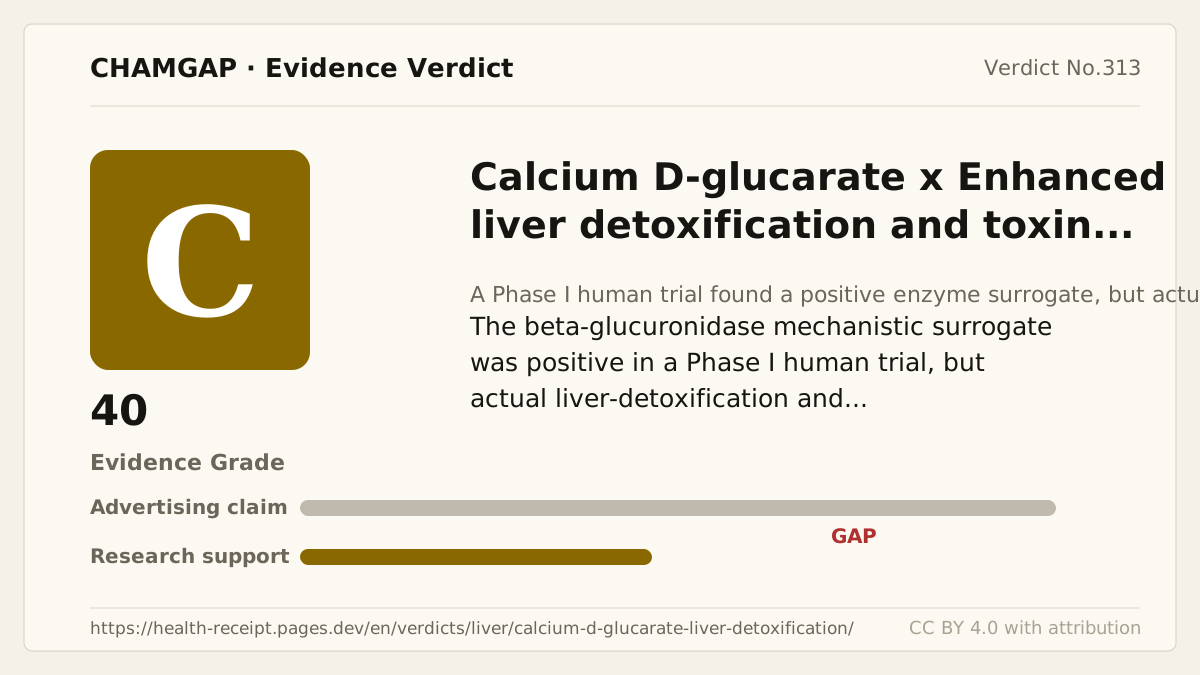
[Chamgap] Calcium D-glucarate × enhanced liver detoxification and toxin elimination — Evidence Grade C·40. 5 cited sources checked. Source: https://chamgap.com/en/verdicts/liver/calcium-d-glucarate-liver-detoxification/ · CC BY 4.0CC BY 4.0 — free to use with attribution; do not distort grades, numbers, or verdict meaning.
What this document does and does not do
Chamgap is an information source. It reports what research has and has not confirmed; it does not tell readers what to take or buy. That decision belongs to readers and, when needed, medical or legal professionals. This verdict reflects literature available up to the search date and may change as new research appears. Nothing here is medical advice.