
Milk basic protein,
does it really help with Maintenance of bone mineral density and suppression of bone resorption?
research showsTwo small RCTs using MBP 40 mg/day reported improvements in radial or lumbar bone mineral density and bone-turnover markers such as NTx. However, the early positive trials included a high proportion of researchers from the ingredient developer Snow Brand and had only 33 to 35 participants. In an independent trial of 84 young Chinese women, the difference in total BMD gain after 8 months among the MBP, whole-milk, and control groups was not significant. There are also no fracture-prevention data, so the grade is C.
ads claimMarketed products use expressions such as 'promotes bone formation,' 'fills bone density,' 'suppresses bone resorption,' and 'prevents osteoporosis.' Public human data mainly address BMD and bone-turnover markers over 6 to 8 months in young women, not fractures or progression to an osteoporosis diagnosis.
Useful facts when choosing a product
- The main human-trial dose was MBP 40 mg/day.
- MBP is a basic protein fraction of milk whey and is labeled separately from a product's total protein or calcium content.
- Main research endpoints were DXA BMD and bone-turnover markers such as NTx, osteocalcin, and BAP.
- Because the ingredient is derived from milk protein, milk-protein allergy and product labeling are relevant to safety classification.
What the research actually shows
The Yamamura 2002 double-blind RCT gave MBP 40 mg/day to 33 healthy adult women for 6 months and reported increased distal radial BMD, but many authors were affiliated with the Snow Brand research institute. The Uenishi 2007 RCT in 35 young women reported a 6-month lumbar L2-L4 BMD gain of 1.57% in the MBP group versus 0.13% with placebo (p=0.042), lower NTx, and higher osteocalcin, but Snow Brand researchers again participated. The independent Zou 2009 RCT randomized 84 young women to control, whole milk, or milk containing 40 mg MBP; analysis of 81 completers found no significant between-group difference in total BMD gain. A signal of lower NTx appeared only after the two milk groups were combined and could not be isolated as an MBP-specific effect.
Why this is classified as C (42)
Positive BMD and bone-turnover signals in small RCTs place the evidence above D. However, manufacturer concentration, small samples, absence of a between-group BMD difference in the independent 84-participant trial, and no fracture-prevention data support C with 42 points.
Counterpoint. Signals in radial and lumbar BMD and a bone-resorption marker at 40 mg/day provide a basis for further research. The current judgment reflects that those signals have not been replicated independently and consistently.
Rejudgment record. Reassessment (cross-check reflected) — Despite positive BMD and NTx findings in manufacturer-linked trials of 33 and 35 participants, the independent 84-person trial found no significant between-group effect, and BMD and NTx are surrogates rather than fracture endpoints; failed independent replication caps the grade at C
Sub-claim grades by effect
This ingredient is marketed for several effects. A single overall grade blends strong and weak claims together, so each effect is graded separately here. The overall grade reflects the strongest disconfirming or core claim.
| Effect (sub-claim) | Grade | Basis |
|---|---|---|
| Maintenance of bone mineral density | C | Manufacturer-linked trials of 33 to 35 participants were positive, but the independent 84-participant trial found no between-group difference in total BMD gain. |
| Suppression of bone resorption | C | There is a signal of lower NTx, but it is a surrogate marker, and one trial could not separate an MBP-specific effect from the effect of whole milk. |
Cross-check — Codex and Claude
Evidence Table
| Study | Design | Sample | Funding | Endpoint | Result | Weight |
|---|---|---|---|---|---|---|
| Yamamura J et al. 2002 | Double-blind randomized placebo-controlled trial | 33 | Centered on the Snow Brand research institute | Distal radial bone mineral density | After MBP 40 mg/day for 6 months, BMD gain at two radial sites was greater than with placebo. | Supportive |
| Uenishi K et al. 2007 | Randomized placebo-controlled trial | 35 | Snow Brand researcher involvement | Lumbar L2-L4 BMD, NTx, and osteocalcin | Six-month BMD gain was 1.57% versus 0.13%, with lower NTx and higher osteocalcin. | Supportive |
| Zou ZY et al. 2009 | Independent randomized controlled trial | 81 | University research; industry funding not reported | Total-body, lumbar, and forearm BMD, NTx, and BAP | No significant difference in total BMD gain among MBP, whole-milk, and control groups; NTx decreased only when the two milk groups were combined. | Key |
Receipt — 3 References
All 3 cited sources were verified for existence at the original page (as of 2026-07-13).
Reviewed and approved: Chamgap Editorial Team · Approval date: 2026-07-13 · Corrections: none
Cite this verdict
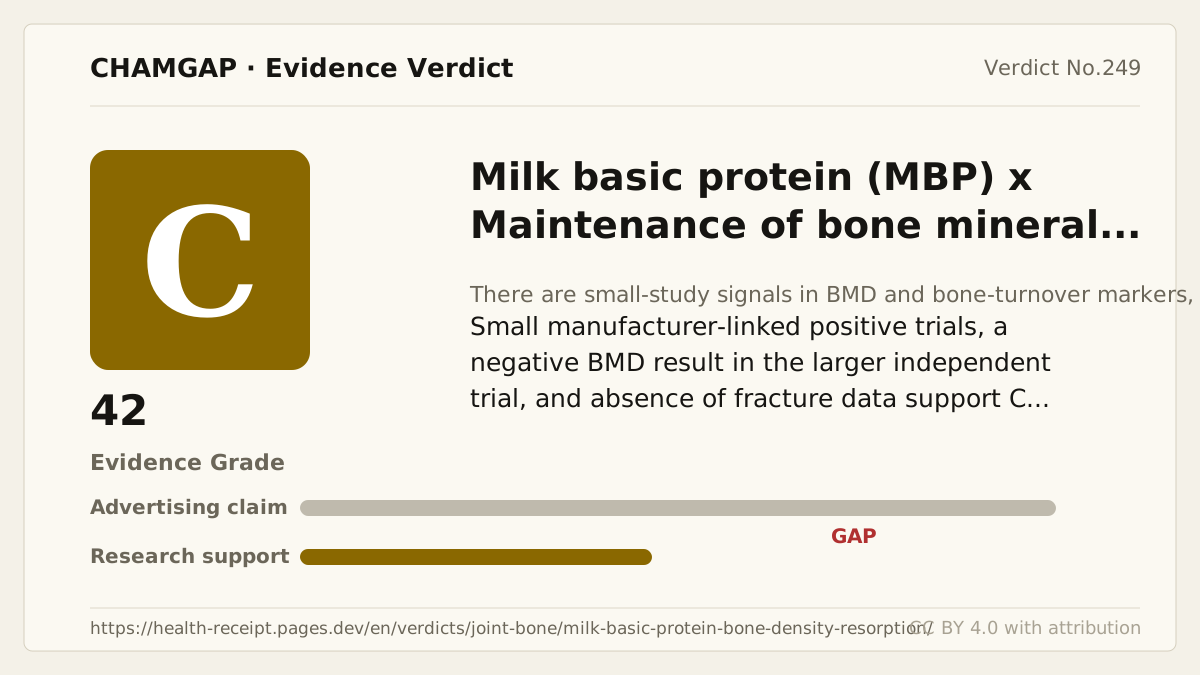
[Chamgap] Milk basic protein (MBP) x maintenance of bone mineral density and suppression of bone resorption — Evidence Grade C·42. 3 cited sources checked. Source: https://chamgap.com/en/verdicts/joint-bone/milk-basic-protein-bone-density-resorption/ · CC BY 4.0CC BY 4.0 — free to use with attribution; do not distort grades, numbers, or verdict meaning.
What this document does and does not do
Chamgap is an information source. It reports what research has and has not confirmed; it does not tell readers what to take or buy. That decision belongs to readers and, when needed, medical or legal professionals. This verdict reflects literature available up to the search date and may change as new research appears. Nothing here is medical advice.