
Avocado-soybean unsaponifiables,
does it really help with Improvement of knee osteoarthritis pain and function?
research showsThere are placebo-controlled RCTs and systematic reviews indicating that ASU 300 mg/day produces a small improvement in pain and function in knee osteoarthritis. However, the effect is small or of borderline clinical importance, and the evidence is concentrated in a specific manufacturer's product. The overall grade is B.
ads claimMarket wording includes 'cartilage protection,' 'joint regeneration,' and 'slowing progression.' Direct human evidence mainly concerns pain and function; structural preservation has not been established.
Useful facts when choosing a product
- The main RCTs studied a specific standardized preparation with a 1:2 avocado-to-soybean ratio.
- The most studied dose is 300 mg/day.
- Commercial products with different manufacturing methods may not be identical to the research product.
- Avocado or soy allergy information needs to be distinguished by product.
What the research actually shows
The Cameron and Chrubasik 2014 Cochrane review rated improvements of about 8.5/100 points in pain and about 7/100 points in function with Piascledine® ASU 300 mg across four placebo-controlled knee studies with 651 participants as small and of uncertain clinical importance. Simental-Mendía 2019 reported VAS -17.36 mm and Lequesne -2.33 in the knee subgroup, but heterogeneity was high and hip results were negative. The 164-participant Maheu 1998 RCT reported improvements in function and pain. Maheu 2014 ERADIAS followed 399 patients with hip, not knee, osteoarthritis for three years; the primary mean joint-space change was negative, while only the proportion of progressors was exploratory-positive.
Why this is classified as B (62)
Knee pain and function are clinical endpoints repeated across four placebo-controlled studies with 651 participants, supporting B. The score is 62 because effects are small at about 8.5/100 and 7/100 points, while heterogeneity, product specificity, and manufacturer links remain. The hip ERADIAS trial was not counted as negative knee evidence.
Counterpoint. For the target claim limited to knee symptoms, a small average improvement signal remains. This judgment does not extend to cartilage regeneration or prevention of surgery.
Rejudgment record. Reassessment (cross-validation incorporated) — Four placebo-controlled knee studies with 651 participants show small improvements in pain and function, but effect size, heterogeneity, and concentration in a specific product preclude A; hip ERADIAS was excluded from negative knee evidence
Cross-check — Codex and Claude
Evidence Table
| Study | Design | Sample | Funding | Endpoint | Result | Weight |
|---|---|---|---|---|---|---|
| Cameron & Chrubasik 2014 | Cochrane systematic review and meta-analysis | 651 | NIH/NCCIH support; independent review | Pain, function, joint space, and adverse events | Small improvements of -8.5/100 points in pain and -7/100 points in function; no significant structural or adverse-event difference. | Key |
| Simental-Mendía et al. 2019 | Systematic review and meta-analysis of RCTs | External funding unverified | VAS, Lequesne index, and adverse events | Knee subgroup positive with pain I²=87%; hip subgroup negative. | Key | |
| Maheu et al. 1998 | 6-month randomized, double-blind, placebo-controlled RCT | 164 | Piascledine product study; details unverified | Lequesne, VAS, and rescue medication | Function and pain improved more than placebo. | Supportive |
| Maheu et al. 2014 ERADIAS | 3-year randomized, double-blind, placebo-controlled RCT in hip osteoarthritis | 345 | Link to Laboratoires Expanscience | Primary mean hip joint-space change, proportion of progressors, and clinical endpoints | Primary mean joint-space change was negative at p=0.72; only the proportion of progressors was exploratory-positive, and clinical endpoints did not differ. This was not a knee trial. | Separate hip evidence |
Receipt — 4 References
All 4 cited sources were verified for existence at the original page (as of 2026-07-11).
Reviewed and approved: Chamgap Editorial Team · Approval date: 2026-07-11 · Corrections: none
Cite this verdict
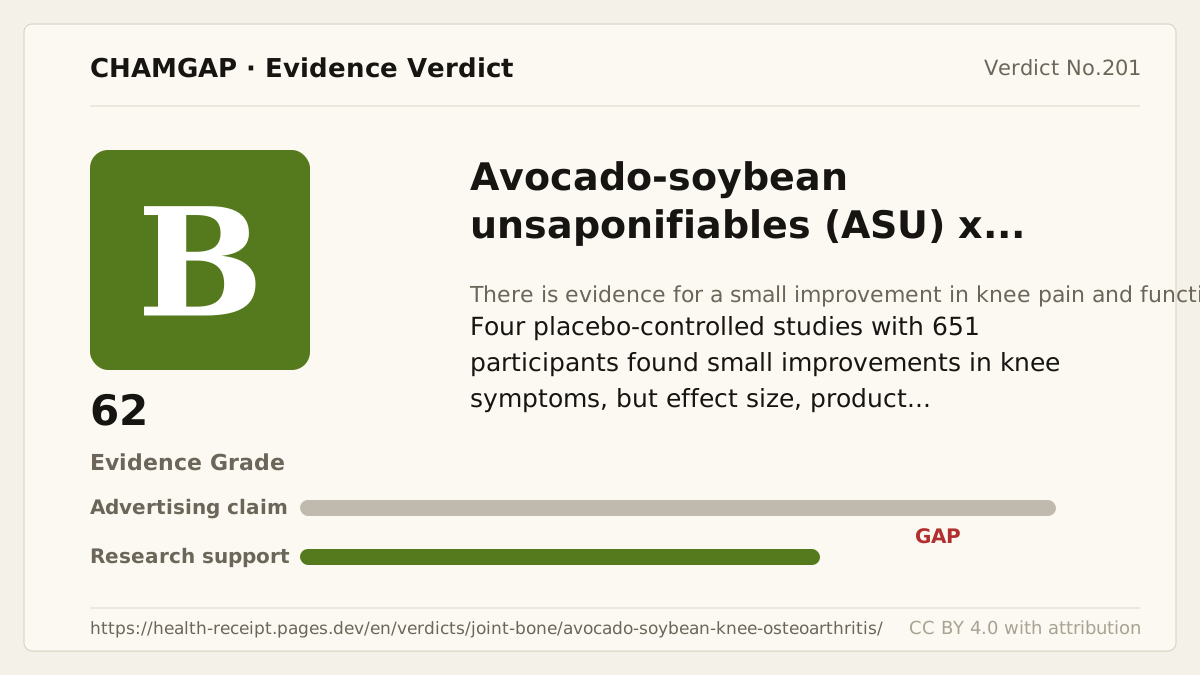
[Chamgap] Avocado-soybean unsaponifiables (ASU) x improvement of knee osteoarthritis pain and function — Evidence Grade B·62. 4 cited sources checked. Source: https://chamgap.com/en/verdicts/joint-bone/avocado-soybean-knee-osteoarthritis/ · CC BY 4.0CC BY 4.0 — free to use with attribution; do not distort grades, numbers, or verdict meaning.
What this document does and does not do
Chamgap is an information source. It reports what research has and has not confirmed; it does not tell readers what to take or buy. That decision belongs to readers and, when needed, medical or legal professionals. This verdict reflects literature available up to the search date and may change as new research appears. Nothing here is medical advice.