
Echinacea,
does it really help with Cold prevention and treatment?
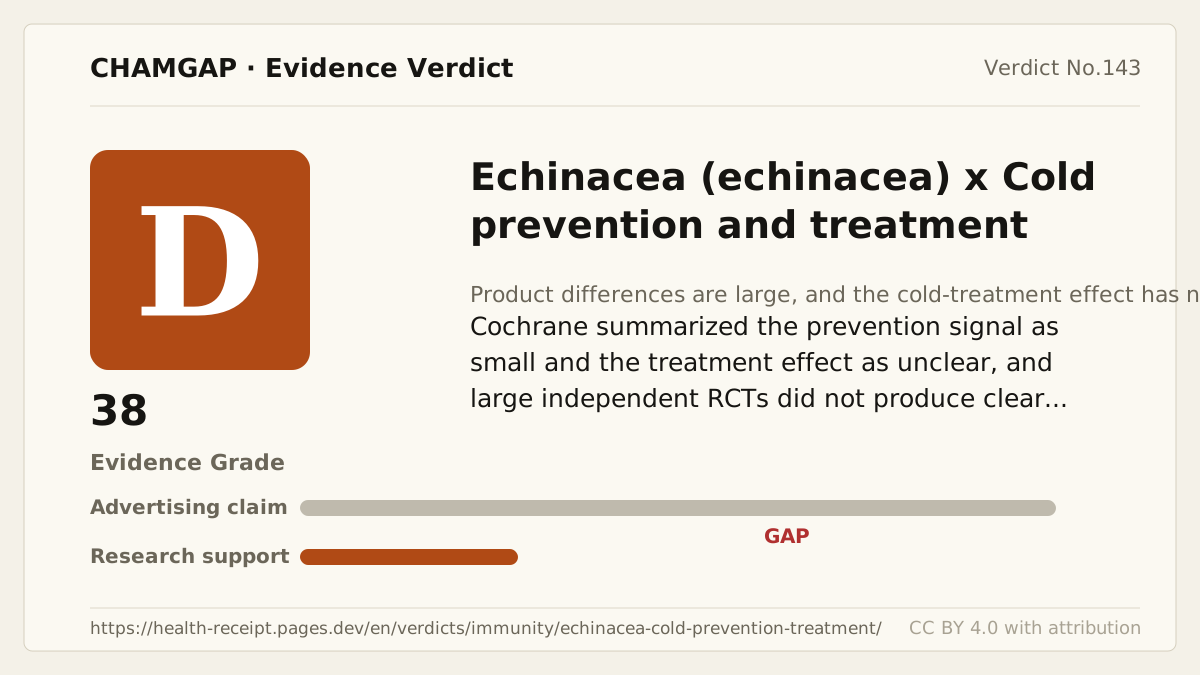
research showsEchinacea has a small possible signal for cold prevention, but treatment effects have not been consistently established in Cochrane review and large independent RCTs. Because product species, plant parts, and extraction methods differ, it is difficult to treat all 'echinacea' as a single efficacy claim.
ads claimProduct wording combines 'immunity,' 'cold prevention,' 'early cold,' and 'European herb.' The actual evidence separates by echinacea species, root/aerial parts, and alcoholic extract/pressed juice.
Useful facts when choosing a product
- E. purpurea, E. angustifolia, and E. pallida are difficult to combine under the same evidence.
- People with Asteraceae allergy, asthma or atopic tendency, and people taking immunosuppressants need caution.
- Gastrointestinal discomfort, rash, and allergic reactions are reported.
- This is not evidence for replacing cold treatments or vaccination.
What the research actually shows
Turner 2005 NEJM cold-virus challenge RCT (n=437) found that Echinacea angustifolia extract did not reduce infection rates or symptom severity. Barrett 2010 Ann Intern Med RCT (n=719) showed a direction toward about 0.5 day shorter illness duration, but it was not statistically clear under prespecified criteria. The Karsch-Volk 2014 Cochrane review concluded that a small pooled signal for prevention was possible, but comparisons between products and treatment effects were difficult to establish. Shah 2007 meta-analysis presented larger positive estimates, but heterogeneity among included studies and possible publication bias remain.
Why this is classified as D (38)
The literature volume is large, but key independent RCTs were not clear on main endpoints, and Cochrane also did not establish a treatment effect. Because there is a prevention signal, this is not F; I place it at the upper part of D, 38 points.
Counterpoint. If narrowed to a particular standardized formulation, some positive signal may remain. But the integrated claim of cold prevention and treatment for general products has not been resolved to that level.
Rejudgment record. Draft — Null main endpoints in high-quality independent RCTs and uncertainty about treatment effect in Cochrane
Cross-check — Codex and Claude
Evidence Table
| Study | Design | Sample | Funding | Endpoint | Result | Weight |
|---|---|---|---|---|---|---|
| Karsch-Volk M et al. 2014 | Cochrane systematic review | 4631 | Non-profit review; original studies mixed | Cold occurrence, cold duration, and symptoms | A small signal was possible for prevention, but treatment effects were inconsistent and product-specific differences were large. | Core |
| Turner RB et al. 2005 | Randomized double-blind placebo-controlled viral challenge trial | 437 | Public funding including NCCAM/ODS | Rhinovirus infection rate and symptom severity | E. angustifolia extract did not reduce infection rate or symptom severity. | Core counterexample |
| Barrett B et al. 2010 | Randomized placebo-controlled trial | 719 | NCCAM public funding | Cold duration and severity | Cold duration was directionally about 0.5 day shorter, but was not statistically clear under prespecified criteria. | Core counterexample |
| Shah SA et al. 2007 | Meta-analysis | 14 | Mixed | Cold occurrence and duration | Reported reductions in cold occurrence and duration, but the positive estimates were larger than those in the later Cochrane review. | Supporting |
Receipt — 5 References
All 5 cited sources were verified for existence at the original page (as of 2026-07-09).
Reviewed and approved: Chamgap Editorial Team · Approval date: 2026-07-09 · Corrections: none
Cite this verdict
[Chamgap] Echinacea x cold prevention and treatment — Evidence Grade D·38. 5 cited sources checked. Source: https://chamgap.com/en/verdicts/immunity/echinacea-cold-prevention-treatment/ · CC BY 4.0CC BY 4.0 — free to use with attribution; do not distort grades, numbers, or verdict meaning.
What this document does and does not do
Chamgap is an information source. It reports what research has and has not confirmed; it does not tell readers what to take or buy. That decision belongs to readers and, when needed, medical or legal professionals. This verdict reflects literature available up to the search date and may change as new research appears. Nothing here is medical advice.