
Hesperidin,
does it really help with Improvement of blood pressure, endothelial function, and venous circulation?
research showsIn a meta-analysis of nine trials and 2,414 participants, the SBP change was -0.29 mmHg and was nonsignificant; endothelial FMD trials conflict. Venous-circulation evidence comes from diosmin-dominant MPFF and other flavonoid combinations and cannot be attributed to hesperidin alone.
ads claimDescriptions may state that a citrus bioflavonoid improves blood pressure, vascular elasticity, and leg circulation together. Actual data mix conflicting surrogate markers with evidence from diosmin combination products.
Useful facts when choosing a product
- Single-ingredient trials mainly used 450-500 mg/day for three to six weeks.
- FMD is a surrogate marker of endothelial function.
- MPFF used in venous disease is a diosmin-dominant combination.
What the research actually shows
Rizza 2011 reported improved FMD after 500 mg/day for three weeks in 24 participants. Salden 2016 gave 450 mg/day for six weeks to 68 participants, but the primary FMD endpoint was negative in the full population. In Shylaja 2024, the pooled SBP change across nine trials and 2,414 participants was -0.29 mmHg (95% CI -2.21 to 1.63) and was nonsignificant. Venous studies concern diosmin-dominant MPFF and other flavonoid combinations and cannot be attributed to hesperidin alone.
Why this is classified as C (40)
The blood-pressure meta-analysis was negative, and FMD evidence conflicts between a small positive trial and a negative primary endpoint in the larger RCT. Venous evidence comes from diosmin-dominant combinations and cannot be attributed to hesperidin alone. The lack of independent, consistent single-ingredient evidence places the judgment at the lower end of C with 40 points.
Counterpoint. An endothelial signal in a particular population or 2S formulation remains possible. This judgment concerns attribution to hesperidin alone, not MPFF as a whole.
Rejudgment record. New judgment — The blood-pressure meta-analysis was negative, FMD evidence conflicts, and venous evidence comes from diosmin-dominant combinations that cannot be attributed to hesperidin alone, placing the judgment at the lower end of C with 40 points.
Sub-claim grades by effect
This ingredient is marketed for several effects. A single overall grade blends strong and weak claims together, so each effect is graded separately here. The overall grade reflects the strongest disconfirming or core claim.
| Effect (sub-claim) | Grade | Basis |
|---|---|---|
| Blood-pressure improvement | D | A nine-trial meta-analysis found no significant effect on SBP or DBP. |
| Improvement of endothelial function | C | A 24-person trial was positive, but primary FMD in a 68-person RCT was negative. |
| Improvement of venous circulation | ? | Evidence concerns diosmin-dominant MPFF and other flavonoid combinations and cannot be attributed to hesperidin alone. |
Cross-check — Codex and Claude
Evidence Table
| Study | Design | Sample | Funding | Endpoint | Result | Weight |
|---|---|---|---|---|---|---|
| Shylaja H et al. 2024 | Meta-analysis of RCTs | 2414 | Independent and academic affiliations | SBP and DBP | SBP was -0.29 mmHg (95% CI -2.21 to 1.63), with no significant change; DBP was also nonsignificant. | Key |
| Salden BN et al. 2016 | Double-blind placebo-controlled RCT | 68 | Industry involvement with a specific 2S formulation | FMD and blood pressure | Primary FMD was negative in the full population. | Key |
| Rizza S et al. 2011 | Double-blind crossover RCT | 24 | Unknown | FMD | FMD improved with 500 mg/day. | Supportive |
Receipt — 3 References
All 3 cited sources were verified for existence at the original page (as of 2026-07-11).
Reviewed and approved: Chamgap Editorial Team · Approval date: 2026-07-11 · Corrections: none
Cite this verdict
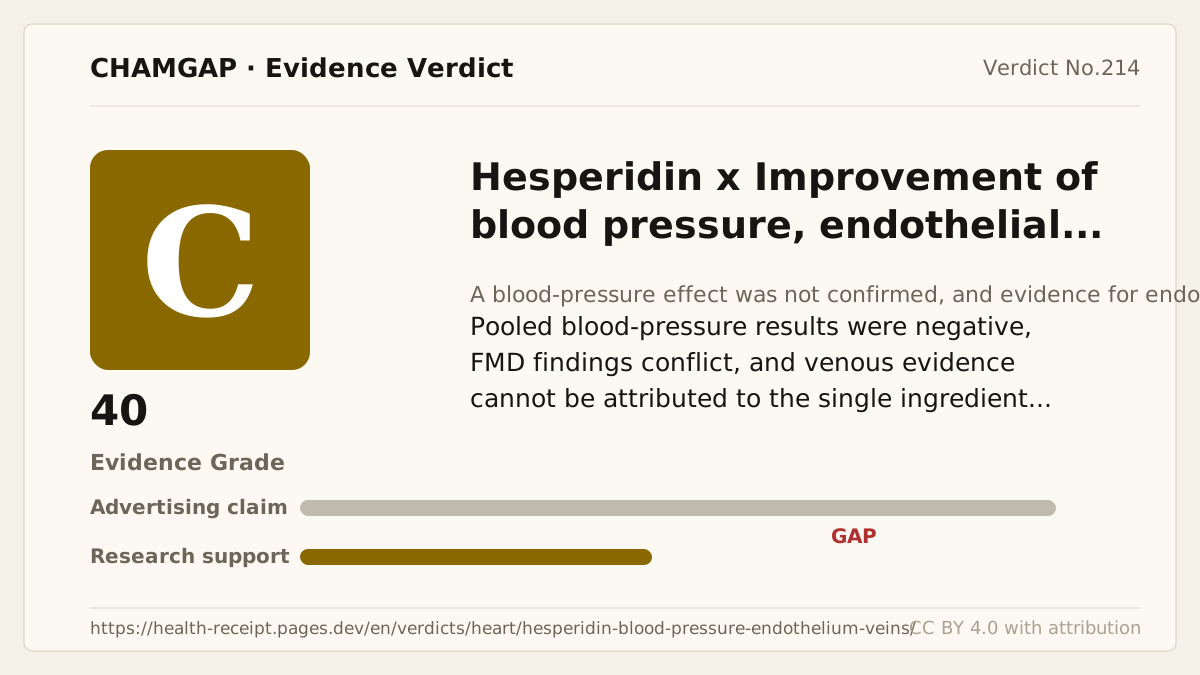
[Chamgap] Hesperidin x Improvement of blood pressure, endothelial function, and venous circulation — Evidence Grade C·40. 3 cited sources checked. Source: https://chamgap.com/en/verdicts/heart/hesperidin-blood-pressure-endothelium-veins/ · CC BY 4.0CC BY 4.0 — free to use with attribution; do not distort grades, numbers, or verdict meaning.
What this document does and does not do
Chamgap is an information source. It reports what research has and has not confirmed; it does not tell readers what to take or buy. That decision belongs to readers and, when needed, medical or legal professionals. This verdict reflects literature available up to the search date and may change as new research appears. Nothing here is medical advice.