
Tisochrysis lutea powder,
does it really help with Improvement of dry-eye symptoms and tear secretion?
research showsIn a randomized trial of 100 participants, OSDI decreased more with 900 mg/day for 12 weeks than with placebo, and some Schirmer-test results improved. The grade is C because only one Korean study exists and tear break-up time results were limited by time point and eye.
ads claimAdvertisements may broadly claim tear generation and ocular-surface restoration. The clearest clinical result is a 12-week OSDI change in adults with mild symptoms; treatment of severe dry eye and long-term recurrence prevention were not evaluated.
Useful facts when choosing a product
- The clinical dose was 900 mg/day for 12 weeks.
- Participants had OSDI scores of 13 to 32 and used digital devices for at least four hours daily.
- Ninety-three participants completed the study.
- The paper reported no major safety concern.
What the research actually shows
The 2024 study by Kim and colleagues randomized 100 adults with mild dry-eye symptoms who used digital devices for at least four hours daily to T. lutea powder at 900 mg/day or a maltodextrin placebo. Ninety-three completed the trial; at week 12, OSDI changed from 19.78 to 13.27 in the test group and from 21.35 to 18.48 in controls. Schirmer testing increased from baseline in both eyes in the test group, while significant tear break-up time findings were limited to the right eye at week six. The authors declared no conflicts, but no independent replication exists.
Why this is classified as C (58)
Regulatory recognition is not grading evidence. A positive primary OSDI endpoint and supportive tear-secretion signals favor human efficacy, but public evidence consists of one manufacturer-specific proprietary-product RCT, objective measures were only partly consistent, and independent replication is absent. This supports C with 58 points.
Counterpoint. A symptom-improvement signal was confirmed in adults with mild dry eye using the exact powder at 900 mg/day for 12 weeks.
Rejudgment record. Reassessment (cross-check reflected) — Regulatory recognition is not grading evidence; the primary 12-week OSDI endpoint and some Schirmer results were positive in one 100-person trial of a manufacturer-specific proprietary product, but tear break-up time and staining findings were limited and no independent replication exists
Cross-check — Codex and Claude
Evidence Table
| Study | Design | Sample | Funding | Endpoint | Result | Weight |
|---|---|---|---|---|---|---|
| Kim CW et al. 2024 | Randomized placebo-controlled human trial | 12 | The paper declared no conflicts; detailed funding was unclear | Primary OSDI endpoint, Schirmer test, tear break-up time, and corneoconjunctival staining | A between-group difference in OSDI at week 12 and some Schirmer improvement; positive tear break-up time findings were limited by time point and eye. | Key |
| Hong SC et al. 2022 | Cell and mouse mechanistic study | 7 | Supported by the Korean oceans ministry and KIST; a coauthor was affiliated with the ingredient company | Tear volume, corneal damage, and inflammatory pathways | Improved tear volume and tissue measures in a scopolamine dry-eye mouse model. | Supportive |
Receipt — 2 References
All 2 cited sources were verified for existence at the original page (as of 2026-07-11).
Reviewed and approved: Chamgap Editorial Team · Approval date: 2026-07-11 · Corrections: none
Cite this verdict
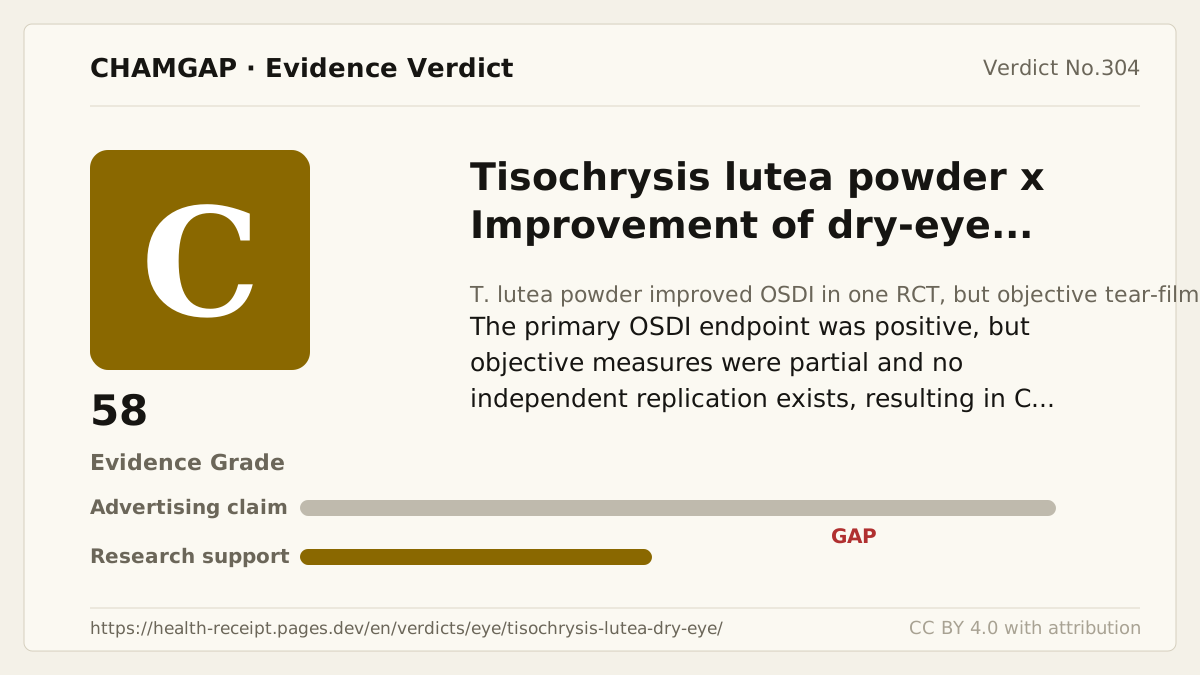
[Chamgap] Tisochrysis lutea powder × Improvement of dry-eye symptoms and tear secretion — Evidence Grade C·58. 2 cited sources checked. Source: https://chamgap.com/en/verdicts/eye/tisochrysis-lutea-dry-eye/ · CC BY 4.0CC BY 4.0 — free to use with attribution; do not distort grades, numbers, or verdict meaning.
What this document does and does not do
Chamgap is an information source. It reports what research has and has not confirmed; it does not tell readers what to take or buy. That decision belongs to readers and, when needed, medical or legal professionals. This verdict reflects literature available up to the search date and may change as new research appears. Nothing here is medical advice.