
Maqui berry extract,
does it really help with Improvement in dry eye and tear production?
research showsIn a 74-person double-blind placebo-controlled RCT of standardized maqui berry extract, four-week Schirmer tear volume increased by 6.4 mm versus placebo (p=0.005), and some dry-eye symptoms improved. An independent 20-patient RCT also found positive OSDI and Schirmer results. Tear volume and patient symptoms are clinical endpoints directly relevant to this claim, but concentration on supplied MaquiBright material and small samples place the evidence at the bottom of B.
ads claimProducts present “lacrimal-gland activation,” “tear production,” “dry-eye relief,” and “screen-fatigue relief.” The human evidence concerns short-term Schirmer and symptom outcomes for specific anthocyanin- and delphinidin-standardized formulations and does not establish efficacy for every cause of dry eye or long-term treatment.
Useful facts when choosing a product
- Study formulations were MaquiBright®/BrightSight® or related standardized extracts, most commonly at 30–60 mg/day.
- The 60 mg powder was reported to contain 21 mg total anthocyanins and 15 mg total delphinidins.
- The main objective endpoint was the Schirmer test; TBUT and corneal-staining results were not consistently positive.
- No serious adverse events were reported in the four-week and two-month trials, but long-term safety data are limited.
What the research actually shows
The Hitoe 2014 pilot, conducted by Oryza researchers, gave 13 participants 30 or 60 mg/day for 60 days and reported increased tear volume, but it had no placebo group. Yamashita 2019 assigned 74 people with eye dryness and fatigue associated with VDT work to 60 mg/day or placebo and reported improved Schirmer tear volume and some VAS and DEQS symptoms after four weeks; Oryza provided the study capsules. Kundu 2023 randomized 20 patients with dry eye and found improvements in OSDI and Schirmer testing after two months, but no change in TBUT or corneal staining, and reported no financial support or conflicts of interest.
Why this is classified as B (60)
The 74-person RCT's 6.4-mm placebo-adjusted Schirmer increase and symptom improvement were replicated by positive OSDI and Schirmer results in an independent 20-patient RCT. Two placebo-controlled trials with direct clinical endpoints support B, while supplied MaquiBright material and small samples place it at the lower bound of 60 points.
Counterpoint. A limited replication signal remains because Schirmer tear volume and OSDI improved in placebo-controlled trials conducted by different research groups.
Rejudgment record. Reassessment (cross-check reflected) — A 74-person double-blind RCT found a four-week 6.4-mm placebo-adjusted Schirmer increase (p=0.005) and symptom improvement, and an independent 20-patient RCT was positive for OSDI and Schirmer; these are direct clinical endpoints, while supplied MaquiBright material and small samples limit the grade to the bottom of B
Sub-claim grades by effect
This ingredient is marketed for several effects. A single overall grade blends strong and weak claims together, so each effect is graded separately here. The overall grade reflects the strongest disconfirming or core claim.
| Effect (sub-claim) | Grade | Basis |
|---|---|---|
| Improvement in dry-eye symptoms | B | Some symptom improvement in the 74-person RCT and OSDI improvement in an independent 20-patient RCT were replicated, but samples were small. |
| Increased tear production | B | The 6.4-mm placebo-adjusted Schirmer increase in the 74-person RCT and a positive Schirmer result in an independent 20-patient RCT replicated a direct clinical endpoint. |
Cross-check — Codex and Claude
Evidence Table
| Study | Design | Sample | Funding | Endpoint | Result | Weight |
|---|---|---|---|---|---|---|
| Hitoe S et al. 2014 | Open dose-ranging pilot study without placebo | 60 | All authors affiliated with the R&D division of Oryza Oil & Fat Chemical | Schirmer test and dry-eye questionnaire | Both 30 mg and 60 mg groups increased tear volume from baseline, but there was no placebo group. | Ancillary |
| Yamashita SI et al. 2019 | Randomized, double-blind, placebo-controlled trial | 4 | Oryza provided the study capsules; conducted by a contract clinical-research organization | Schirmer, TBUT, pupillary response, flicker, VAS, and DEQS | At 60 mg/day, Schirmer tear volume increased by 6.4±8.1 mm versus placebo (p=0.005), and some symptoms improved. | Key |
| Kundu G et al. 2023 | Randomized placebo-controlled trial | 2 | Reported no financial support and no conflicts of interest | OSDI, Schirmer 1, TBUT, corneal staining, and tear inflammatory factors | OSDI and Schirmer improved, but TBUT and corneal staining showed no significant change versus placebo. | Key |
Receipt — 3 References
All 3 cited sources were verified for existence at the original page (as of 2026-07-11).
Reviewed and approved: Chamgap Editorial Team · Approval date: 2026-07-11 · Corrections: none
Cite this verdict
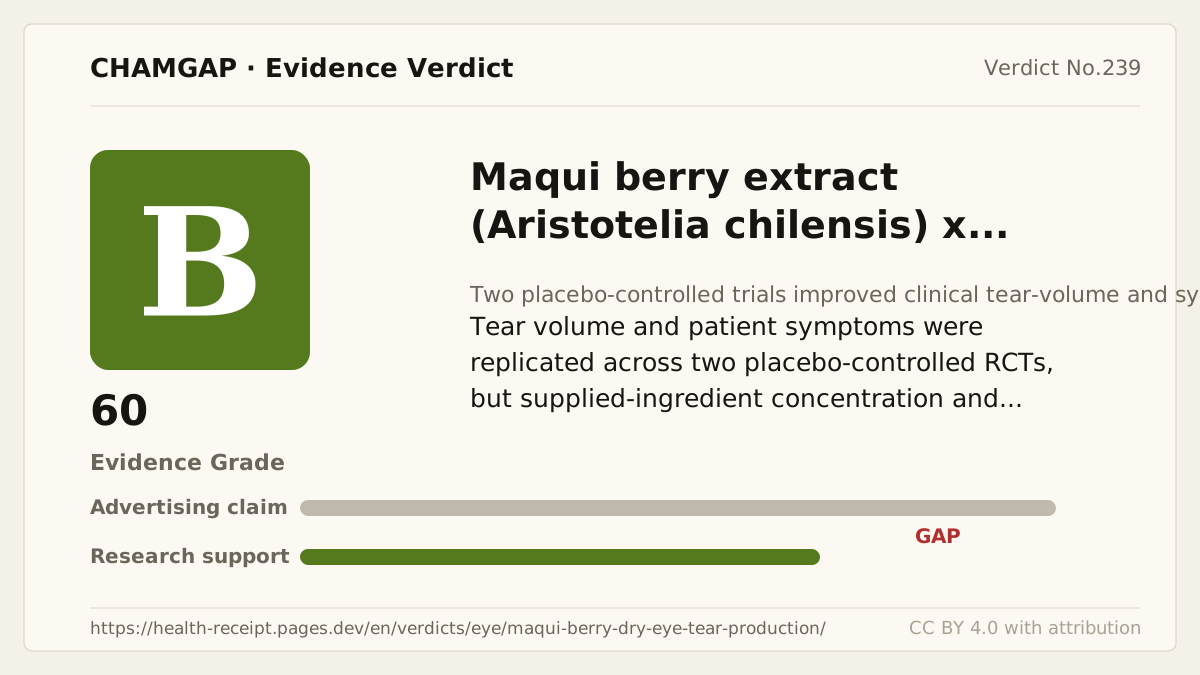
[Chamgap] Maqui berry extract (Aristotelia chilensis) x improvement in dry eye and tear production — Evidence Grade B·60. 3 cited sources checked. Source: https://chamgap.com/en/verdicts/eye/maqui-berry-dry-eye-tear-production/ · CC BY 4.0CC BY 4.0 — free to use with attribution; do not distort grades, numbers, or verdict meaning.
What this document does and does not do
Chamgap is an information source. It reports what research has and has not confirmed; it does not tell readers what to take or buy. That decision belongs to readers and, when needed, medical or legal professionals. This verdict reflects literature available up to the search date and may change as new research appears. Nothing here is medical advice.