
Perilla leaf extract,
does it really help with Eye-fatigue relief?
research showsPerilla leaf aqueous extract improved visual-function measures such as near points and accommodation after smartphone VDT work in a small placebo-controlled study of roughly 30 participants and one week. The paper is internally inconsistent, stating both 30 participants total and 30 per group, so a definitive total is not asserted. The grade is C because the 2017 reports share investigators, may overlap in samples, and focus on accommodative surrogates.
ads claimAdvertising presents 'ciliary muscle relaxation,' 'focus recovery,' and 'smartphone eye-fatigue relief' as a single established effect. The human data directly concern short-term accommodation before and after a VDT challenge, not long-term vision preservation or prevention of eye disease.
Useful facts when choosing a product
- The research formulation was a perilla leaf aqueous extract at 500 mg/day.
- The assessment period was limited to a single intake or one week.
- Main outcomes were surrogates such as near-point accommodation, near point of convergence, accommodative power, and accommodative facility.
- The research received a government industrial-support grant, and no independent large replication was identified.
What the research actually shows
The Kim 2017 study used perilla leaf aqueous extract at 500 mg/day for one week before a two-hour smartphone VDT challenge and reported improved near-point accommodation. Because the paper states both 30 participants total and 30 per group, the definitive total is not asserted and the study is described as roughly 30 participants. The related Jeong 2017 report evaluated similar visual-function measures, but the same-year reports share investigators and similar protocols and may overlap in samples, so they were not counted as independent replications.
Why this is classified as C (45)
Direct placebo-controlled human data exist, but the evidence is small, brief, surrogate-centered, and potentially overlapping in investigators and samples, resulting in C with 45 points.
Counterpoint. A short-term signal for reducing deterioration in accommodation after VDT work remains. This judgment does not include long-term vision protection or prevention of eye disease.
Rejudgment record. Reassessment (cross-check reflected) — A positive roughly 30-person, one-week placebo-controlled signal, but internally inconsistent sample reporting, overlapping 2017 investigators and possibly samples, accommodative surrogates, and no independent replication
Cross-check — Codex and Claude
Evidence Table
| Study | Design | Sample | Funding | Endpoint | Result | Weight |
|---|---|---|---|---|---|---|
| Kim J et al. 2017 | Randomized double-blind placebo-controlled trial | 30 | Support program funded by the Korean Ministry of Trade, Industry and Energy | Near-point accommodation after a two-hour VDT challenge | One week of perilla leaf aqueous extract at 500 mg/day improved near-point accommodation versus placebo after the VDT challenge. | Key |
| Jeong KI et al. 2017 | Placebo-controlled crossover-style visual-function study | 30 | Government and research-institute linked; details unknown | Near point of convergence, accommodative power, and accommodative facility | Favorable changes followed extract intake, with possible sample overlap with related research. | Supportive |
Receipt — 2 References
All 2 cited sources were verified for existence at the original page (as of 2026-07-11).
Reviewed and approved: Chamgap Editorial Team · Approval date: 2026-07-11 · Corrections: none
Cite this verdict
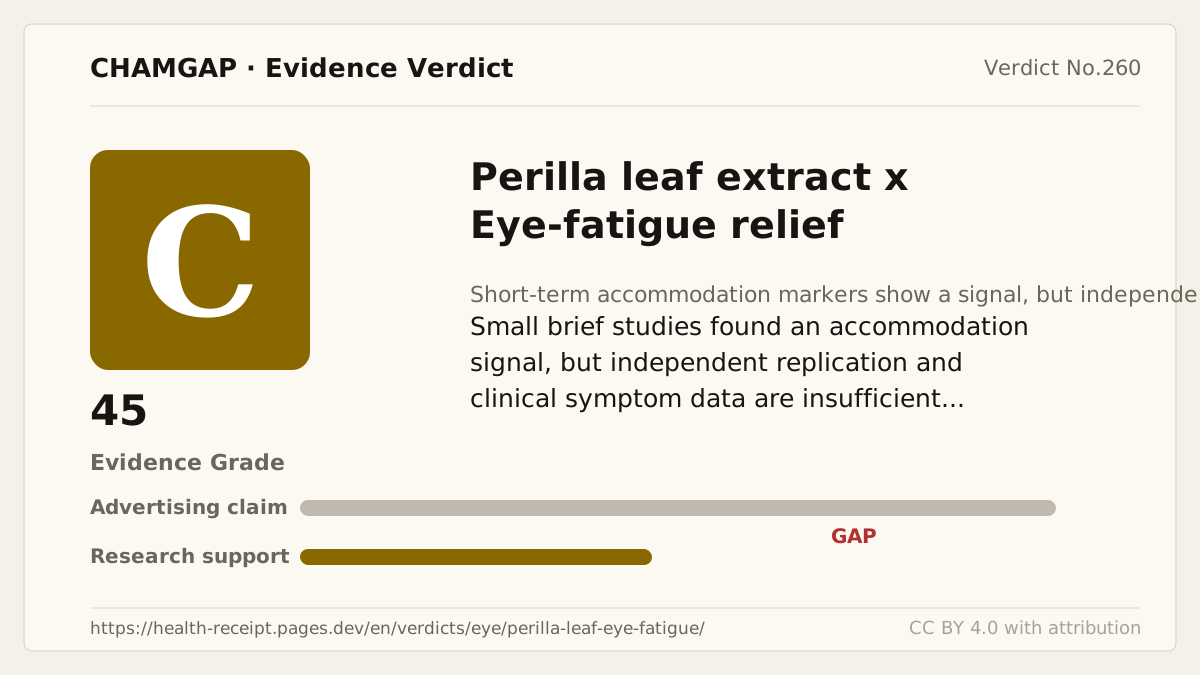
[Chamgap] Perilla leaf extract x eye-fatigue relief — Evidence Grade C·45. 2 cited sources checked. Source: https://chamgap.com/en/verdicts/eye/perilla-leaf-eye-fatigue/ · CC BY 4.0CC BY 4.0 — free to use with attribution; do not distort grades, numbers, or verdict meaning.
What this document does and does not do
Chamgap is an information source. It reports what research has and has not confirmed; it does not tell readers what to take or buy. That decision belongs to readers and, when needed, medical or legal professionals. This verdict reflects literature available up to the search date and may change as new research appears. Nothing here is medical advice.