
Centella asiatica extract powder,
does it really help with Maintenance of macular pigment density and eye health?
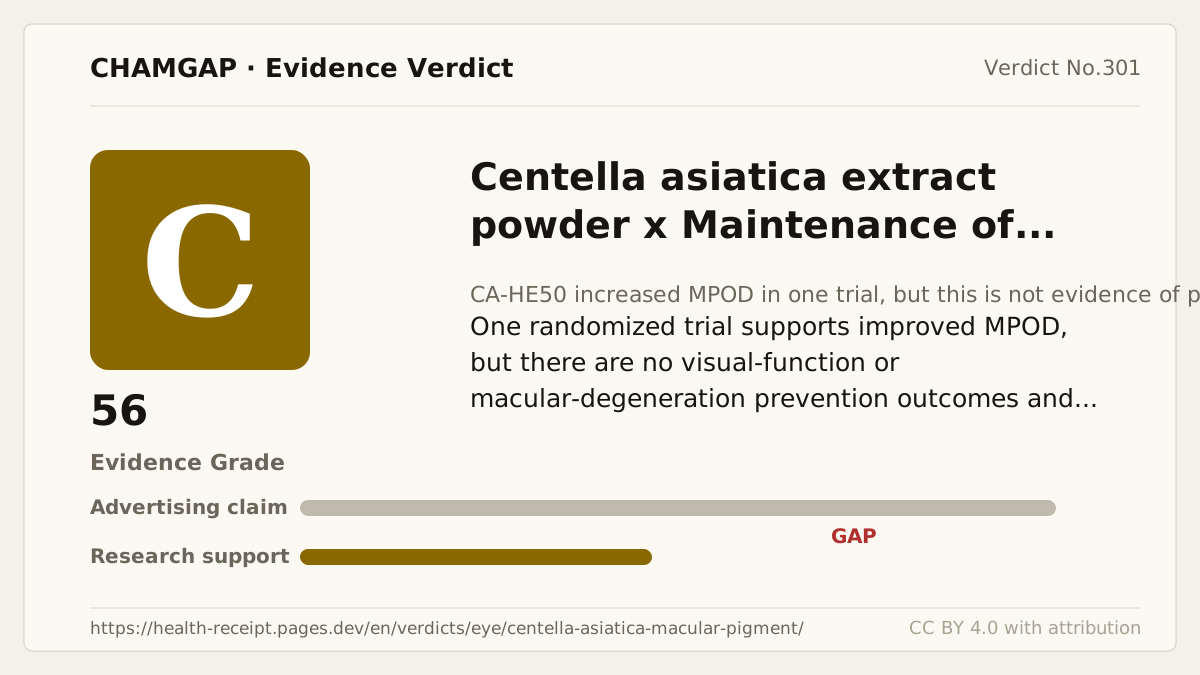
research showsA randomized trial of standardized Centella asiatica extract CA-HE50 at 300 mg/day for six months in 80 participants found a greater increase in macular pigment optical density (MPOD) than placebo. However, the published human evidence is concentrated in this single industry-linked trial, and MPOD is a surrogate rather than an outcome of disease incidence or preserved visual function, so the grade is C.
ads claimProduct descriptions may translate maintenance of macular pigment into broad eye health or protection against age-related macular disease. The published clinical data directly support only a change in MPOD among middle-aged adults with low MPOD.
Useful facts when choosing a product
- The trial used CA-HE50 standardized to asiaticoside, which is not interchangeable with generic gotu kola powder.
- The study dose was 300 mg/day for six months.
- The key outcome was MPOD; visual acuity and macular-degeneration incidence were not evaluated.
- No serious safety signal appeared in the trial, but rare liver injury has been reported with oral Centella products.
What the research actually shows
The 2026 trial by Baek and colleagues randomized 80 adults aged 45 to 65 years with MPOD of 0.2 to 0.4 to CA-HE50 300 mg/day or placebo and followed them for 180 days. The primary endpoint, MPOD at day 180, increased relative to placebo in the right eye, left eye, and bilateral average. The study received government support and ingredient-manufacturing support, company employees were coauthors, and visual function or clinical macular-degeneration outcomes were not measured.
Why this is classified as C (56)
Regulatory recognition is not grading evidence. Published evidence is concentrated in one manufacturer-linked trial of the proprietary CA-HE50 product using the MPOD surrogate, with no independent replication or visual-function or disease outcome, so the grade is C. Consistent results in both eyes support 56 points in the middle-to-upper C range.
Counterpoint. A signal for improving MPOD remains for the exact CA-HE50 formulation. This judgment does not include preservation of vision or prevention of macular degeneration.
Rejudgment record. Reassessment (cross-check reflected) — Regulatory recognition is not grading evidence; one manufacturer-linked trial of the proprietary CA-HE50 product was positive for MPOD, but only a surrogate was measured and there is no independent replication or visual-function or disease outcome
Sub-claim grades by effect
This ingredient is marketed for several effects. A single overall grade blends strong and weak claims together, so each effect is graded separately here. The overall grade reflects the strongest disconfirming or core claim.
| Effect (sub-claim) | Grade | Basis |
|---|---|---|
| Increase in macular pigment optical density (MPOD) | C | A single six-month RCT in 80 participants was positive, but industry involvement and lack of independent replication remain. |
| Preservation of visual function and prevention of macular degeneration | ? | No human trial of Centella extract assessing these clinical endpoints was identified. |
Cross-check — Codex and Claude
Evidence Table
| Study | Design | Sample | Funding | Endpoint | Result | Weight |
|---|---|---|---|---|---|---|
| Baek HI et al. 2026 | Randomized double-blind placebo-controlled trial | 6 | Supported by the Korean agriculture ministry and manufacturing support from GENENCELL; company employees were coauthors | Change in MPOD at day 180 as the primary endpoint | MPOD increased versus placebo in the right eye, left eye, and bilateral average, all with p<0.001. | Key |
Receipt — 1 References
All 1 cited sources were verified for existence at the original page (as of 2026-07-11).
Reviewed and approved: Chamgap Editorial Team · Approval date: 2026-07-11 · Corrections: none
Cite this verdict
[Chamgap] Centella asiatica extract powder × Maintenance of macular pigment density and eye health — Evidence Grade C·56. 1 cited sources checked. Source: https://chamgap.com/en/verdicts/eye/centella-asiatica-macular-pigment/ · CC BY 4.0CC BY 4.0 — free to use with attribution; do not distort grades, numbers, or verdict meaning.
What this document does and does not do
Chamgap is an information source. It reports what research has and has not confirmed; it does not tell readers what to take or buy. That decision belongs to readers and, when needed, medical or legal professionals. This verdict reflects literature available up to the search date and may change as new research appears. Nothing here is medical advice.