
Royal jelly,
does it really help with Fatigue recovery and increased vitality?
research showsFor the fatigue subclaim, a 64-person stroke RCT was null, while the positive 52-person cancer-fatigue trial compared a processed-honey-plus-royal-jelly formulation with a honey control and therefore measured the difference between the complete formulations; this subclaim is D. Exercise endurance is C based on a positive trial in 18 athletes.
ads claimAdvertisements bundle tonification, immunity, fatigue recovery, and vitality, while human evidence varies by disease, exercise context, and formulation.
Useful facts when choosing a product
- The exercise trial used 1 g/day of freeze-dried royal jelly for two weeks.
- The positive cancer-fatigue trial used a combination of processed honey and royal jelly.
- Bee-product allergy and possible anaphylaxis are reflected in safety.
What the research actually shows
Mofid 2016 reported that a processed-honey-plus-royal-jelly formulation improved fatigue versus a honey control in 52 cancer patients; this was a difference between the complete formulations. Karimi 2024 found no significant fatigue difference in 64 stroke patients. Pasdar 2025 found that 1 g/day for two weeks increased time to exhaustion by 4.63 minutes versus placebo in 18 endurance athletes.
Why this is classified as C (44)
Direct human trials exist, but fatigue results conflict and positive evidence depends on a combination or a single 18-person exercise trial, resulting in C with 44 points.
Counterpoint. A direct placebo-controlled signal remains for the exercise-endurance subclaim.
Rejudgment record. Reassessment (cross-check reflected) — A 64-person post-stroke fatigue RCT was null, the positive 52-person cancer-fatigue result reflected a difference between complete formulations, and the positive exercise-endurance result is limited to one 18-person trial
Sub-claim grades by effect
This ingredient is marketed for several effects. A single overall grade blends strong and weak claims together, so each effect is graded separately here. The overall grade reflects the strongest disconfirming or core claim.
| Effect (sub-claim) | Grade | Basis |
|---|---|---|
| Fatigue | D | Post-stroke fatigue RCT was negative; positive cancer-fatigue evidence used a honey combination |
| Exercise endurance | C | Time to exhaustion improved in an 18-athlete crossover trial, but it is a single small study |
Cross-check — Codex and Claude
Evidence Table
| Study | Design | Sample | Funding | Endpoint | Result | Weight |
|---|---|---|---|---|---|---|
| Mofid B et al. 2016 | Double-blind randomized combination-controlled trial | 52 | No external financial support | Cancer-related fatigue by visual-analogue and fatigue-severity scales | Processed honey plus royal jelly improved fatigue versus honey control. | Indirect, combination |
| Karimi E et al. 2024 | Triple-blind randomized placebo-controlled trial | 64 | No commercial conflict declared | Fatigue, cognition, mental health, and BDNF | Selected outcomes including cognition improved, but the fatigue difference was not significant. | Key, negative |
| Pasdar Y et al. 2025 | Randomized double-blind placebo-controlled crossover trial | 18 | Academic research; no conflict declared | Time to exhaustion, perceived exertion, oxidative markers, and PGC-1 alpha | Time to exhaustion increased by 4.63 minutes versus placebo, while perceived exertion and most oxidative markers did not differ. | Direct, small |
Receipt — 3 References
All 3 cited sources were verified for existence at the original page (as of 2026-07-11).
Reviewed and approved: Chamgap Editorial Team · Approval date: 2026-07-11 · Corrections: none
Cite this verdict
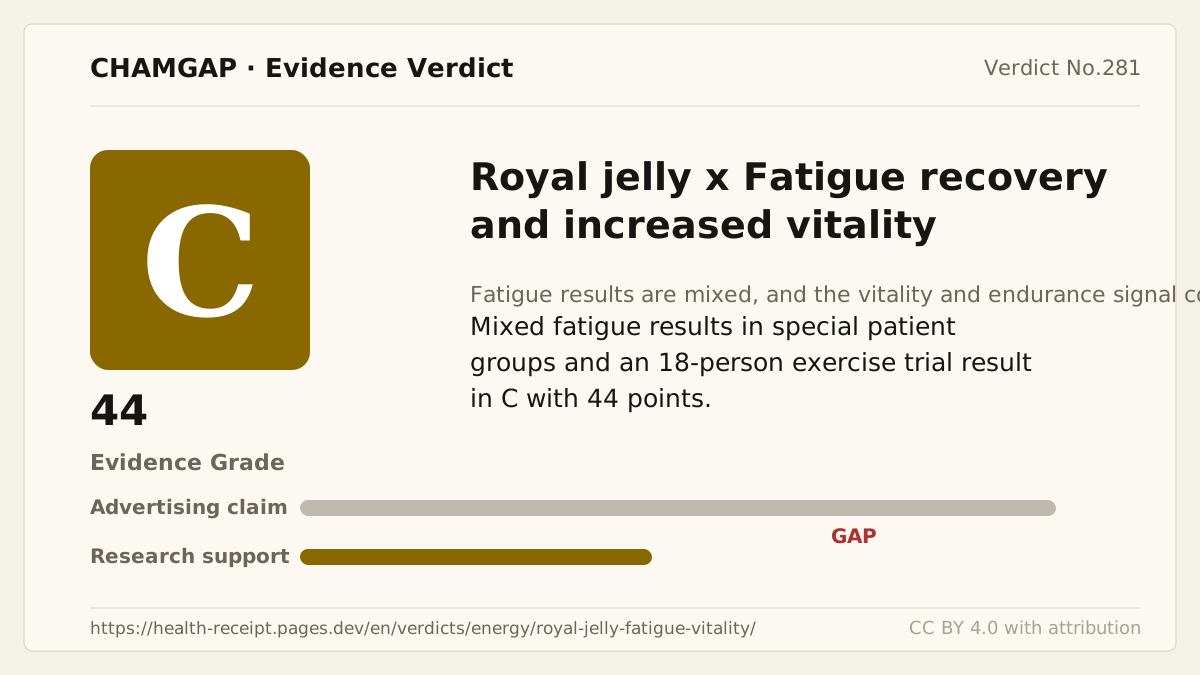
[Chamgap] Royal jelly x fatigue recovery and increased vitality — Evidence Grade C·44. 3 cited sources checked. Source: https://chamgap.com/en/verdicts/energy/royal-jelly-fatigue-vitality/ · CC BY 4.0CC BY 4.0 — free to use with attribution; do not distort grades, numbers, or verdict meaning.
What this document does and does not do
Chamgap is an information source. It reports what research has and has not confirmed; it does not tell readers what to take or buy. That decision belongs to readers and, when needed, medical or legal professionals. This verdict reflects literature available up to the search date and may change as new research appears. Nothing here is medical advice.