
Vitamin B1,
does it really help with Fatigue and nerve function?
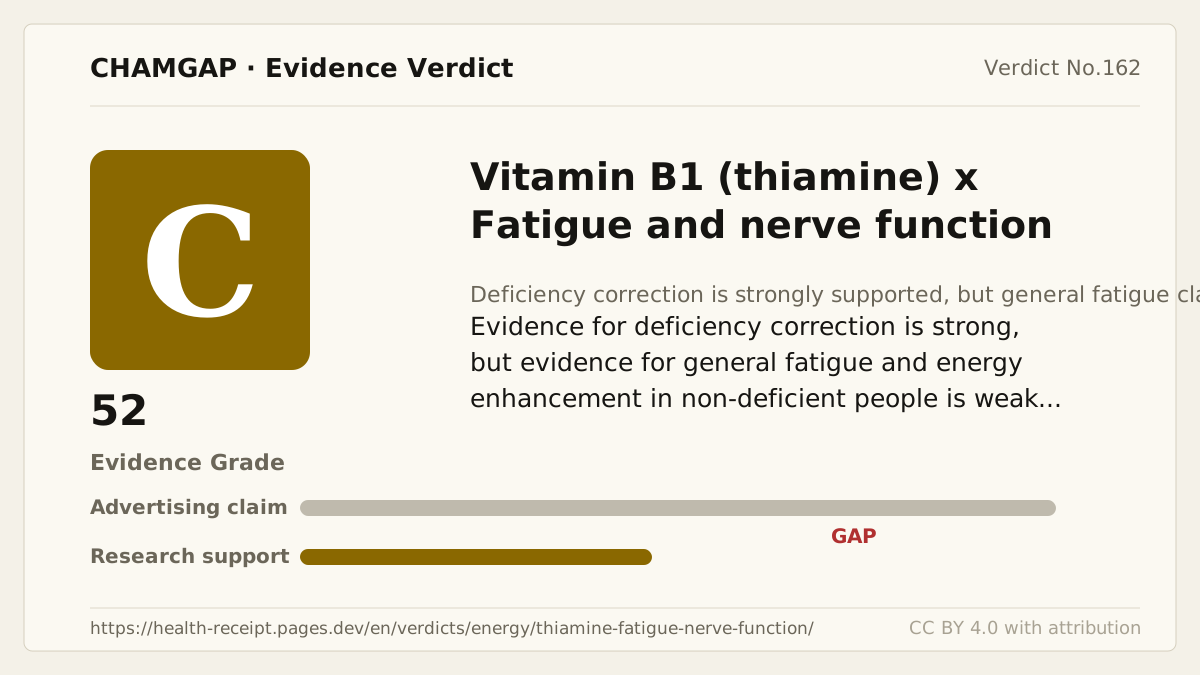
research showsThiamine deficiency causes beriberi and Wernicke-Korsakoff syndrome, and the evidence that supplementation treats and prevents these conditions is strong. However, most people consume the recommended amount, and evidence supporting "fatigue/energy enhancement" in non-deficient general populations has not been separately established. Therefore, the judgment is divided into strong evidence for deficiency correction and weak evidence for general fatigue claims, with an overall grade of C.
ads claimAdvertisements claim 'fatigue recovery,' 'vitality,' 'nerve vitamin,' 'carbohydrate metabolism,' and 'eye twitching/numbness.' The parts with strong evidence are deficiency prevention/correction and deficiency-related neurologic disease.
Useful facts when choosing a product
- The adult recommended intake is roughly around 1 mg/day, and need varies with carbohydrate intake, alcohol use, malabsorption, diuretic use, and other factors.
- As a water-soluble vitamin, safety at ordinary doses is generally good, but high-dose injections belong in the domain of medical management.
- Derivatives such as benfotiamine should be evaluated separately for claims such as diabetic neuropathy.
- If fatigue persists, other causes such as anemia, thyroid disease, sleep, depression, infection, and medications should also be considered.
What the research actually shows
Medical and nutritional evidence establishes that thiamine deficiency causes dry/wet beriberi, Wernicke-Korsakoff syndrome, and peripheral neuropathy, and that supplementation treats and prevents these conditions. In risk groups such as alcohol use disorder, malnutrition, hyperemesis gravidarum, and bariatric surgery, thiamine administration for Wernicke prevention/treatment has strong evidence in the deficiency context. However, most people consume the recommended amount, and separate high-quality evidence has not been established that single thiamine supplementation significantly improves fatigue or energy in non-deficient healthy people.
Why this is classified as C (52)
Physiological and clinical evidence for deficiency correction and maintenance of nerve function is strong, but the supplement claim under judgment, general fatigue and energy enhancement, lacks direct RCT evidence. Separating strong deficiency correction from weak general fatigue claims gives the general efficacy rating C with 52 points.
Counterpoint. Supplementation can have substantial meaning in deficiency-risk groups. This judgment does not view additional fatigue-recovery effects in people with sufficient intake as A/B-level.
Rejudgment record. Final reassessment — Deficiency correction is strong, but evidence for non-deficient general fatigue/energy enhancement has not been established, so C
Cross-check — Codex and Claude
Evidence Table
| Study | Design | Sample | Funding | Endpoint | Result | Weight |
|---|---|---|---|---|---|---|
| NIH Office of Dietary Supplements Thiamin Fact Sheet | Public-agency nutrition evidence summary | U.S. NIH | Deficiency, nerve function, and recommended intake | Summarizes thiamine deficiency and clinical problems such as beriberi/Wernicke. | Key | |
| Cochrane/clinical reviews on Wernicke prevention and treatment | Systematic review and clinical evidence | Public/unknown | Wernicke prevention and treatment | Thiamine administration in risk groups is within standard treatment/prevention. | Key | |
| Study 3 | Limited human research | Unknown | Fatigue | Evidence that single thiamine improves fatigue in non-deficient healthy people is limited. | Supportive |
Receipt — 3 References
All 3 cited sources were verified for existence at the original page (as of 2026-07-09).
Reviewed and approved: Chamgap Editorial Team · Approval date: 2026-07-09 · Corrections: none
Cite this verdict
[Chamgap] Vitamin B1 (thiamine) x fatigue and nerve function — Evidence Grade C·52. 3 cited sources checked. Source: https://chamgap.com/en/verdicts/energy/thiamine-fatigue-nerve-function/ · CC BY 4.0CC BY 4.0 — free to use with attribution; do not distort grades, numbers, or verdict meaning.
What this document does and does not do
Chamgap is an information source. It reports what research has and has not confirmed; it does not tell readers what to take or buy. That decision belongs to readers and, when needed, medical or legal professionals. This verdict reflects literature available up to the search date and may change as new research appears. Nothing here is medical advice.