
Sage extract,
does it really help with Improvement of memory and attention?
research showsRepeated cognitive-task signals across randomized trials are recognized. However, S. lavandulifolia essential oil, S. officinalis extract, and the two-species Cognivia blend are mixed despite substantial formulation heterogeneity; the evidence centers on small single-dose crossover trials and lacks long-term daily-function endpoints, so the grade is C.
ads claimProducts use claims such as 'memory enhancement,' 'focus,' 'acetylcholine protection,' and 'brain booster.' Research used S. officinalis, S. lavandulifolia essential oil, and combinations of the two in different formulations, so the same effect cannot be assumed for plain sage powder or an arbitrary extract.
Useful facts when choosing a product
- Human trials used heterogeneous formulations, including essential oil at 25-150 μL, S. officinalis extract at 167-1332 mg, and a two-species combination extract at 600 mg.
- The young- and older-adult trials mainly measured computerized cognitive tasks one to six hours after dosing.
- The 29-day trial used the branded Cognivia ingredient and was funded by and coauthored with the manufacturer Nexira.
- Thujone content in sage essential oil varies by product, so concentrated essential oil and ordinary leaf extracts do not have identical safety profiles.
What the research actually shows
Tildesley 2003 reported that 50 μL of S. lavandulifolia essential oil improved immediate word recall in two crossover trials of 20 and 24 healthy young adults. Scholey 2008 gave 20 adults older than 65 years S. officinalis extract at 167-1332 mg in a crossover design and found improved secondary memory and attention accuracy over six hours with 333 mg. Wightman 2021 gave 94 adults aged 30-60 years 600 mg of a combination of S. officinalis polyphenols and S. lavandulifolia terpenoids for 29 days and reported acute and chronic signals in selected working-memory and accuracy tasks. Akhondzadeh 2003 reported improved ADAS-cog and CDR-SB in a four-month trial of 42 patients with Alzheimer's disease, but that population differs from a memory-supplement claim in healthy adults.
Why this is classified as C (57)
Repeated cognitive-task signals place the evidence above D. However, heterogeneity across S. lavandulifolia essential oil, S. officinalis extract, and the two-species Cognivia blend, small single-dose crossover trials, industry support, and no long-term daily-function endpoint support C with 57 points.
Counterpoint. Repeated memory signals across age groups and sage formulations provide a basis for a larger independent follow-up trial. This assessment does not extend short-term cognitive-task signals to long-term memory preservation or dementia prevention.
Rejudgment record. Reassessment (cross-check reflected) — Repeated cognitive-task signals are recognized, but heterogeneity among S. lavandulifolia essential oil, S. officinalis extract, and the two-species Cognivia blend, together with small single-dose crossover trials and no long-term daily-function endpoint, supports C
Sub-claim grades by effect
This ingredient is marketed for several effects. A single overall grade blends strong and weak claims together, so each effect is graded separately here. The overall grade reflects the strongest disconfirming or core claim.
| Effect (sub-claim) | Grade | Basis |
|---|---|---|
| Improved memory | C | Recall and working-memory signals in several small acute trials and a 29-day trial; limited long-term independent replication |
| Improved attention | C | Limited to attention accuracy in a 20-person older-adult trial and selected short-term task signals |
Cross-check — Codex and Claude
Evidence Table
| Study | Design | Sample | Funding | Endpoint | Result | Weight |
|---|---|---|---|---|---|---|
| Tildesley NTJ et al. 2003 | Two randomized double-blind placebo-controlled crossover trials | 24 | Sponsored by Oxford Natural Products | Immediate and delayed word recall | S. lavandulifolia essential oil at 50 μL improved immediate word recall in both trials. | Key, acute |
| Scholey AB et al. 2008 | Randomized double-blind five-period crossover trial | 20 | Unknown | Secondary memory, attention accuracy, and working memory | S. officinalis 333 mg improved secondary memory and attention accuracy one to six hours after dosing. | Key, acute |
| Wightman EL et al. 2021 | Randomized double-blind placebo-controlled parallel trial | 94 | Funded by Nexira with a company employee as coauthor | Working memory, accuracy, and recall tasks | A 600 mg two-species combination extract for 29 days improved selected working-memory and accuracy tasks acutely and chronically. | Key, industry-linked |
| Akhondzadeh S et al. 2003 | Randomized double-blind placebo-controlled trial | 42 | Iranian academic institutions | ADAS-cog and CDR-SB | Four months of S. officinalis extract improved cognition and clinical dementia ratings versus placebo, but this was a small disease population. | Supportive disease population |
Receipt — 4 References
All 4 cited sources were verified for existence at the original page (as of 2026-07-13).
Reviewed and approved: Chamgap Editorial Team · Approval date: 2026-07-13 · Corrections: none
Cite this verdict
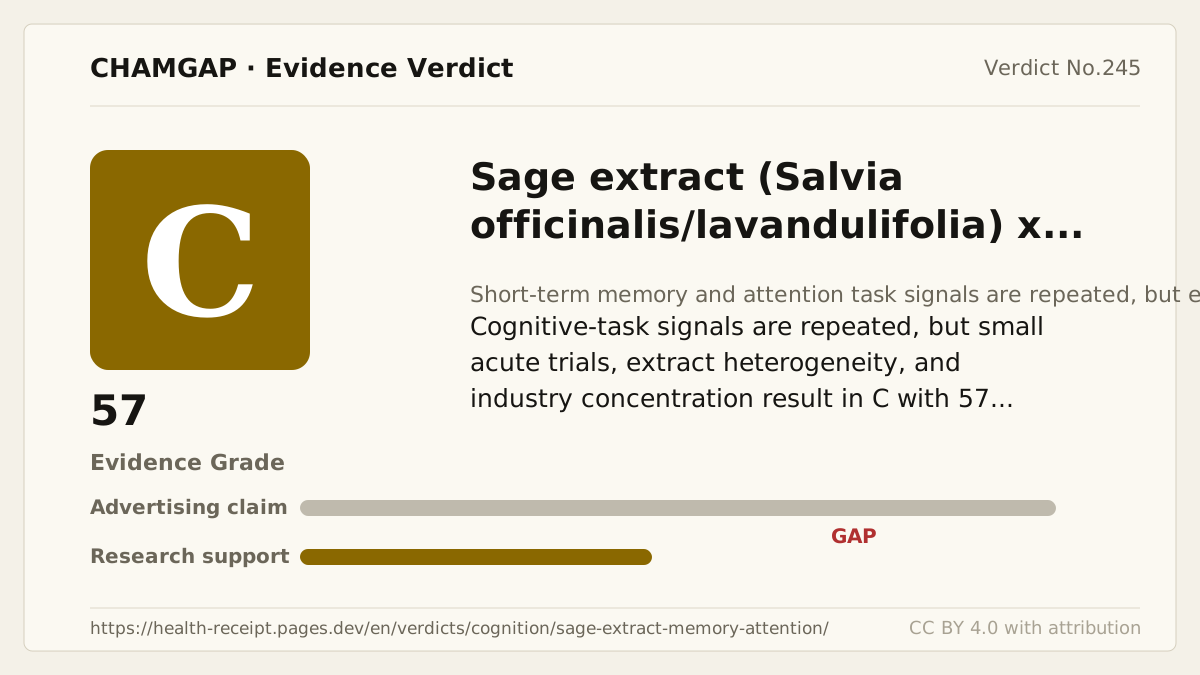
[Chamgap] Sage extract (Salvia officinalis/lavandulifolia) x improvement of memory and attention — Evidence Grade C·57. 4 cited sources checked. Source: https://chamgap.com/en/verdicts/cognition/sage-extract-memory-attention/ · CC BY 4.0CC BY 4.0 — free to use with attribution; do not distort grades, numbers, or verdict meaning.
What this document does and does not do
Chamgap is an information source. It reports what research has and has not confirmed; it does not tell readers what to take or buy. That decision belongs to readers and, when needed, medical or legal professionals. This verdict reflects literature available up to the search date and may change as new research appears. Nothing here is medical advice.