
Huperzine A,
does it really help with Memory and cognition?
research showsHuperzine A has signals of improved cognition and daily function in RCTs and meta-analyses in patients with Alzheimer disease, but most studies are evaluated as small, short-term Chinese studies with low methodological quality. The evidence is much weaker for generalizing to focus or memory supplement claims in healthy adults.
ads claimAdvertisements broadly claim 'memory,' 'brain booster,' 'focus,' 'students,' and 'dementia prevention.' The center of the actual evidence is short-term studies in patients with Alzheimer disease.
Useful facts when choosing a product
- Clinical-trial doses are usually low microgram/milligram doses in the range of 0.2-0.8 mg/day.
- Cholinergic adverse reactions such as nausea, vomiting, diarrhea, sweating, salivation, and bradycardia are possible.
- Caution is needed when combined with cholinesterase inhibitors, anticholinergics, beta blockers, and similar drugs.
- Safety data for pregnancy, lactation, and long-term use are insufficient.
What the research actually shows
The Li 2008 Cochrane review reported possible improvements in cognitive function and activities of daily living from data on 6 RCTs and 454 patients with Alzheimer disease, but concluded that study quality was low. The Yang 2013 PLOS One meta-analysis reported cognitive improvement signals in MMSE/ADAS-Cog and other measures across 20 RCTs and 1823 participants, but methodological issues such as allocation concealment, blinding, and publication bias were substantial. The Sun 1999 adolescent student study reported memory and learning signals in 34 matched adolescent pairs, but it is a small, old, single study.
Why this is classified as C (55)
Because there are RCTs with direct cognitive endpoints, the grade is not unknown or D. However, independent high-quality large RCTs are lacking, and healthy-person memory claims are essentially a separate issue, so the grade is C with 55 points.
Counterpoint. Short-term cognitive-score signals in patients with Alzheimer disease remain. This judgment does not extend them to general focus supplement efficacy in healthy adults.
Rejudgment record. Draft — Direct cognition RCTs and meta-analyses exist, but quality is low, disease-population limited, and generalization to healthy people is restricted
Cross-check — Codex and Claude
Evidence Table
| Study | Design | Sample | Funding | Endpoint | Result | Weight |
|---|---|---|---|---|---|---|
| Li J et al. 2008 | Cochrane systematic review | 454 | Unknown | Cognitive function, activities of daily living, and global assessment | There was a signal of improvement in Alzheimer disease, but study quality was low. | Key |
| Yang G et al. 2013 | Systematic review and meta-analysis | 1823 | Unknown | MMSE, ADAS-Cog, and ADL | Reported signals of cognitive and ADL improvement, but methodological quality was low. | Key |
| Sun QQ et al. 1999 | Randomized/controlled student study | 34 | Unknown | Memory and learning performance | Signal of improved memory and learning performance in adolescents. | Low |
Receipt — 3 References
All 3 cited sources were verified for existence at the original page (as of 2026-07-09).
Reviewed and approved: Chamgap Editorial Team · Approval date: 2026-07-09 · Corrections: none
Cite this verdict
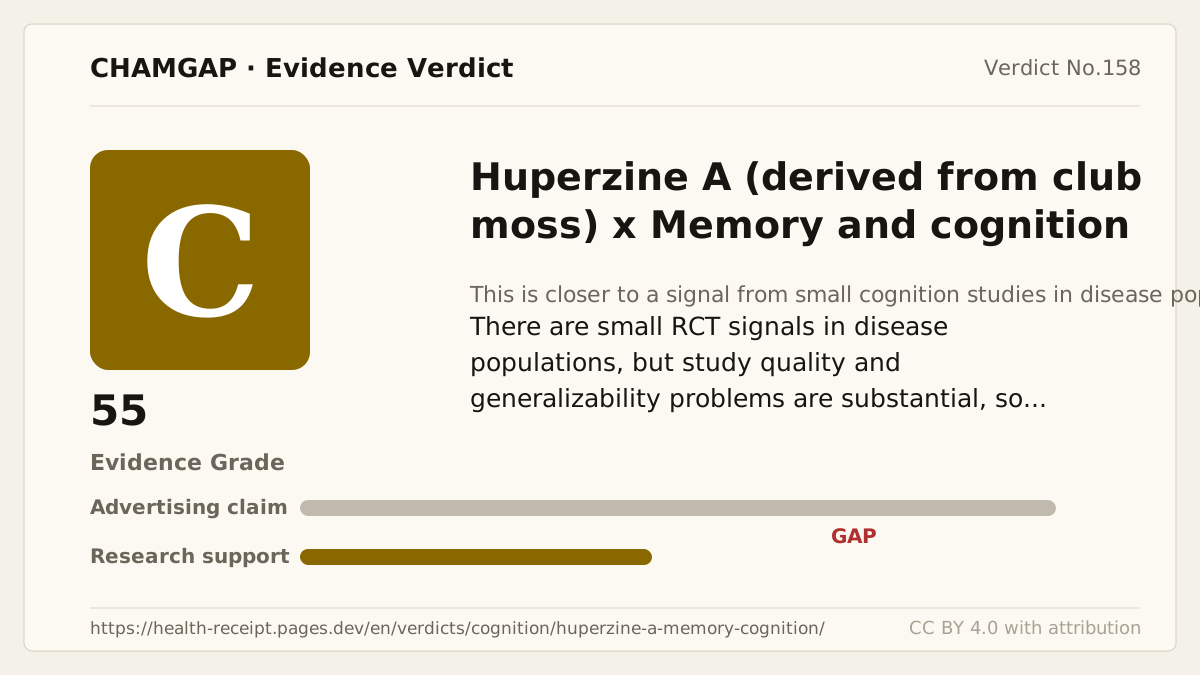
[Chamgap] Huperzine A x memory and cognition — Evidence Grade C·55. 3 cited sources checked. Source: https://chamgap.com/en/verdicts/cognition/huperzine-a-memory-cognition/ · CC BY 4.0CC BY 4.0 — free to use with attribution; do not distort grades, numbers, or verdict meaning.
What this document does and does not do
Chamgap is an information source. It reports what research has and has not confirmed; it does not tell readers what to take or buy. That decision belongs to readers and, when needed, medical or legal professionals. This verdict reflects literature available up to the search date and may change as new research appears. Nothing here is medical advice.