
Bacopa monnieri,
does it really help with Memory and cognition?
research showsBacopa has positive signals in some memory and attention submeasures, but study size, populations, and endpoints are limited. Even for the narrow claim of 'memory improvement,' the evidence is limited, so it is judged C.
ads claimProducts in Korea and abroad emphasize 'brahmi,' 'students,' 'memory,' 'concentration,' and 'Ayurveda.' Some also mention ADHD, dementia, or anxiety, but those disease claims are outside the scope of this judgment.
Useful facts when choosing a product
- The research dose is usually a standardized extract around 300 mg/day for at least 8-12 weeks.
- Bacoside content and extraction methods differ by product, so products may not be equivalent to the studied products.
- Common adverse effects are gastrointestinal symptoms such as nausea, abdominal cramps, increased bowel movements, and diarrhea.
- Data on possible interactions with sedatives, thyroid-related drugs, and anticholinergics are limited.
What the research actually shows
Meta-analyses such as Kongkeaw 2014 pooled Bacopa RCTs and reported improvement signals in some submeasures of memory and attention. RCTs by Stough 2001 and Roodenrys 2002 also found some positive results in new-information learning, delayed recall, and attention-related measures after at least 8-12 weeks of intake. However, the studies are generally small, centered on healthy adults, and differ in standardized extracts and test endpoints. There are no confirmatory clinical endpoints such as reduced dementia incidence, prevention of clinical cognitive decline, or disease treatment.
Why this is classified as C (52)
There are human signals in some memory and attention submeasures, so it is placed at C rather than D. However, there are no large confirmatory independent RCTs, clinical cognitive-decline prevention endpoints, or disease-treatment endpoints, and study heterogeneity is substantial, making B difficult. Even for the narrow 'memory improvement' claim, the evidence is limited, so it is C, 52 points.
Counterpoint. A C judgment does not mean no effect; it means evidence is insufficient to extend some test signals to real-life memory improvement or disease claims such as dementia or ADHD.
Rejudgment record. Final judgment by lead Claude — Signals exist in some memory and attention submeasures, but C is assigned because studies are small, healthy-adult centered, heterogeneous, and lack clinical endpoints.
Cross-check — Codex and Claude
Evidence Table
| Study | Design | Sample | Funding | Endpoint | Result | Weight |
|---|---|---|---|---|---|---|
| Kongkeaw C et al. 2014 | Meta-analysis | Mixed | Cognition and memory tests | Reported signals for improvement in attention speed and some memory-related measures. | Core | |
| Stough C et al. 2001/2008 | Double-blind RCT | Possible extract-related ties | Memory and cognition | Reported improvement in some measures such as delayed recall with standardized extract around 12 weeks. | Core | |
| Roodenrys S et al. 2002 | Randomized placebo-controlled trial | 76 | Unknown | New-information learning and memory | Reported signals for improvement in measures related to new-information retention and memory. | Core |
| FDA warning letters 2019 | Regulatory material | Official regulation | Disease claims | Disease claims such as Alzheimer's disease for Bacopa products were warned as unapproved claims. | Supporting |
Receipt — 4 References
All 4 cited sources were verified for existence at the original page (as of 2026-07-09).
Reviewed and approved: Chamgap Editorial Team · Approval date: 2026-07-09 · Corrections: none
Cite this verdict
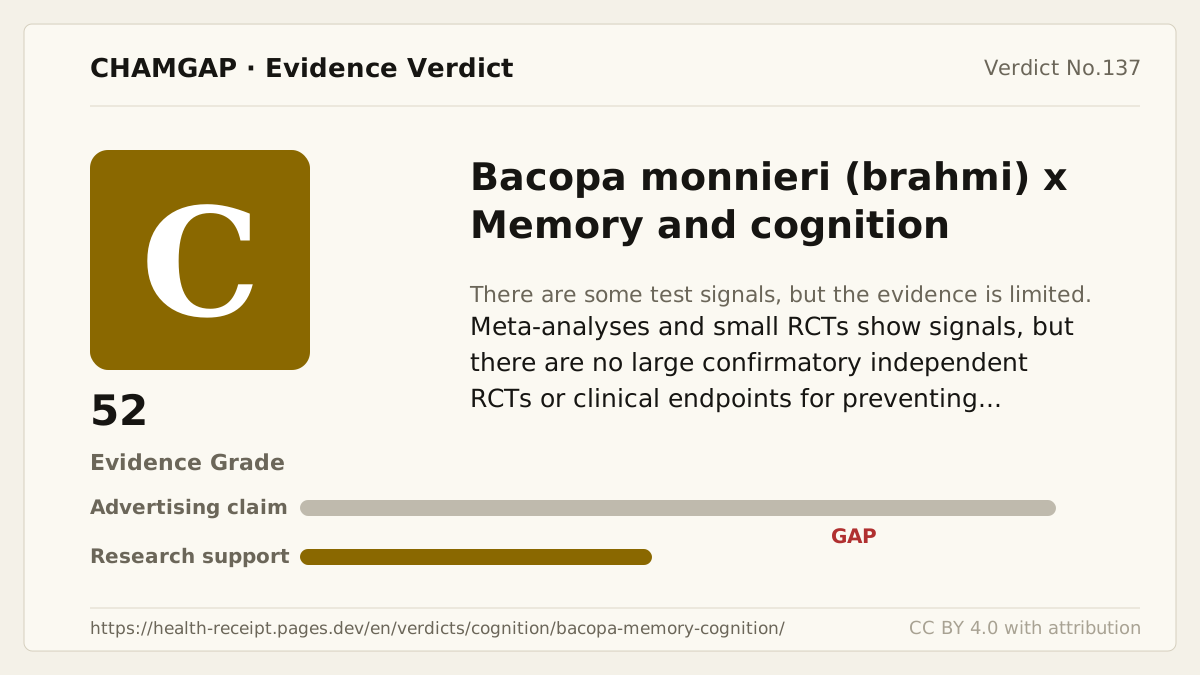
[Chamgap] Bacopa monnieri x memory and cognition — Evidence Grade C·52. 4 cited sources checked. Source: https://chamgap.com/en/verdicts/cognition/bacopa-memory-cognition/ · CC BY 4.0CC BY 4.0 — free to use with attribution; do not distort grades, numbers, or verdict meaning.
What this document does and does not do
Chamgap is an information source. It reports what research has and has not confirmed; it does not tell readers what to take or buy. That decision belongs to readers and, when needed, medical or legal professionals. This verdict reflects literature available up to the search date and may change as new research appears. Nothing here is medical advice.