
Alpha-GPC,
does it really help with Cognition and exercise performance?
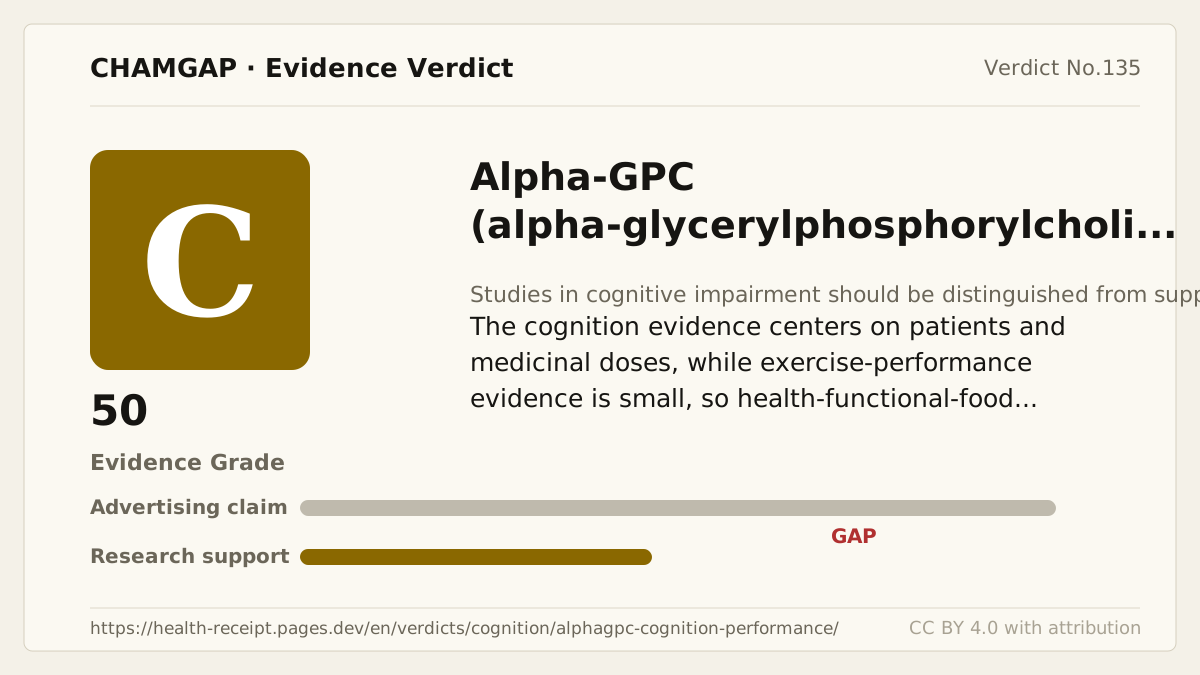
research showsAlpha-GPC shows some cognitive-improvement signals in studies of patients with Alzheimer's disease or vascular cognitive impairment, but those findings are hard to transfer directly to evidence for memory or concentration supplements in healthy adults. Exercise-performance evidence consists of only a few acute, small studies, so the overall judgment is C.
ads claimProducts emphasize 'choline,' 'acetylcholine,' 'concentration,' 'studying,' and 'exercise power.' The strongest actual evidence is closer to studies in patients with cognitive impairment than to healthy students or office workers.
Useful facts when choosing a product
- The Alzheimer's RCT dose was 1200 mg/day, which may differ from general supplement doses of 300-600 mg/day.
- An FDA GRAS notice is a safety judgment for a specific ingredient and use level, not recognition of cognitive efficacy.
- Headache, gastrointestinal discomfort, insomnia, and dizziness from low blood pressure have been reported as possible effects.
- The stroke-risk signal in the Korean observational study may involve confounding, but it is reflected as a safety caution.
What the research actually shows
The De Jesus Moreno 2003 multicenter double-blind RCT gave choline alfoscerate 1200 mg/day for 180 days to 261 patients with mild to moderate Alzheimer's disease and reported improvements versus placebo in ADAS-Cog and other measures. A 2023 systematic review and meta-analysis summarized studies in adults with cognitive impairment positively, but the context is mostly patient and medicine based. For exercise performance, small studies such as Bellar 2015 reported lower-body/upper-body power signals, but no large independent RCT exists. Lee 2021 JAMA Network Open, a Korean claims-data cohort study, reported an association between alpha-GPC use and increased 10-year stroke risk, but as an observational study it cannot establish causality.
Why this is classified as C (50)
There are studies in cognitive impairment, so this is not D, but directness is low for supplement claims about cognition and exercise performance in healthy adults. Exercise performance is limited to small short-term studies and remains only a supporting signal. It is judged C, 50 points.
Counterpoint. The context in which it is used as a medicine for patients with cognitive impairment needs separate evaluation. This judgment targets health-functional-food style claims about cognition and exercise performance.
Rejudgment record. Draft — Indirectness of patient evidence, small exercise-performance studies, and safety signal.
Cross-check — Codex and Claude
Evidence Table
| Study | Design | Sample | Funding | Endpoint | Result | Weight |
|---|---|---|---|---|---|---|
| De Jesus Moreno Moreno M. 2003 | Multicenter double-blind RCT | 261 | Possible medicine/industry ties | ADAS-Cog and cognitive impairment | Reported that 1200 mg/day improved cognitive scales in patients with Alzheimer's disease. | Core |
| Study 2 | Systematic review and meta-analysis | Mixed | Cognition and activities of daily living | Summarized positive signals in adult cognitive impairment, but the evidence is patient centered. | Supporting | |
| Bellar D et al. 2015 | Randomized placebo-controlled trial | Possible ingredient provision | Power and strength | Reported signals for some exercise-power measures. | Supporting | |
| Lee G et al. 2021 | Retrospective cohort | 1200 | Public/unknown | Stroke | Reported an association between alpha-GPC use and increased stroke risk, but causality is uncertain. | Safety |
Receipt — 3 References
All 3 cited sources were verified for existence at the original page (as of 2026-07-09).
Reviewed and approved: Chamgap Editorial Team · Approval date: 2026-07-09 · Corrections: none
Cite this verdict
[Chamgap] Alpha-GPC x cognition and exercise performance — Evidence Grade C·50. 3 cited sources checked. Source: https://chamgap.com/en/verdicts/cognition/alphagpc-cognition-performance/ · CC BY 4.0CC BY 4.0 — free to use with attribution; do not distort grades, numbers, or verdict meaning.
What this document does and does not do
Chamgap is an information source. It reports what research has and has not confirmed; it does not tell readers what to take or buy. That decision belongs to readers and, when needed, medical or legal professionals. This verdict reflects literature available up to the search date and may change as new research appears. Nothing here is medical advice.