
L-tyrosine,
does it really help with Stress, focus, and cognitive performance?
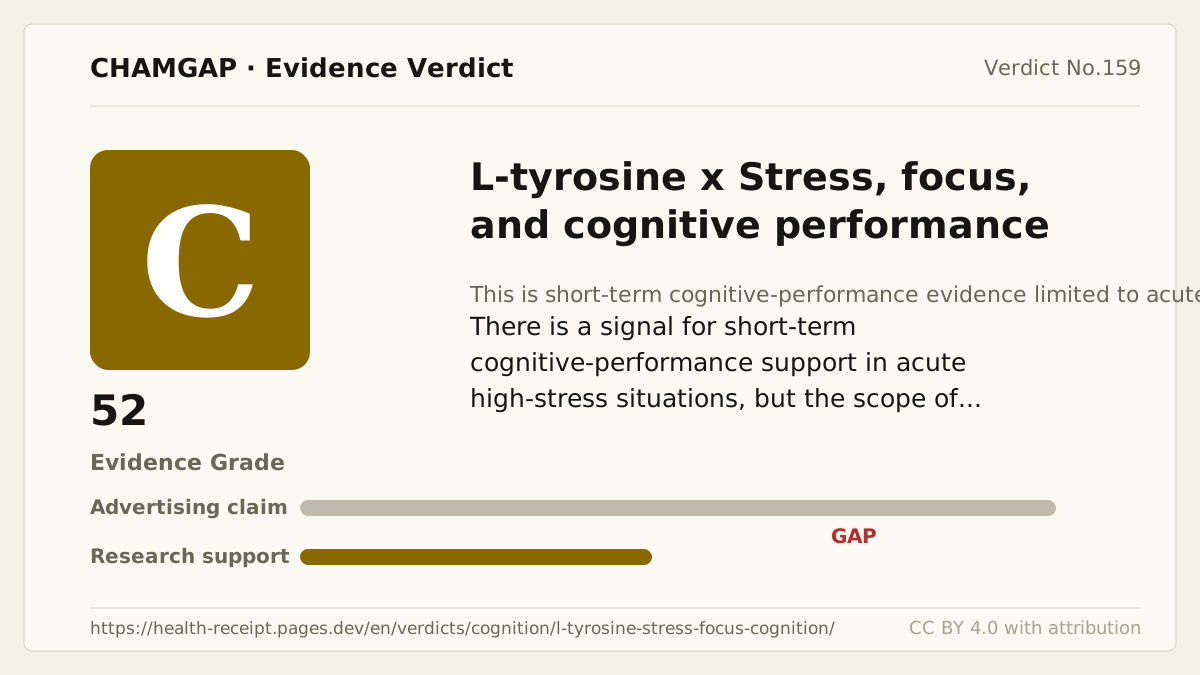
research showsL-tyrosine has small signals of mitigating short-term declines in working memory and information processing under extreme conditions such as acute high stress, sleep deprivation, and cognitive load. However, the evidence is biased toward military/experimental contexts, and evidence is insufficient for generalizing to ordinary focus, ADHD, chronic fatigue, or exercise performance. It is C for about "acute high-stress short-term cognitive-performance support."
ads claimAdvertisements broadly claim 'dopamine precursor,' 'focus,' 'mental energy,' 'stress relief,' and 'study/work efficiency.' Actual studies are usually laboratory cognitive tasks under acute high-load conditions.
Useful facts when choosing a product
- Research doses often use acute high doses such as 100-150 mg/kg by body weight, which differ from ordinary products at 500-2000 mg/day.
- N-acetyl L-tyrosine may differ in conversion to tyrosine in the body, so it is difficult to apply the same evidence.
- People with hyperthyroidism, those using levodopa, MAOIs, or thyroid medication, and people with migraine need caution.
- Evidence for cognitive improvement and safety with long-term daily use is limited.
What the research actually shows
The Shurtleff 1994 RCT reported a signal that tyrosine administration mitigated working-memory decline caused by cold exposure. The Neri 1995 study reported results reducing part of the cognitive-performance decline during prolonged wakefulness/sleep deprivation. The Jongkees 2015 review summarized that tyrosine may help in stress or high cognitive-load situations, but evidence for general enhancement in non-stress situations is inconsistent. Overall, samples are small and biased toward military and experimental contexts.
Why this is classified as C (52)
There are direct cognitive-performance RCTs and reviews in acute stress situations, so the grade is not D. However, because the studies are small, acute, and specific to military/experimental contexts, they cannot be generalized to everyday focus, ADHD, chronic fatigue, or exercise performance, so the rating is C with 52 points.
Counterpoint. There may be a small practical signal in situations with high acute stress, such as all-nighters, cold exposure, or military training. It should not be generalized to enhancement of everyday focus.
Rejudgment record. Final reassessment — Short-term cognitive-performance signal under acute high stress, but C because of small scale and military/experimental context limitations
Cross-check — Codex and Claude
Evidence Table
| Study | Design | Sample | Funding | Endpoint | Result | Weight |
|---|---|---|---|---|---|---|
| Shurtleff D et al. 1994 | Randomized placebo-controlled trial | Possibly U.S. military/public research | Cold-induced working-memory decline | Tyrosine mitigated working-memory decline caused by cold exposure. | Key | |
| Neri DF et al. 1995 | Randomized placebo-controlled trial | Possibly military-related research | Cognitive performance during sleep deprivation/prolonged wakefulness | Mitigated decline in performance on some tasks during prolonged wakefulness. | Key | |
| Jongkees BJ et al. 2015 | Narrative systematic review | 15 | Unknown | Cognitive performance during stress and cognitive load | Promising in stress situations, but general enhancement in ordinary conditions is unclear. | Key |
Receipt — 3 References
All 3 cited sources were verified for existence at the original page (as of 2026-07-09).
Reviewed and approved: Chamgap Editorial Team · Approval date: 2026-07-09 · Corrections: none
Cite this verdict
[Chamgap] L-tyrosine x stress, focus, and cognitive performance — Evidence Grade C·52. 3 cited sources checked. Source: https://chamgap.com/en/verdicts/cognition/l-tyrosine-stress-focus-cognition/ · CC BY 4.0CC BY 4.0 — free to use with attribution; do not distort grades, numbers, or verdict meaning.
What this document does and does not do
Chamgap is an information source. It reports what research has and has not confirmed; it does not tell readers what to take or buy. That decision belongs to readers and, when needed, medical or legal professionals. This verdict reflects literature available up to the search date and may change as new research appears. Nothing here is medical advice.