
Salacia reticulata/oblonga extract,
does it really help with Suppression of the postprandial glucose rise?
research showsSingle-dose crossover RCTs reported signals in postprandial glucose or insulin, but these were short surrogate-marker trials. The Heacock trial included 39 participants, and Jeykodi 2016 tested Salacia chinensis rather than the title species S. reticulata/oblonga. FPG and HbA1c were negative in the 90-day type 2 diabetes trial.
ads claimIt may be described as alpha-glucosidase blocking, carbohydrate blocking, or postprandial-glucose suppression. A single-meal response does not establish long-term HbA1c improvement.
Useful facts when choosing a product
- Single-dose trials used 200-1,000 mg.
- Species, plant part, and extract standardization vary by product.
- Fermentation-related gas, bloating, or diarrhea may occur.
- Hypoglycemia is possible with glucose-lowering drugs.
What the research actually shows
Heacock 2005 found a nonsignificant 23% glucose-AUC reduction and a significant 29% insulin-AUC reduction with 1,000 mg in 39 participants. Jeykodi 2016 reported dose-related postprandial improvement in 35 participants, but it tested S. chinensis rather than the title species S. reticulata/oblonga, and all authors were affiliated with OmniActive. The Jayawardena 2012 90-day diabetes trial found no significant FPG or HbA1c reduction.
Why this is classified as C (40)
Acute postprandial outcomes are surrogate markers and results are mixed. Jeykodi 2016 tested a different species, S. chinensis, and the 90-day diabetes trial was negative for FPG and HbA1c, placing the judgment at the lower end of C with 40 points.
Counterpoint. A particular standardized extract may reduce the acute glycemic response to a carbohydrate meal.
Rejudgment record. New judgment — Acute postprandial evidence is surrogate and mixed; a different-species attribution limit and negative 90-day FPG and HbA1c place the judgment at the lower end of C with 40 points.
Cross-check — Codex and Claude
Evidence Table
| Study | Design | Sample | Funding | Endpoint | Result | Weight |
|---|---|---|---|---|---|---|
| Heacock PM et al. 2005 | Double-masked randomized crossover trial | 39 | Possible product involvement | Postprandial glucose and insulin AUC | At 1,000 mg, glucose AUC fell 23% nonsignificantly and insulin AUC fell 29%. | Key |
| Jeykodi S et al. 2016 | Double-blind placebo-controlled crossover RCT | 35 | OmniActive Health Technologies; S. chinensis ingredient | Postprandial glucose and insulin | Reported dose-related improvement. | Supportive |
| Jayawardena MH et al. 2012 | Ninety-day placebo-controlled clinical trial | 2 | Unknown | FPG and HbA1c | Reductions were not significant. | Key |
Receipt — 3 References
All 3 cited sources were verified for existence at the original page (as of 2026-07-11).
Reviewed and approved: Chamgap Editorial Team · Approval date: 2026-07-11 · Corrections: none
Cite this verdict
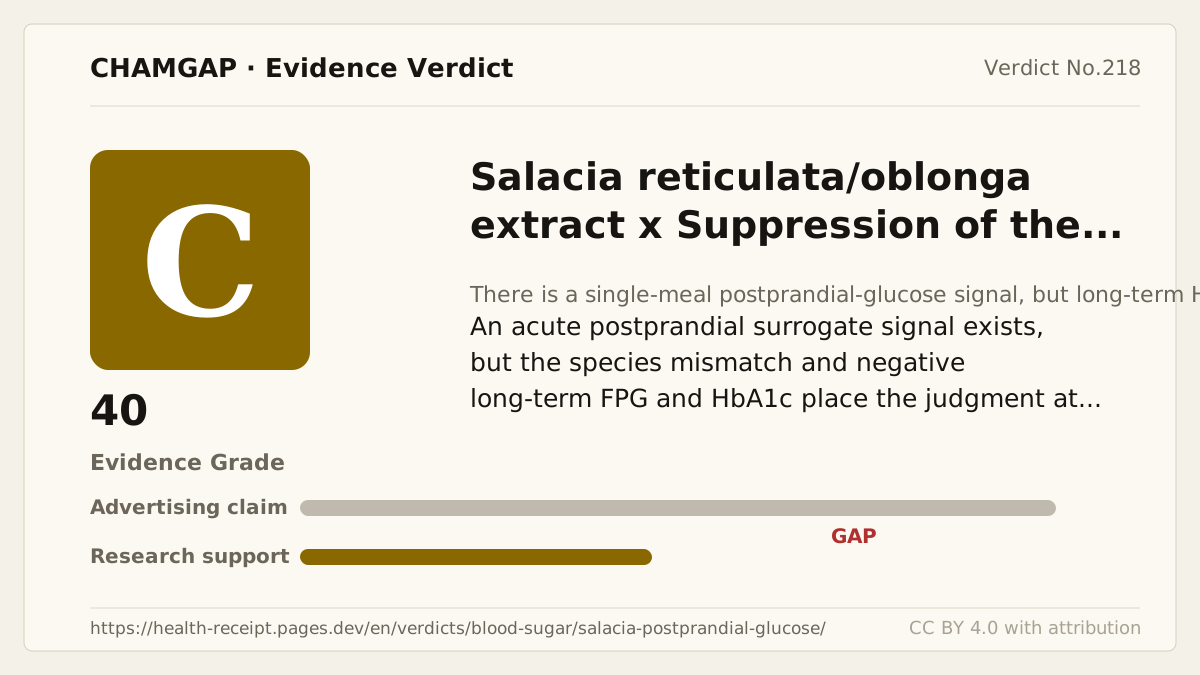
[Chamgap] Salacia reticulata/oblonga extract x Suppression of the postprandial glucose rise — Evidence Grade C·40. 3 cited sources checked. Source: https://chamgap.com/en/verdicts/blood-sugar/salacia-postprandial-glucose/ · CC BY 4.0CC BY 4.0 — free to use with attribution; do not distort grades, numbers, or verdict meaning.
What this document does and does not do
Chamgap is an information source. It reports what research has and has not confirmed; it does not tell readers what to take or buy. That decision belongs to readers and, when needed, medical or legal professionals. This verdict reflects literature available up to the search date and may change as new research appears. Nothing here is medical advice.