
Resistant maltodextrin,
does it really help with Postprandial blood glucose, bowel movements, and triglycerides?
research showsThe representative effect of resistant maltodextrin, reduced postprandial glycemic response, has human evidence but is a surrogate marker, so C is the ceiling. Evidence for improved bowel movements separately points in a favorable direction, but claims bundling postprandial blood glucose and triglycerides should be read as C.
ads claimKorean products bundle 'postprandial blood glucose,' 'bowel movements,' and 'improvement in blood triglycerides' in one package. Regulatory individual recognition or dietary-fiber recognition is not an efficacy bonus, and numerical improvement needs to be distinguished from disease prevention.
Useful facts when choosing a product
- Postprandial blood-glucose studies often examine acute responses when taken with a carbohydrate meal.
- Bowel-movement markers can vary depending on dose and baseline fiber intake.
- Gas, abdominal bloating, and loose stools may occur.
- People taking diabetes or lipid medications should interpret numerical changes with a clinician.
What the research actually shows
Yamada 2018 meta-analysis summarized results in the direction that resistant maltodextrin increases stool frequency and fecal volume. The EFSA Nutriose review addresses a reduced postprandial glycemic response claim, but this is not a clinical event; it is the surrogate marker of postprandial blood-glucose numbers. FDA's dietary-fiber-related review is also material confirming the scope of physiological effects, not a grade-raising bonus. Triglycerides likewise center on postprandial TG or blood-lipid numbers, so the clinical connection is weaker.
Why this is classified as C (55)
Because the representative effects, reduced postprandial glycemic response and triglycerides, are surrogate markers, C is the ceiling under methodology rule 1. I acknowledge the directionality of the bowel-movement meta-analysis, but place the overall bundled claim at 55 points.
Counterpoint. Lowering the postprandial blood-glucose peak has meaning as a health-functional-food claim. However, regulatory individual recognition is not a grade bonus and is not evidence for diabetes treatment or cardiovascular prevention.
Rejudgment record. Draft — The representative effect, reduced postprandial glycemic response, and triglycerides are surrogate markers, so under methodology rule 1 the ceiling is C; bowel-movement evidence is separate
Cross-check — Codex and Claude
Evidence Table
| Study | Design | Sample | Funding | Endpoint | Result | Weight |
|---|---|---|---|---|---|---|
| Yamada K et al. 2018 | Systematic review and meta-analysis | Mixed/includes Japanese dietary-fiber product studies | Stool frequency and fecal volume | Reported results in the direction that resistant maltodextrin intake improves bowel-movement markers. | Core | |
| EFSA NDA Panel 2014 | Regulatory scientific review | Regulatory agency assessment | Postprandial glycemic response | Reviewed claims that low-digestible carbohydrates reduce glycemic response. | Supporting | |
| FDA 2018/2020 dietary fiber review | Regulatory scientific review | Regulatory agency assessment | Physiological effects such as blood-glucose and insulin attenuation and bowel movements | Reviewed blood-glucose, insulin, and gut-function data as evidence for recognizing resistant maltodextrin as dietary fiber. | Supporting |
Receipt — 4 References
All 4 cited sources were verified for existence at the original page (as of 2026-07-09).
Reviewed and approved: Chamgap Editorial Team · Approval date: 2026-07-09 · Corrections: none
Cite this verdict
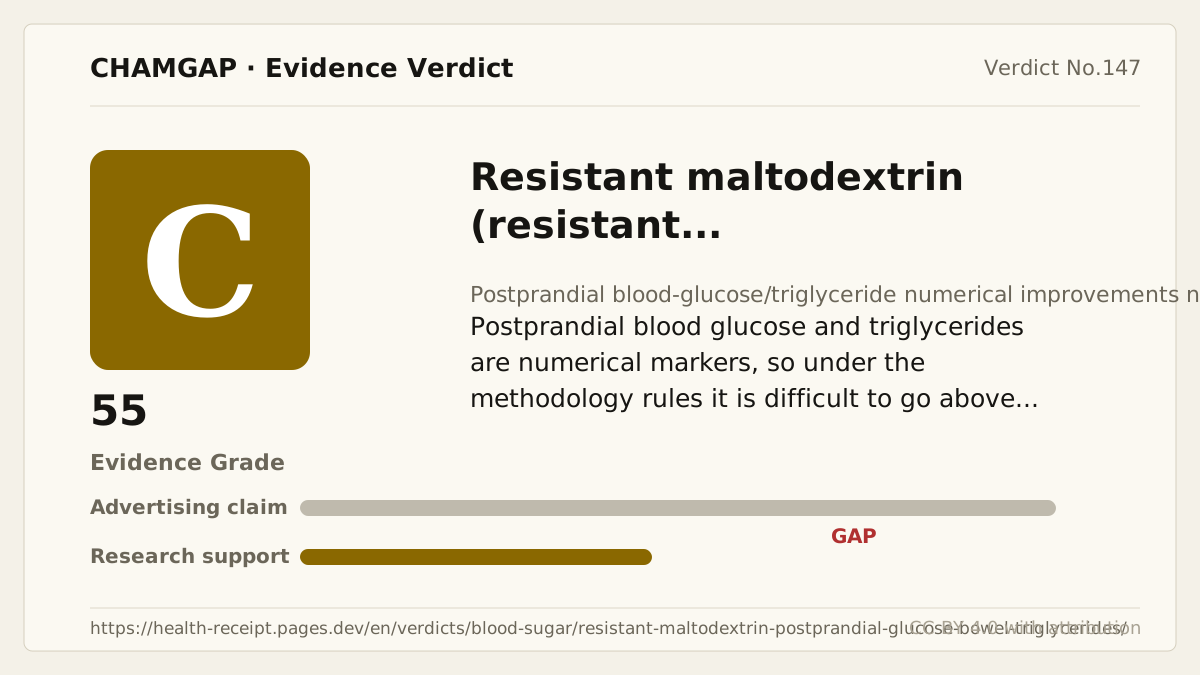
[Chamgap] Resistant maltodextrin x postprandial blood glucose, bowel movements, and triglycerides — Evidence Grade C·55. 4 cited sources checked. Source: https://chamgap.com/en/verdicts/blood-sugar/resistant-maltodextrin-postprandial-glucose-bowel-triglycerides/ · CC BY 4.0CC BY 4.0 — free to use with attribution; do not distort grades, numbers, or verdict meaning.
What this document does and does not do
Chamgap is an information source. It reports what research has and has not confirmed; it does not tell readers what to take or buy. That decision belongs to readers and, when needed, medical or legal professionals. This verdict reflects literature available up to the search date and may change as new research appears. Nothing here is medical advice.