
Resistant starch,
does it really help with Improvement of insulin sensitivity and fasting glucose?
research showsSome meta-analyses report small improvements in fasting glucose and HOMA-IR, but an analysis of 22 RS2 RCTs and 670 participants found no significant effect on fasting glucose or insulin resistance. All are surrogate markers, and findings vary by starch type, dose, and population.
ads claimIt may be described as stabilizing glucose or restoring insulin sensitivity. RS1-RS5 differ by source and processing, so one formulation result cannot be applied uniformly to all resistant starch.
Useful facts when choosing a product
- Trial doses ranged widely, usually 8-40 g/day.
- RS2 and RS1, RS3, or RS4 are not physiologically identical.
- Main outcomes were surrogate markers such as FPG, HOMA-IR, and clamp sensitivity.
- Gas or bloating may occur.
What the research actually shows
Xiong 2021 reported FPG -0.09 mmol/L and HOMA-IR -0.33 across 19 RCTs, but other insulin endpoints were not significant. Snelson 2019 found no FPG or insulin-resistance effect across 22 RCTs and 670 participants and noted trials lasted 1-12 weeks with 10-60 participants. Maki 2012 reported improved sensitivity in men with overweight, but the study had manufacturer funding involvement.
Why this is classified as C (43)
There are many RCTs, but meta-analyses conflict and only surrogate rather than clinical outcomes are available, resulting in C with 43 points.
Counterpoint. A small marker improvement remains possible with a particular RS2 formulation, higher dose, or metabolic-risk population.
Rejudgment record. New judgment — There are many RCTs, but meta-analyses conflict and only surrogate rather than clinical outcomes are available, resulting in C with 43 points.
Sub-claim grades by effect
This ingredient is marketed for several effects. A single overall grade blends strong and weak claims together, so each effect is graded separately here. The overall grade reflects the strongest disconfirming or core claim.
| Effect (sub-claim) | Grade | Basis |
|---|---|---|
| Improvement of insulin sensitivity | C | Some trials were positive, but the overall RS2 meta-analysis was negative. |
| Improvement of fasting glucose | C | A -0.09 mmol/L signal in one meta-analysis conflicts with a null result in another. |
Cross-check — Codex and Claude
Evidence Table
| Study | Design | Sample | Funding | Endpoint | Result | Weight |
|---|---|---|---|---|---|---|
| Xiong K et al. 2021 | Meta-analysis of 19 RCTs | 19 | Unknown | FPG and HOMA-IR | FPG -0.09 mmol/L and HOMA-IR -0.33; other insulin endpoints were nonsignificant. | Key |
| Snelson M et al. 2019 | Meta-analysis of 22 RCTs | 670 | Academic research | FPG and insulin resistance | No significant effect on either outcome. | Key |
| Maki KC et al. 2012 | Randomized placebo-controlled trial | Funding from National Starch | Insulin sensitivity | Improved in men but not women. | Supportive |
Receipt — 3 References
All 3 cited sources were verified for existence at the original page (as of 2026-07-11).
Reviewed and approved: Chamgap Editorial Team · Approval date: 2026-07-11 · Corrections: none
Cite this verdict
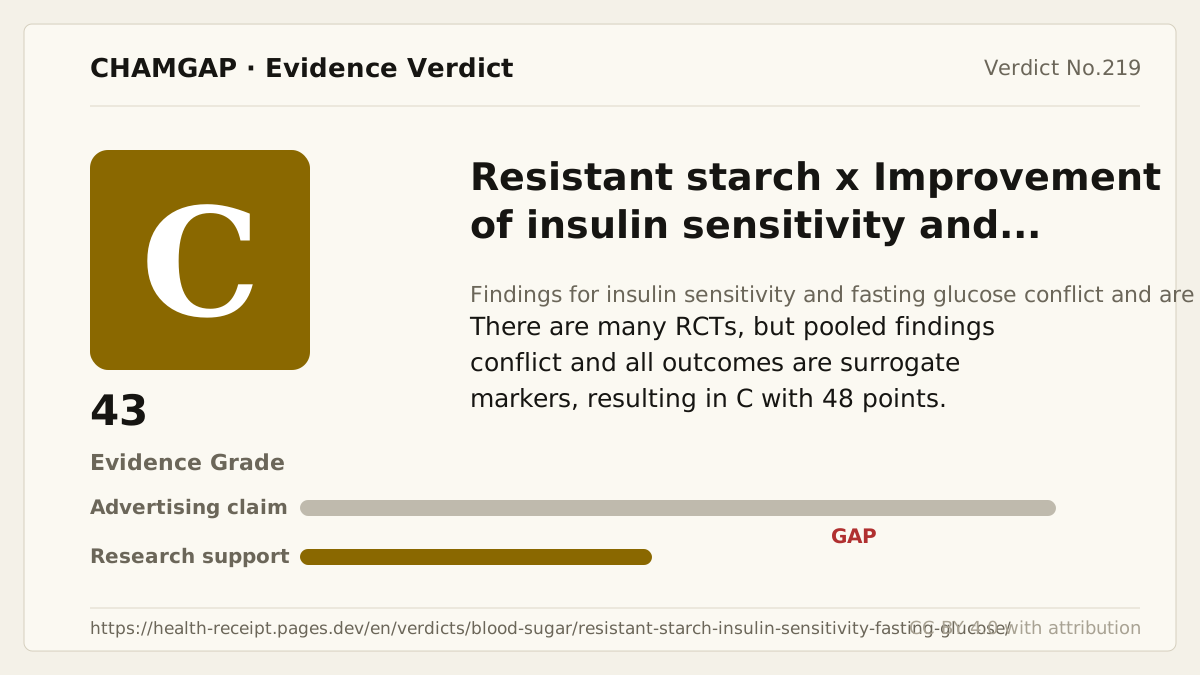
[Chamgap] Resistant starch x Improvement of insulin sensitivity and fasting glucose — Evidence Grade C·43. 3 cited sources checked. Source: https://chamgap.com/en/verdicts/blood-sugar/resistant-starch-insulin-sensitivity-fasting-glucose/ · CC BY 4.0CC BY 4.0 — free to use with attribution; do not distort grades, numbers, or verdict meaning.
What this document does and does not do
Chamgap is an information source. It reports what research has and has not confirmed; it does not tell readers what to take or buy. That decision belongs to readers and, when needed, medical or legal professionals. This verdict reflects literature available up to the search date and may change as new research appears. Nothing here is medical advice.