
Fisetin,
does it really help with Senolytic activity and healthspan extension?
research showsA self-reported subgroup of 10 people showed reduced peripheral-blood senescence markers after fisetin, but this was uncontrolled surrogate evidence. A 10-person biological-age pilot showed no average improvement, and healthspan or lifespan extension has not been tested or established in humans. The senolytic-marker signal is rated C, while the healthspan and lifespan claim is rated ?.
ads claimAdvertising connects mouse lifespan studies and the 'zombie-cell removal' mechanism to reversal of human aging, lower biological age, and longer healthspan. Human data consist of early marker and disease studies, not lifespan-extension outcomes.
Useful facts when choosing a product
- Human study doses ranged widely from 100 mg/day to intermittent 20 mg/kg dosing.
- Fisetin is poorly water-soluble, so formulation and bioavailability may affect results.
- C12FDG-positive PBMCs in the 10-person observational subgroup are a senescence surrogate, not healthspan itself.
- Long-term safety and drug-interaction data for high intermittent doses are limited.
What the research actually shows
In the self-reported subgroup of the Hambright 2024 study, 10 people used fisetin at 100 mg/day for an average of about 58 days; C12FDG-positive PBMCs fell by an average of 27.2% and several circulating markers decreased. This was a selected uncontrolled subgroup. The Lee 2024 pilot gave 500 mg/day for one week each month for six months to 10 adults over age 50; biological age fell in four, rose in five, and telomere length did not change significantly. The 74-participant knee-osteoarthritis RCT reported in the Tashman 2025 abstract found that intermittent 20 mg/kg fisetin did not improve pain, function, or MRI cartilage measures versus placebo. No result directly assessing human healthspan or overall lifespan was identified.
Why this is classified as C (40)
A limited positive human senescence-marker signal prevents classifying all evidence as preclinical-only or absent. Uncontrolled very small surrogate evidence, a null biological-age pilot, a null clinical-function RCT, and no healthspan or lifespan data place the overall rating at the bottom of C with 40 points.
Counterpoint. Whether marker reduction is replicated and linked to function, disease incidence, or survival is a separate question. This judgment distinguishes a senolytic-candidate signal from a healthspan-extension claim.
Rejudgment record. Reassessment (cross-check reflected) — A very small uncontrolled positive senescence-marker signal, but null biological-age and clinical-function results and no human healthspan or lifespan literature
Sub-claim grades by effect
This ingredient is marketed for several effects. A single overall grade blends strong and weak claims together, so each effect is graded separately here. The overall grade reflects the strongest disconfirming or core claim.
| Effect (sub-claim) | Grade | Basis |
|---|---|---|
| Cellular-senescence markers (senolytic) | C | Exploratory surrogates including C12FDG-positive PBMCs in an uncontrolled 10-person study |
| Healthspan and lifespan extension | ? | No human lifespan evidence; mouse evidence only |
| Clinical efficacy in osteoarthritis | D | A 74-person RCT was null for pain, function, and MRI outcomes |
Cross-check — Codex and Claude
Evidence Table
| Study | Design | Sample | Funding | Endpoint | Result | Weight |
|---|---|---|---|---|---|---|
| Hambright WS et al. 2024 | Self-reported uncontrolled subgroup within a prospective cohort | 10 | NIH NIAMS and the U.S. Department of Defense Office of Naval Research | C12FDG-positive PBMCs and SASP-related circulating markers | After 100 mg/day for an average of 58 days, C12FDG-positive PBMCs fell by an average of 27.2%; this was a selected uncontrolled subgroup. | Key but limited |
| Lee E, Burns M. 2024 | Single-arm before-and-after pilot | 10 | Participants paid for supplements and testing; product source disclosed | TruAge biological age and predicted telomere length | Biological age fell in four, rose in five, and was unchanged in one; telomere length did not change significantly. | Contradictory |
| Tashman S et al. 2025 | Phase I/II randomized double-blind placebo-controlled trial abstract | 74 | U.S. Department of Defense Office of Naval Research | Pain, patient-reported outcomes, walking, strength, and MRI cartilage | No differences between fisetin and placebo in pain, function, strength, gait, or MRI cartilage measures; adverse events also did not differ. | Null clinical outcome |
| Yousefzadeh MJ et al. 2018 | Cell and aged-mouse preclinical study | NIH, Glenn/AFAR, and other foundations | Senescence markers, health measures, and mouse lifespan | Reduced senescent-cell burden and improved health measures and lifespan in aged mice; this cannot be directly extrapolated to human lifespan. | Preclinical |
Receipt — 4 References
All 4 cited sources were verified for existence at the original page (as of 2026-07-11).
Reviewed and approved: Chamgap Editorial Team · Approval date: 2026-07-11 · Corrections: none
Cite this verdict
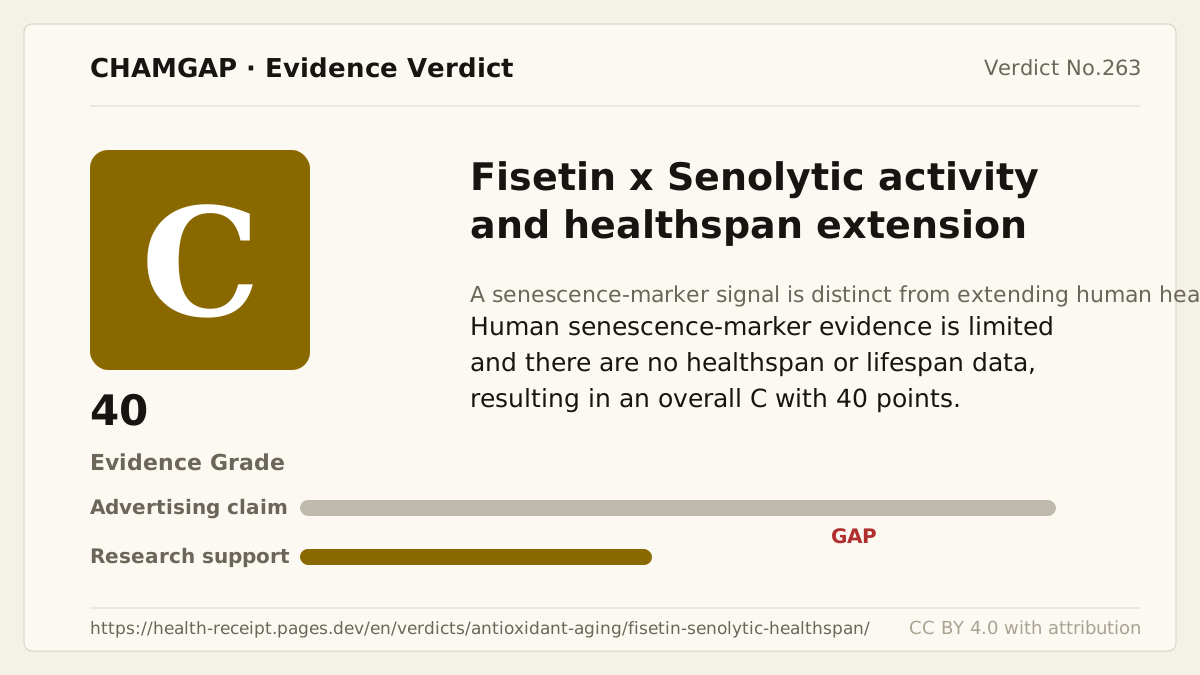
[Chamgap] Fisetin x senolytic activity and healthspan extension — Evidence Grade C·40. 4 cited sources checked. Source: https://chamgap.com/en/verdicts/antioxidant-aging/fisetin-senolytic-healthspan/ · CC BY 4.0CC BY 4.0 — free to use with attribution; do not distort grades, numbers, or verdict meaning.
What this document does and does not do
Chamgap is an information source. It reports what research has and has not confirmed; it does not tell readers what to take or buy. That decision belongs to readers and, when needed, medical or legal professionals. This verdict reflects literature available up to the search date and may change as new research appears. Nothing here is medical advice.