
Sophora japonica fruit extract,
does it really help with Menopausal women’s health and improvement in the Kupperman Index?
research showsIn an 87-person RCT of Rexflavone® 350 mg/day, a sophoricoside-standardized Sophora japonica fruit extract, the 12-week between-group difference in the modified Kupperman Index was borderline at p=0.037. Hormonal measures were largely null, and evidence is concentrated in one developer-linked trial. MFDS registration does not add to the evidence grade, so the rating is C.
ads claimProduct descriptions often present MFDS recognition of functionality, sophoricoside content, menopausal women’s health, and improvement in the Kupperman Index together. Regulatory recognition concerns a specified ingredient standard and permitted labeling scope and is considered separately from independent clinical replication.
Useful facts when choosing a product
- The ingredient in the key clinical trial was Rexflavone®, used at 350 mg/day for 12 weeks.
- The registered ingredient is a 60% ethanol extract of Sophora japonica fruit standardized to 10–15% sophoricoside.
- The key efficacy endpoint was the modified Kupperman Index combining 11 menopausal symptoms.
- The registration dossier advises caution for children, pregnant or nursing women, and people sensitive to estrogenic activity.
What the research actually shows
The Lee 2010 RCT assigned 87 postmenopausal women to Rexflavone® 350 mg/day, a sophoricoside-standardized Sophora japonica fruit extract, or placebo for 12 weeks. The between-group difference in modified Kupperman Index change was p=0.037, while hormonal measures changed little. Choi 2021 reorganized the MFDS registration dossier and was not a new independent clinical trial.
Why this is classified as C (46)
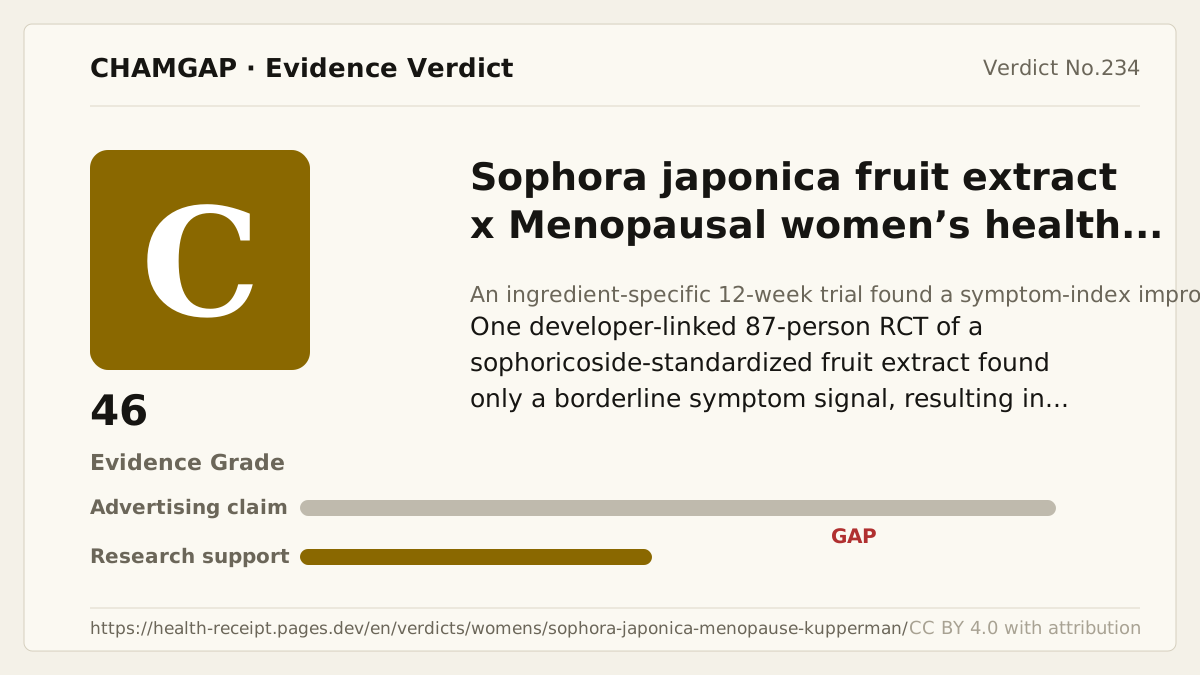
A single developer-linked 87-person RCT of the sophoricoside-standardized fruit extract found a borderline Kupperman signal at p=0.037, while hormonal measures were largely null. There is no independent replication, and MFDS registration is irrelevant to the grade, resulting in C with 46 points.
Counterpoint. No unusual changes in clinical laboratory tests or vital signs were reported over 12 weeks, and the positive ITT finding for change in the Kupperman Index remains a hypothesis for an independent follow-up trial.
Rejudgment record. Reassessment (cross-check reflected) — The Rexflavone-specific 87-person RCT of a sophoricoside-standardized fruit extract found a borderline between-group Kupperman result at p=0.037, hormonal measures were largely null, the trial was developer-linked without independent replication, and MFDS registration is irrelevant under rule ④
Sub-claim grades by effect
This ingredient is marketed for several effects. A single overall grade blends strong and weak claims together, so each effect is graded separately here. The overall grade reflects the strongest disconfirming or core claim.
| Effect (sub-claim) | Grade | Basis |
|---|---|---|
| Improvement in the modified Kupperman Index | C | One manufacturer-linked RCT was positive, but there was attrition, significance differed by analysis, and independent replication is absent. |
| Broad improvement in menopausal women’s health | D | Hormones and lipids changed little, and broad health outcomes such as osteoporosis have not been independently demonstrated in humans. |
Cross-check — Codex and Claude
Evidence Table
| Study | Design | Sample | Funding | Endpoint | Result | Weight |
|---|---|---|---|---|---|---|
| Lee J et al. 2010 | Randomized, double-blind, placebo-controlled trial | 12 | Included an author affiliated with RexGene Biotech; linked to the ingredient developer | Modified Kupperman Index, hormones, and lipids | Reported improvement in the total Kupperman Index, while hormones and lipids changed little; reporting of between-group significance differed by analysis. | Key |
| Thomas AJ et al. 2014 | Systematic review | 1 | Supported by the US National Institute of Nursing Research; no competing interests reported | Hot flashes, sleep, mood, pain, cognition, and Kupperman Index | Summarized Rexflavone results differently by subgroup and time point and judged that replication in larger samples was needed. | Supportive |
| Choi MJ et al. 2021 | Summary of MFDS registration procedure and submitted dossier | 80 | Ingredient-registration case report; limited independence | Kupperman Index and safety | Reported p=0.0366 for the between-group difference in ITT change and the registered dose of 350 mg/day, but this was not a new trial. | Ancillary |
Receipt — 3 References
All 3 cited sources were verified for existence at the original page (as of 2026-07-11).
Reviewed and approved: Chamgap Editorial Team · Approval date: 2026-07-11 · Corrections: none
Cite this verdict
[Chamgap] Sophora japonica fruit extract x menopausal women’s health and improvement in the Kupperman Index — Evidence Grade C·46. 3 cited sources checked. Source: https://chamgap.com/en/verdicts/womens/sophora-japonica-menopause-kupperman/ · CC BY 4.0CC BY 4.0 — free to use with attribution; do not distort grades, numbers, or verdict meaning.
What this document does and does not do
Chamgap is an information source. It reports what research has and has not confirmed; it does not tell readers what to take or buy. That decision belongs to readers and, when needed, medical or legal professionals. This verdict reflects literature available up to the search date and may change as new research appears. Nothing here is medical advice.