
Workplace wellness program,
does it really help with Improved employee health with lower absenteeism, medical spending and use, and better work performance?
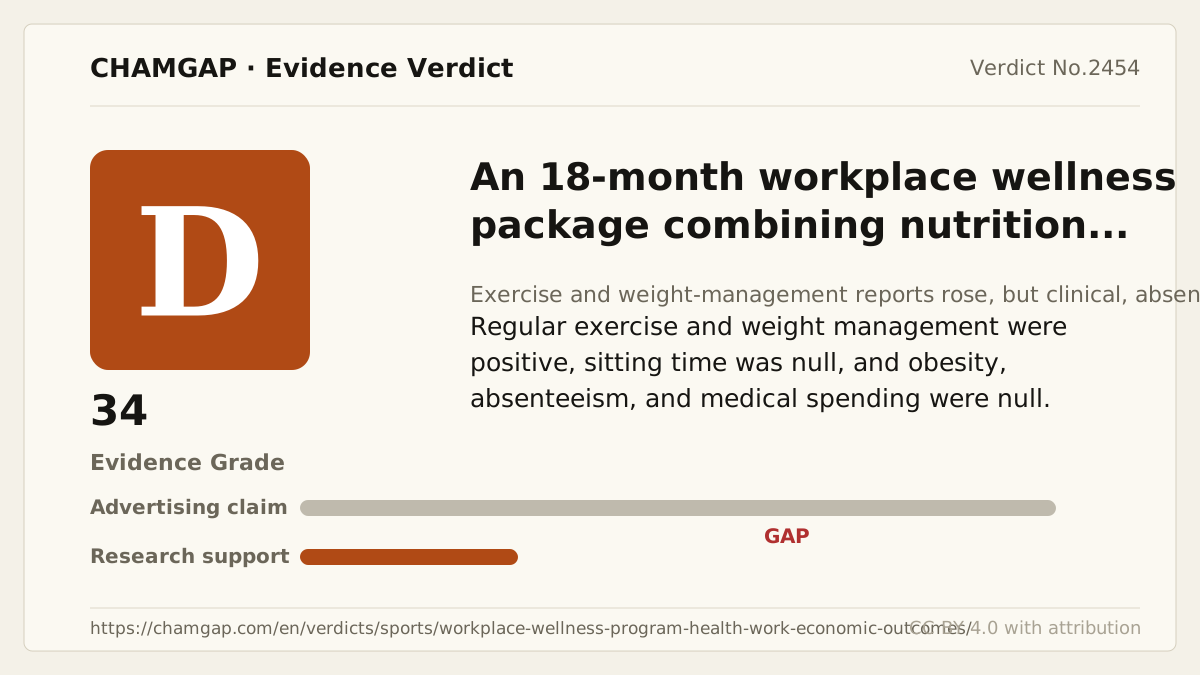
research showsThe grade is D with 34 points. The four registered co-primary domains were health behaviors, obesity, absenteeism, and medical spending. Regular exercise and active weight management were positive, but sitting time was null; obesity, absenteeism, and spending were also null.
ads claimMore employees saying that they exercise cannot be converted into better biometrics, lower absenteeism, higher productivity, or lower medical costs. Korean employer programs linked to health screening may also differ in components, incentives, and uptake.
Useful facts when choosing a product
- Registered dietitians spent about eight hours weekly at each treatment site, delivering eight four-to-seven-week modules, assessments, biometrics, and gift-card incentives.
- Korean employer health programs range from statutory screening linkage to app coaching and consultations and are not necessarily the tested package.
- Absenteeism and tenure covered all 32,974 employees, while medical-spending analyses covered 7,631 employer-insured employees.
What the research actually shows
NCT03167658 cluster-randomized 160 worksites at a US warehouse retailer. Twenty sites and 4,037 employees were offered the program; 140 sites and 28,937 employees received no program, including 20 primary-control sites and 4,106 employees for surveys and biometrics. For the four co-primary domains, group values and adjusted differences (95% CIs) were as follows. In health behavior, regular exercise was 69.8% versus 61.9%, +8.3 percentage points (3.9 to 12.8), and active weight management was 69.2% versus 54.7%, +13.6 points (7.0 to 20.2), both positive; sitting time was 3.5 versus 3.5 hours per day, 0.0 hours (-0.2 to 0.2), null. Obesity was 43.5% versus 43.0%, +0.6 points (-3.7 to 4.8); absenteeism was 2.5% versus 2.6% of scheduled hours, -0.1 points (-0.3 to 0.0); and total medical spending was $3,583 versus $3,953, -$425.57 (-$1,266 to $415), all null. The outcomes split. Registry and public analysis-plan documents appeared after intervention completion, limiting claims of fully prospective registration. Survey and biometric analyses used voluntary respondents employed at 18 months, creating participation selection. Absenteeism and tenure used administrative data for all 32,974 employees. Standard errors were clustered by worksite and the main analysis followed assignment regardless of participation.
Why this is classified as D (34)
Regular exercise and weight management were positive, but sitting time, obesity, absenteeism, and spending were null, giving D with 34 points.
Counterpoint. Some self-reported behaviors changed, but they cannot be expanded into health, work, or cost benefit.
Rejudgment record. Cross-check applied — Registry-analysis-plan comparison with separate evaluation of self-reported behaviors, clinical markers, absenteeism and spending, plus verified participation and cluster correction
| Endpoint | H | Hard endpoint - actual events such as death |
| Replication | R1 | Single confirmatory trial |
| Independence | I2 | Decisive evidence is publicly or non-profit funded |
| Effect size | E0 | Null |
| Precision | C0 | The confidence interval leaves room for benefit |
The scoring table and the verdict agree (D).
Sub-claim grades by effect
This ingredient is marketed for several effects. A single overall grade blends strong and weak claims together, so each effect is graded separately here. The overall grade reflects the strongest disconfirming or core claim.
| Effect (sub-claim) | Grade | Basis |
|---|---|---|
| Increased self-reported exercise and weight management | C | Two items were positive, but the behavior-domain effect was only 0.09 SD. |
| Improved clinical measures | D | Ten measures including blood pressure, BMI, glucose, and lipids were null. |
| Improved absenteeism, medical spending, and performance | D | Administrative and claims data showed no improvement. |
Cross-check — Codex and Claude
Evidence Table
| Study | Design | Sample | Funding | Endpoint | Result | Weight |
|---|---|---|---|---|---|---|
| Song·Baicker 2019 | Cluster-randomized trial across 160 worksites | 28,937 | National Institute on Aging R01 AG050329 and P30 AG012810, Robert Wood Johnson Foundation grant 72611, Abdul Latif Jameel Poverty Action Lab North America; in-kind support from BJ's Wholesale Club | Co-primary domains: health behavior, obesity, absenteeism, and medical spending | Regular exercise and weight management positive; sitting time, obesity, absenteeism, and spending null | Decisive large cluster-randomized evidence |
Receipt — 3 References
All 3 cited sources were verified for existence at the original page (as of 2026-08-08).
Reviewed and approved: Chamgap Editorial Team · Approval date: 2026-08-08 · Corrections: none
Cite this verdict
[Chamgap] Workplace wellness program x better health, work, and economic outcomes — Evidence Grade D·34. 3 cited sources checked. Source: https://chamgap.com/en/verdicts/sports/workplace-wellness-program-health-work-economic-outcomes/ · CC BY 4.0CC BY 4.0 — free to use with attribution; do not distort grades, numbers, or verdict meaning.
What this document does and does not do
Chamgap is an information source. It reports what research has and has not confirmed; it does not tell readers what to take or buy. That decision belongs to readers and, when needed, medical or legal professionals. This verdict reflects literature available up to the search date and may change as new research appears. Nothing here is medical advice.