
Sodium bicarbonate,
does it really help with High-intensity exercise performance?
research showsFor sodium bicarbonate, evidence repeatedly supports improvement in 30-second to 12-minute high-intensity exercise performance with a single 0.2-0.3 g/kg intake or multi-day loading. The effective range is narrow, applying to events with high-intensity and a large acidosis burden, and gastrointestinal adverse effects such as bloating, nausea, and diarrhea can interfere with performance.
ads claimPre-workout advertisements mention "buffering," "lactic acid," and "high-intensity performance." The actual evidence requires a match with exercise duration and intake timing.
Useful facts when choosing a product
- A representative single-dose protocol is 0.2-0.3 g/kg taken 60-180 minutes before exercise.
- Gastrointestinal adverse effects include bloating, belching, nausea, abdominal pain, and diarrhea.
- Because the sodium load is large, hypertension, heart failure, kidney disease, and sodium-restricted diets require separate checking.
- Enteric-coated capsules, split dosing, and co-administration with high-carbohydrate meals are studied as strategies to reduce gastrointestinal adverse effects.
What the research actually shows
The Grgic 2021 ISSN position stand synthesized studies in the 0.2-0.5 g/kg range and summarized performance improvement in 30-second to 12-minute high-intensity cycling, running, swimming, rowing, repeated sprints, and muscular endurance. 0.3 g/kg is presented as a common optimal single dose, while 0.4-0.5 g/kg is mentioned as problematic for increased adverse effects rather than additional benefit. The evidence is clearer for tasks where acidosis accumulates than for single repetitions of strength or power.
Why this is classified as B (74)
Direct performance RCTs and synthesis evidence are sufficient, but the application range and gastrointestinal adverse-effect limitations remain, so this is upper-end B at 74 points.
Counterpoint. It mainly applies to athletes whose event duration matches the evidence, and general health fatigue-recovery claims are separate.
Rejudgment record. Draft — Positive direct high-intensity exercise-performance RCTs and meta-analyses, with gastrointestinal adverse effects and application-range limitations
Cross-check — Codex and Claude
Evidence Table
| Study | Design | Sample | Funding | Endpoint | Result | Weight |
|---|---|---|---|---|---|---|
| Grgic J et al. 2021 | ISSN position stand and synthesis review | ISSN/mixed conflicts of interest | High-intensity exercise performance | Summarized improvement in 30-second to 12-minute high-intensity exercise performance and guidance for managing gastrointestinal adverse effects. | Core | |
| Carr AJ et al. 2011 | Systematic review and meta-analysis | Academic | Exercise performance | Synthesized signals that sodium bicarbonate improves high-intensity performance. | Core | |
| Jones NL et al. 1977 and later RCTs | Randomized crossover performance trials | Academic | Time to exhaustion, repeated sprints, and time trials | Improvement signals were repeated in acidotic high-intensity tasks after intake around 0.3 g/kg. | Supporting |
Receipt — 3 References
All 3 cited sources were verified for existence at the original page (as of 2026-07-10).
Reviewed and approved: Chamgap Editorial Team · Approval date: 2026-07-10 · Corrections: none
Cite this verdict
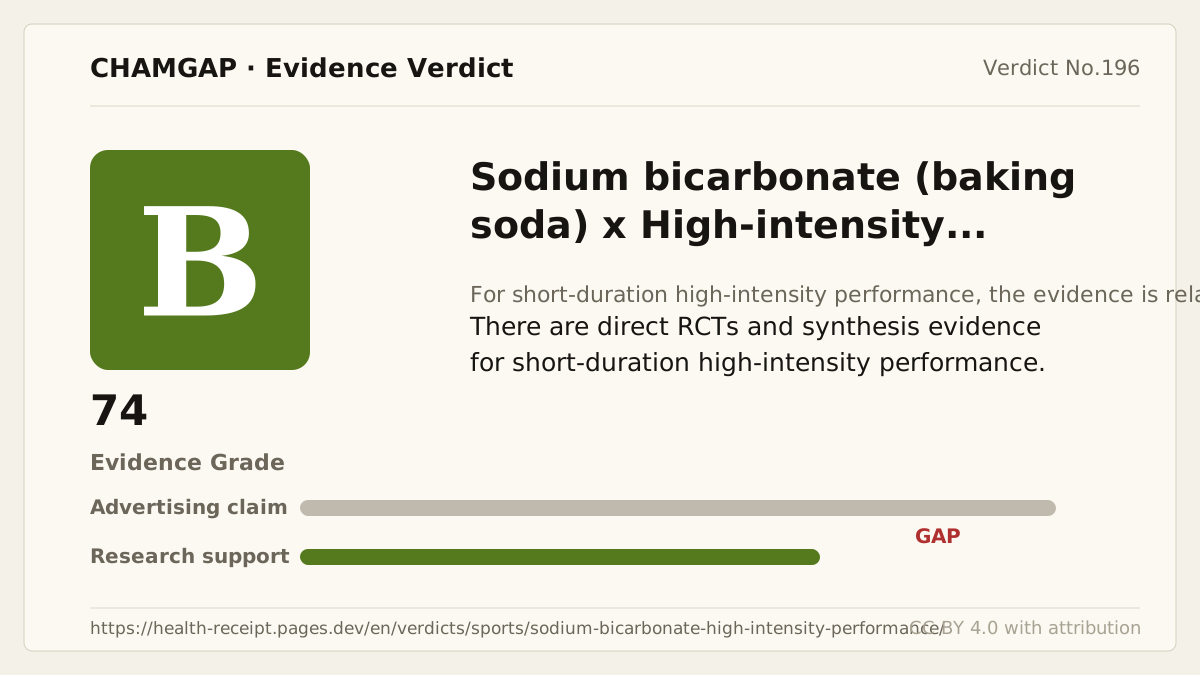
[Chamgap] Sodium bicarbonate x high-intensity exercise performance — Evidence Grade B·74. 3 cited sources checked. Source: https://chamgap.com/en/verdicts/sports/sodium-bicarbonate-high-intensity-performance/ · CC BY 4.0CC BY 4.0 — free to use with attribution; do not distort grades, numbers, or verdict meaning.
What this document does and does not do
Chamgap is an information source. It reports what research has and has not confirmed; it does not tell readers what to take or buy. That decision belongs to readers and, when needed, medical or legal professionals. This verdict reflects literature available up to the search date and may change as new research appears. Nothing here is medical advice.