
Phosphatidic acid,
does it really help with Increased muscle mass and strength during resistance training?
research showsA 16-person pilot and a company-funded 28-person trial of PA at 750 mg/day reported positive signals, but an independent 15-person trial was null for muscle thickness and every one-repetition maximum, and a later 28-person low-dose trial found no interaction. Conflicting small samples place the evidence at the low end of C.
ads claimMarketing may translate mTOR activation directly into visible muscle gain or a creatine-like effect. Human findings are conflicting in short training trials, and the effect of training itself must be separated from any incremental effect of PA.
Useful facts when choosing a product
- The most common human-trial dose was 750 mg/day of PA for eight weeks.
- A trial of 250 and 375 mg found no significant advantage over placebo.
- Several studies used the branded Mediator ingredient, so the results cannot automatically be generalized to ordinary soy or sunflower lecithin or other PA formulations.
- Long-term safety data and evidence in women and older adults are limited.
What the research actually shows
The 16-person 2012 pilot interpreted lean-mass and strength signals for PA at 750 mg/day using magnitude-based inference, limiting certainty. A Chemi Nutra-funded 28-person trial reported significant additional gains in lean mass, hypertrophy, and strength. In contrast, an independent 15-person trial found that 750 mg/day did not improve muscle thickness or squat, deadlift, or bench-press one-repetition maximums, and a later 28-person low-dose trial of 250 and 375 mg/day found no group-by-time interaction for lean mass, muscle cross-sectional area, or lower-body strength.
Why this is classified as C (48)
A 16-person pilot using magnitude-based inference and a company-funded positive 28-person trial conflict with an independent 15-person null trial for muscle thickness and every one-repetition maximum and a later 28-person low-dose null interaction. Short, small, conflicting trials support a low C with 48 points.
Counterpoint. A small incremental benefit remains possible for the exact 750 mg PA formulation combined with supervised resistance training.
Rejudgment record. Reassessment (cross-check reflected) — The assessment contrasts a 16-person pilot using magnitude-based inference and a company-funded positive 28-person trial with an independent 15-person null trial for muscle thickness and every one-repetition maximum and a later 28-person low-dose null interaction
Sub-claim grades by effect
This ingredient is marketed for several effects. A single overall grade blends strong and weak claims together, so each effect is graded separately here. The overall grade reflects the strongest disconfirming or core claim.
| Effect (sub-claim) | Grade | Basis |
|---|---|---|
| Increase in muscle mass during resistance training | C | Small positive trials coexist with null follow-up findings for lean mass and muscle thickness. |
| Increase in strength during resistance training | C | Some 750 mg trials were positive, but follow-up one-repetition maximum results were inconsistent. |
Cross-check — Codex and Claude
Evidence Table
| Study | Design | Sample | Funding | Endpoint | Result | Weight |
|---|---|---|---|---|---|---|
| Hoffman JR et al. 2012 | Randomized double-blind placebo-controlled pilot trial | 8 | Included authors linked to a branded PA ingredient | Lean mass, muscle thickness, and bench-press and squat one-repetition maximums | Reported favorable trends in lean mass and strength with PA at 750 mg/day, but the sample was extremely small. | Supportive, small sample |
| Joy JM et al. 2014 | Randomized double-blind placebo-controlled trial | 8 | Funded by Chemi Nutra with paid consulting and patent interests | Lean mass, hypertrophy, and maximal strength | Reported greater improvements in lean mass, hypertrophy, and strength with PA at 750 mg/day than with placebo. | Key, industry-linked |
| Andre TL et al. 2016 | Randomized double-blind placebo-controlled trial | 8 | Used the branded Mediator ingredient | Lean mass, rectus femoris cross-sectional area, and lower-body strength | Neither 250 nor 375 mg produced a significant group-by-time interaction versus placebo. | Key, null |
| Gonzalez AM et al. 2017 | Randomized placebo-controlled trial | 8 | Unknown | Thickness of four muscles and squat, deadlift, and bench-press one-repetition maximums | PA at 750 mg/day did not differ from placebo for changes in muscle thickness or one-repetition maximum strength. | Key, null |
Receipt — 4 References
All 4 cited sources were verified for existence at the original page (as of 2026-07-15).
Reviewed and approved: Chamgap Editorial Team · Approval date: 2026-07-15 · Corrections: none
Cite this verdict
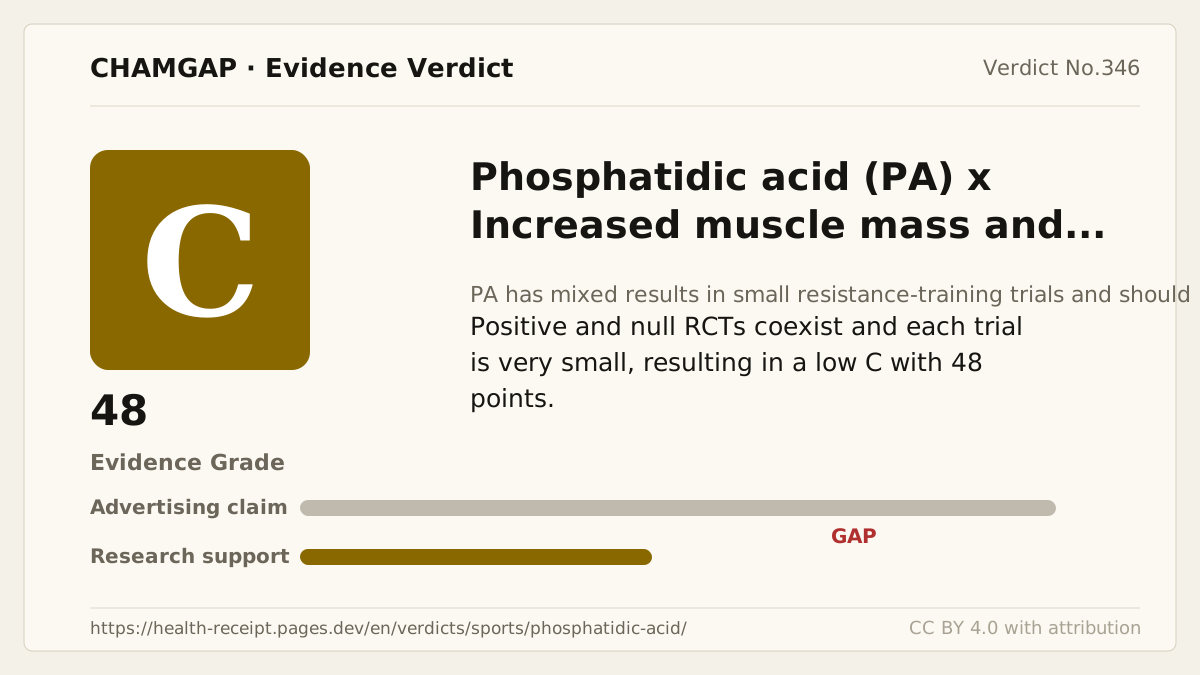
[Chamgap] Phosphatidic acid (PA) × Increased muscle mass and strength during resistance training — Evidence Grade C·48. 4 cited sources checked. Source: https://chamgap.com/en/verdicts/sports/phosphatidic-acid/ · CC BY 4.0CC BY 4.0 — free to use with attribution; do not distort grades, numbers, or verdict meaning.
What this document does and does not do
Chamgap is an information source. It reports what research has and has not confirmed; it does not tell readers what to take or buy. That decision belongs to readers and, when needed, medical or legal professionals. This verdict reflects literature available up to the search date and may change as new research appears. Nothing here is medical advice.