
Glycerol supplement,
does it really help with Fluid retention during exercise and improved endurance?
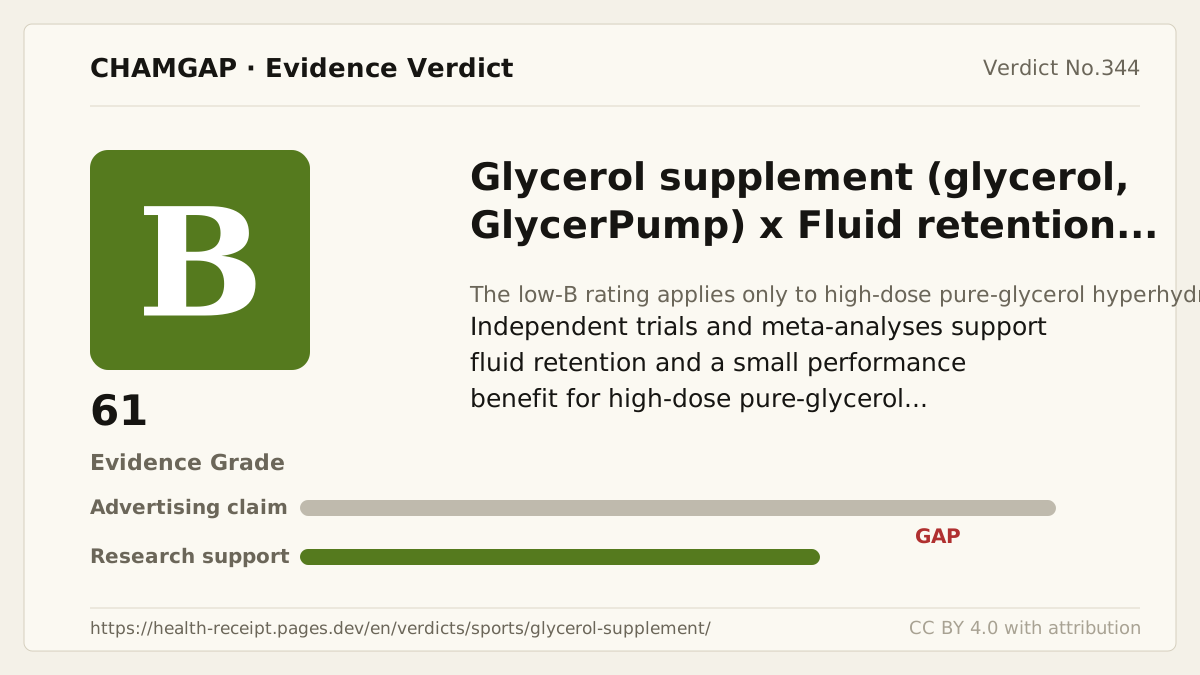
research showsHigh-dose hyperhydration with approximately 1.1 to 1.2 g/kg of pure glycerol and 22 to 26 mL/kg of water increases fluid retention, and meta-analyses pooling multiple independent trials show a small endurance benefit. These findings cannot be extrapolated to low-dose pre-workout products such as GlycerPump.
ads claimMarketing often attributes strong pump and endurance effects to one or two scoops of stabilized glycerol powder, whereas hyperhydration research used tens of grams of glycerol by body weight plus more than a liter of water.
Useful facts when choosing a product
- GlycerPump is generally marketed as a powder containing 65% glycerol.
- Imported sports supplements are available to Korean consumers.
- Per-product doses vary and often do not match the research dose of approximately 1.1 to 1.2 g/kg glycerol.
- For a 70 kg adult, the research dose corresponds to approximately 77 to 84 g glycerol with about 1.5 to 1.8 L water.
- Evidence from high-dose pure-glycerol hyperhydration cannot be extrapolated to low-dose pre-workout products such as GlycerPump.
What the research actually shows
Multiple independent randomized trials tested hyperhydration with approximately 1.1 to 1.2 g/kg of pure glycerol and 22 to 26 mL/kg of water before exercise. A 2007 meta-analysis reported 7.7 mL/kg greater fluid retention and a 2.62% improvement across limited performance estimates, and a 2023 systematic review confirmed repeated plasma-volume increases. A 2024 meta-analysis found small significant effects for time to exhaustion (g=0.31) and time trials (g=0.25), while total work was not significant. This verdict applies only to the high-dose pure-glycerol hyperhydration protocol and cannot be extrapolated to low-dose pre-workout products such as GlycerPump.
Why this is classified as B (61)
Direct fluid-retention outcomes are consistent, and multiple independent RCTs plus two meta-analyses support a small performance benefit for high-dose pure-glycerol hyperhydration, resulting in a low B with 61 points. Small effects, a null total-work outcome, and formulation and dose limits prevent a higher B.
Counterpoint. The B rating is limited to approximately 1.1 to 1.2 g/kg of pure glycerol with 22 to 26 mL/kg of water. It does not establish efficacy for low-dose pre-workout products such as GlycerPump.
Rejudgment record. Reassessment (cross-check reflected) — The reassessment reflects accumulated independent RCTs, direct fluid-retention outcomes, and small performance effects in the 2007 and 2024 meta-analyses while excluding extrapolation to low-dose retail products.
Sub-claim grades by effect
This ingredient is marketed for several effects. A single overall grade blends strong and weak claims together, so each effect is graded separately here. The overall grade reflects the strongest disconfirming or core claim.
| Effect (sub-claim) | Grade | Basis |
|---|---|---|
| Hyperhydration and fluid retention | B | Studies combining approximately 1.1 to 1.2 g/kg glycerol with a large fluid load show relatively consistent increases in fluid retention. |
| Actual endurance-performance improvement | C | Meta-analysis is significant, but effects are small, total work is null, and applicability is limited to specific formulations and doses. |
Cross-check — Codex and Claude
Evidence Table
| Study | Design | Sample | Funding | Endpoint | Result | Weight |
|---|---|---|---|---|---|---|
| Goulet et al. (2007) | Meta-analysis of glycerol hyperhydration | 4 | Academic research | Fluid retention and endurance performance | With approximately 1.1 g/kg glycerol and 23.9 mL/kg fluid, retention increased by 7.7 mL/kg; a 2.62% improvement was reported across the limited performance estimates. | Supports fluid retention, but performance evidence was sparse |
| Goulet et al. (2006) | Randomized double-blind crossover trial | 6 | Academic research | Urine output, thermoregulation, and performance during two hours of cycling | A dose of 1.2 g/kg glycerol with 26 mL/kg water reduced urine output by 246 mL but did not improve performance or thermoregulation. | Positive mechanistic signal but null performance in a very small sample |
| Jardine et al. (2023) | Systematic review | 361 | Academic research | Plasma volume, thermoregulation, performance, and adverse effects | All ten plasma-volume studies reported increases, but only two of 22 performance studies found a time-trial benefit, and gastrointestinal symptoms were reported in 26 studies. | Broad review with substantial heterogeneity and male predominance |
| McCubbin & Irwin (2024) | Systematic review and meta-analysis of pre-exercise hyperhydration strategies | 19 | Academic research | Time to exhaustion, time-trial performance, and total work | Small significant effects were found for time to exhaustion (g=0.31) and time trials (g=0.25), while total work was not significantly improved. | Small effects across a limited evidence base |
Receipt — 4 References
All 4 cited sources were verified for existence at the original page (as of 2026-07-15).
Reviewed and approved: Chamgap Editorial Team · Approval date: 2026-07-15 · Corrections: none
Cite this verdict
[Chamgap] Do glycerol supplements improve fluid retention and endurance during exercise? — Evidence Grade B·61. 4 cited sources checked. Source: https://chamgap.com/en/verdicts/sports/glycerol-supplement/ · CC BY 4.0CC BY 4.0 — free to use with attribution; do not distort grades, numbers, or verdict meaning.
What this document does and does not do
Chamgap is an information source. It reports what research has and has not confirmed; it does not tell readers what to take or buy. That decision belongs to readers and, when needed, medical or legal professionals. This verdict reflects literature available up to the search date and may change as new research appears. Nothing here is medical advice.